
Homeowners: survey first PIV from £700–£1,000 to stop recurring mould
Homeowners: survey first PIV from £700–£1,000 to stop recurring mould
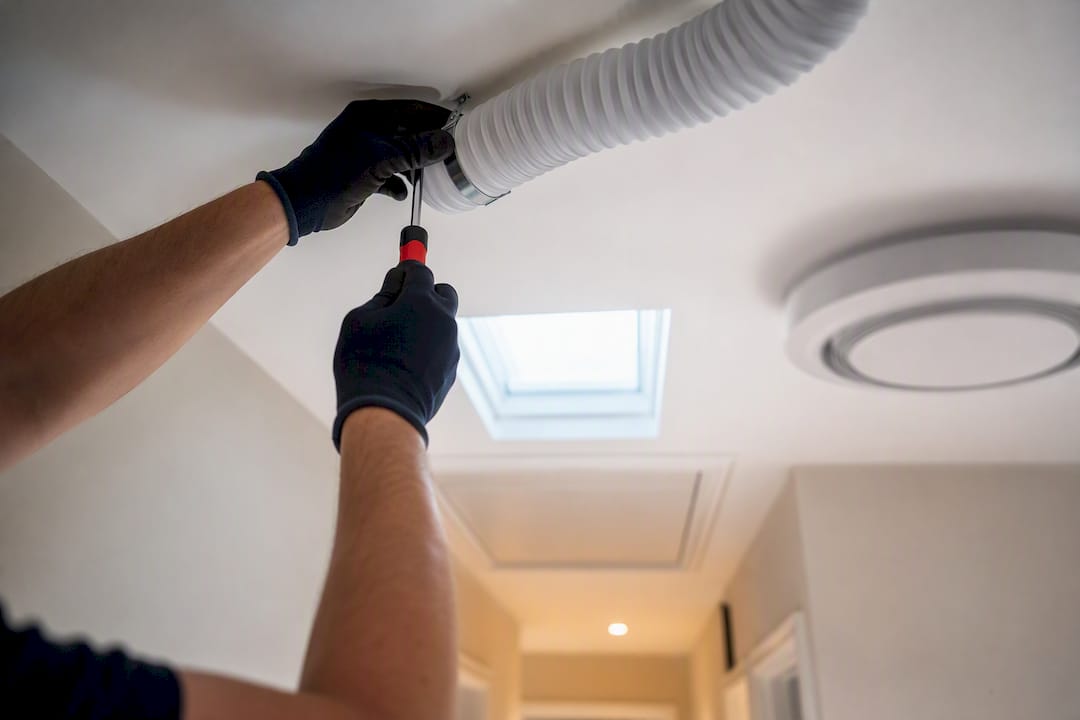
Positive input ventilation (PIV) is a whole-house system that pushes filtered, drier air into your home from a loft or wall-mounted unit, diluting the moist air that causes condensation and mould. It works best as a retrofit solution in older, leaky properties where full mechanical ventilation with heat recovery (MVHR) would mean major disruption. For persistent condensation on windows, cold walls, or recurring black mould, PIV is often the simpler, lower-cost fix.
TL;DR:
- Positive input ventilation is most effective in older, leaky homes with loft access and usually costs between £700 and £1,000 for supply and installation.
- Proper installation requires a loft or wall survey, central diffuser placement, and commissioning, with typical loft mounting taking around two to three hours.
- Non-heated models use minimal electricity, making them low-cost to run, whereas heated variants increase operational costs but improve comfort.
- PIV is unsuitable for airtight, modern homes without natural leakage, where mechanical heat recovery systems perform better.
- Regular maintenance includes filter cleaning and ensuring internal doors have undercuts; issues like poor airflow or noise often stem from improper mounting or blocked diffusion points.
Table of Contents
- What is positive input ventilation?
- How does positive input ventilation work?
- Pros and benefits of PIV for condensation and mould
- Cons, limitations and risks of PIV systems
- Installation and commissioning: what to expect
- Costs and running costs of PIV systems
- Maintenance and common PIV problems
- PIV versus dehumidifiers, MVHR, and dMEV
- Is PIV right for your home? Questions to ask an installer
- Quay Point Plastering’s practical view
- How Quay Point Plastering can help with condensation and mould
- Sources
- FAQ
What is positive input ventilation?
Understanding positive input ventilation starts with a simple idea: instead of extracting damp air, PIV supplies fresh air continuously, raising the pressure inside your home so moist air is pushed out through gaps, vents, and extractor ducts rather than settling on cold surfaces.
Most residential units are loft mounted, drawing air from the roof space and pushing it through a central ceiling diffuser, usually on a landing. Wall-mounted versions exist for flats or houses without loft access, mounted through an external wall instead.
You’ll encounter several manufacturer families when researching options, including Nuaire’s Drimaster range, Vent-Axia’s PoziDry units, and Elta’s positive input systems. Each follows the same core principle, with variation in:
- Filter type and grade (standard versus fine particulate)
- Availability of a heater element for winter comfort
- Sensor and control options, from basic timers to humidity-led automation
- Loft or wall-mounted housing depending on property layout
How does positive input ventilation work?
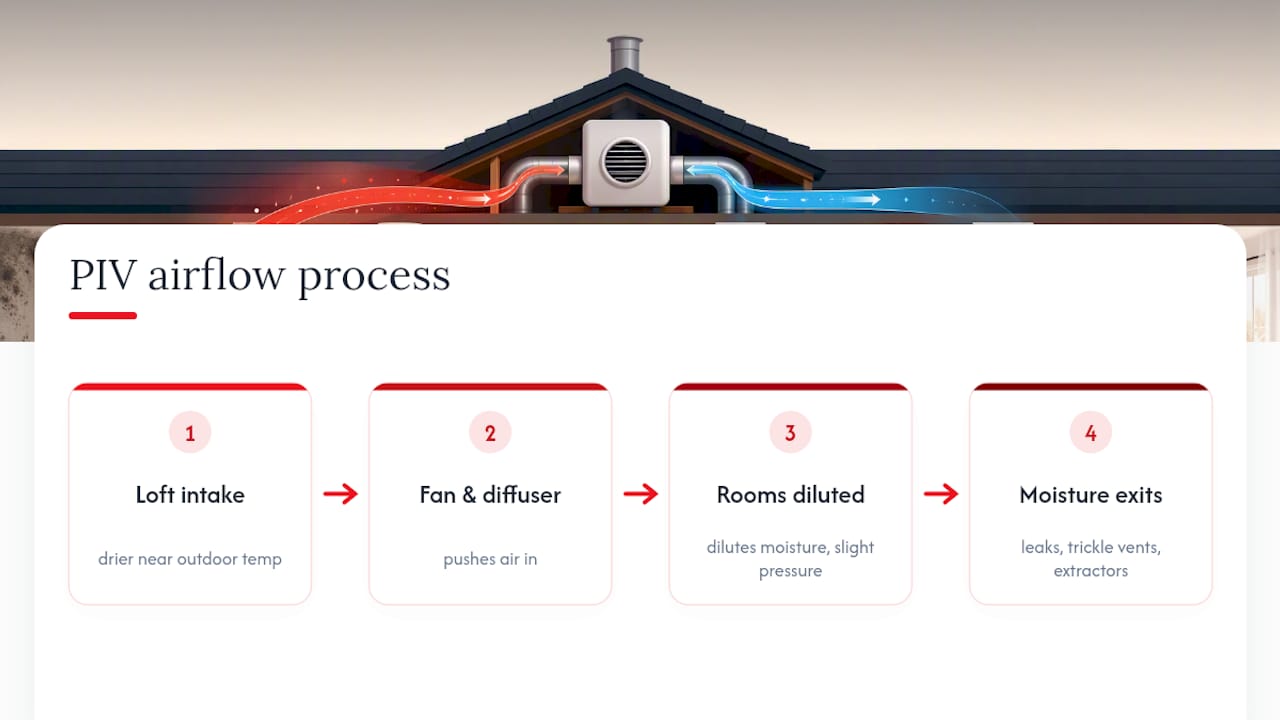
The mechanism relies on dilution and displacement rather than extraction. A fan draws air from the loft space (which is usually close to outdoor temperature and drier than the air inside occupied rooms) and pushes it into the home through a central diffuser. This slightly pressurises the building, so moisture-laden air is continually diluted and forced out through natural leakage points, trickle vents, and extractor fans.
Ordinary household activity generates far more moisture than most people realise. Cooking, bathing, and drying laundry indoors can produce up to 12.5 litres of moisture a day, which is exactly the load PIV is designed to dilute continuously rather than let settle on cold surfaces.
Controls vary by model. Basic units run on a fixed low speed continuously, while others use humidistats or boost settings tied to bathroom or kitchen use. Heated variants warm the incoming air slightly, which reduces the “cold draught” complaint but adds running cost. For PIV to distribute air effectively around the whole property, internal doors usually need undercuts or transfer grilles, and wet rooms often benefit from an enhancement extract fan working alongside the main unit rather than relying on dilution alone.
Pros and benefits of PIV for condensation and mould
The benefits of positive input ventilation are most visible in homes with a long history of condensation on north-facing windows, cold bedroom corners, or recurring mould around wardrobes and reveals. A correctly commissioned system tackles several problems at once:
- Whole-house humidity reduction rather than treating one room at a time
- Fewer condensation and black mould recurrences on cold surfaces
- Filtered incoming air, which can reduce airborne dust, pollen, and allergens
- Low running costs for non-heated models compared with running a dehumidifier constantly
- A retrofit installation that avoids the ductwork disruption of full MVHR
Pro Tip: If mould keeps returning to the same spot after cleaning, that’s usually a sign of a cold bridge or ventilation gap, not a hygiene issue. A PIV system addresses the moisture side, but a survey will confirm whether insulation or repointing is also needed.
Industry guidance backs this up directly: the joint position from the Property Care Association, RVA, and BEAMA confirms that a properly designed and commissioned PIV system dilutes and displaces internal air with filtered, lower-moisture external air, cutting the conditions mould needs to establish itself.
Cons, limitations and risks of PIV systems
PIV isn’t a universal fix, and the drawbacks matter as much as the benefits when deciding whether it suits your property.
- Incoming air is cooler in winter, which some occupants notice as a draught from the diffuser, especially with non-heated units
- Poorly mounted fans can transmit vibration and low hum through loft joists into bedrooms below
- Very airtight, well-insulated new-build homes are generally unsuitable, since dilution ventilation depends on some natural air leakage to work
- In those airtight cases, MVHR is usually the better long-term option because it recovers heat rather than pushing it into the loft space
The PCA/RVA/BEAMA joint position also addresses a common misconception directly: while PAS2035 retrofit guidance flags a theoretical risk of interstitial condensation from positive pressure systems, the industry body found no evidence that a correctly installed PIV unit causes it. The caveat is “correctly installed.” Enhancement extract fans in bathrooms and kitchens, plus adequate background ventilation, are what keep the system working as intended rather than pushing moist air into places it can’t escape.
Pro Tip: Ask any installer quoting for PIV whether your property already has a working MVHR system. Industry guidance is clear that PIV should not be fitted alongside one, since repairing or replacing the existing MVHR is the correct fix.
Installation and commissioning: what to expect
A professional installation follows a fairly predictable sequence, and knowing the steps helps you judge whether a quote is thorough or rushed.
- Loft or wall survey to confirm ventilation, access, and structural suitability for mounting the unit.
- Diffuser siting, typically a central landing position that allows air to reach bedrooms and living areas without long duct runs.
- Electrical connection, usually a straightforward spur taking an electrician around 30 to 60 minutes.
- Enhancement extract fans fitted in bathrooms or kitchens where the survey shows dilution alone won’t clear moisture fast enough.
- Door undercuts or transfer grilles added where internal doors block air movement between rooms.
- Commissioning, including airflow rate checks, sensor calibration, and handover documentation confirming the system meets Building Regulations Part F ventilation requirements.
Loft-mounted installation itself commonly takes around two to three hours once the electrician’s work is included, making it one of the least disruptive whole-house ventilation upgrades available.
Costs and running costs of PIV systems
Unit prices typically sit in the £250 to £500 bracket, with heated models and advanced sensor packages pushing towards the top of that range. Supply-and-fit installation commonly adds another £300 to £600, so a complete job often lands around £700 to £1,000 depending on the model and any extra extract fans needed.
- Non-heated units often draw as little as 5 to 30 watts continuously, which translates to a modest annual electricity cost, similar to leaving a low-energy light bulb running
- Heated variants cost more to run whenever the heater element activates, since it draws considerably more power than the fan alone
- Against that, portable dehumidifiers tend to cost more to run for whole-house use and only treat the room they sit in, not the property as a whole
For a household weighing dehumidifier vs extractor fan vs PIV, the practical answer usually comes down to scope: a dehumidifier treats a room, an extractor treats a moment of high moisture, and PIV treats the whole house continuously.
Maintenance and common PIV problems
Keeping a PIV system working reliably doesn’t take much, but skipping the basics is the most common reason owners call an installer complaining the unit “isn’t working.”
- Replace or clean filters roughly every six to twelve months, more often in dusty lofts or near busy roads.
- Check the diffuser isn’t blocked by furniture, curtains, or loft insulation that has crept over the intake.
- If mould persists despite the unit running, check that internal doors have undercuts. Blocked air transfer is one of the most common reasons a correctly fitted PIV underperforms.
- If the unit is noisy, check the loft mounting brackets. Vibration transmission usually means a fitting issue rather than a fan fault.
- If rooms feel unusually dry or draughty, a professional can check the airflow setting. It may simply be running faster than the property needs.
If these checks don’t resolve the issue, a proper survey rather than a repeat filter change is the next sensible step, particularly where mould keeps recurring in the same location.
PIV versus dehumidifiers, MVHR, and dMEV
Choosing between these options depends on your property’s airtightness, loft access, and how disruptive you’re willing to let the work be.
- PIV suits leaky, older homes with loft access and general condensation across several rooms, without the ducting work MVHR needs
- Dehumidifiers work well for a single damp room or a temporary problem, such as drying out after a leak, but cost more to run across a whole house and don’t filter incoming air
- MVHR is the stronger choice for airtight or new-build properties, since it recovers heat from outgoing air rather than venting it, though it needs full ducting and a bigger budget
- Decentralised mechanical extract ventilation (dMEV), continuous low-speed extract fans in wet rooms, suits retrofits where loft access is poor or the issue is localised to bathrooms and kitchens rather than the whole property
Is PIV right for your home? Questions to ask an installer
Before booking any PIV installation, a few checks separate a system that will perform from one that won’t.
- Does the property have adequate loft ventilation to supply clean air to the unit?
- Is there an existing MVHR system already installed? If so, PIV isn’t the right fix.
- Will internal doors need undercuts, and has the installer assessed air transfer room by room?
- Does the quote include an airflow test and commissioning certificate, not just a fit-and-leave visit?
- What’s covered in the aftercare or servicing plan, and is there a written guarantee on the work?
Pro Tip: If an installer can’t tell you the measured airflow rate after fitting, or hasn’t discussed whether your bathroom needs an enhancement extract fan, ask them to go back and check. Those two details are the clearest sign of a properly commissioned system.
Quay Point Plastering’s practical view
PIV rarely solves a damp problem on its own, and treating it as a standalone fix is the mistake we see most. A proper survey identifies whether condensation stems from ventilation, cold bridging, or a fabric defect first. Where PIV is genuinely appropriate, we specify it alongside enhancement extracts and document the commissioning figures, so clients know the system is actually performing, not just installed.
— Quay
How Quay Point Plastering can help with condensation and mould
Guessing at a ventilation fix without a survey is how homeowners end up paying twice, once for a PIV unit that never resolves the mould, and again for the treatment that was actually needed. Quay Point Plastering starts every job with a proper inspection across Dorset, Hampshire, and Wiltshire, documenting exactly what’s causing the damp before recommending anything.

A damp and timber survey identifies whether your condensation issue needs PIV, an enhancement extract fan, insulation work, or a combination of the three, backed by a written scope of work rather than a guess. If mould has already taken hold, our damp and mould treatments cover the remediation side alongside any ventilation upgrade, all with a written guarantee on the workmanship. Get in touch to book a no-obligation assessment and find out exactly what your property needs before spending on any system.
Sources
For technical depth beyond this explainer, the PCA/RVA/BEAMA joint position statement covers commissioning standards in full, while Nuaire’s product documentation details Drimaster specifications and control options.
- Positive Input Ventilation explained: Pros, cons, costs and more — Homebuilding & Renovating
- Common activities that create moisture — South Tyneside Council
FAQ
How does a positive input ventilation system work?
A loft or wall-mounted fan draws in outside air, filters it, and pushes it into the home through a central diffuser, raising internal air pressure slightly so moist air is diluted and displaced rather than settling on cold surfaces.
What are the disadvantages of a PIV unit?
Incoming air can feel cold in winter, poorly mounted units may transmit noise or vibration, and PIV generally doesn’t suit very airtight new-build homes, where MVHR is the better fit.
What are the common issues with PIV?
The most frequent problems are blocked or dirty filters, poor internal air transfer caused by tight-fitting doors without undercuts, and units installed without proper commissioning or airflow testing.
Do PIV units use a lot of electricity?
Non-heated units typically run on as little as 5 to 30 watts, keeping annual electricity costs modest, while heated variants use considerably more power whenever the heating element is active.