
Mould in bedroom: what to do now and how to stop it
Mould in bedroom: what to do now and how to stop it
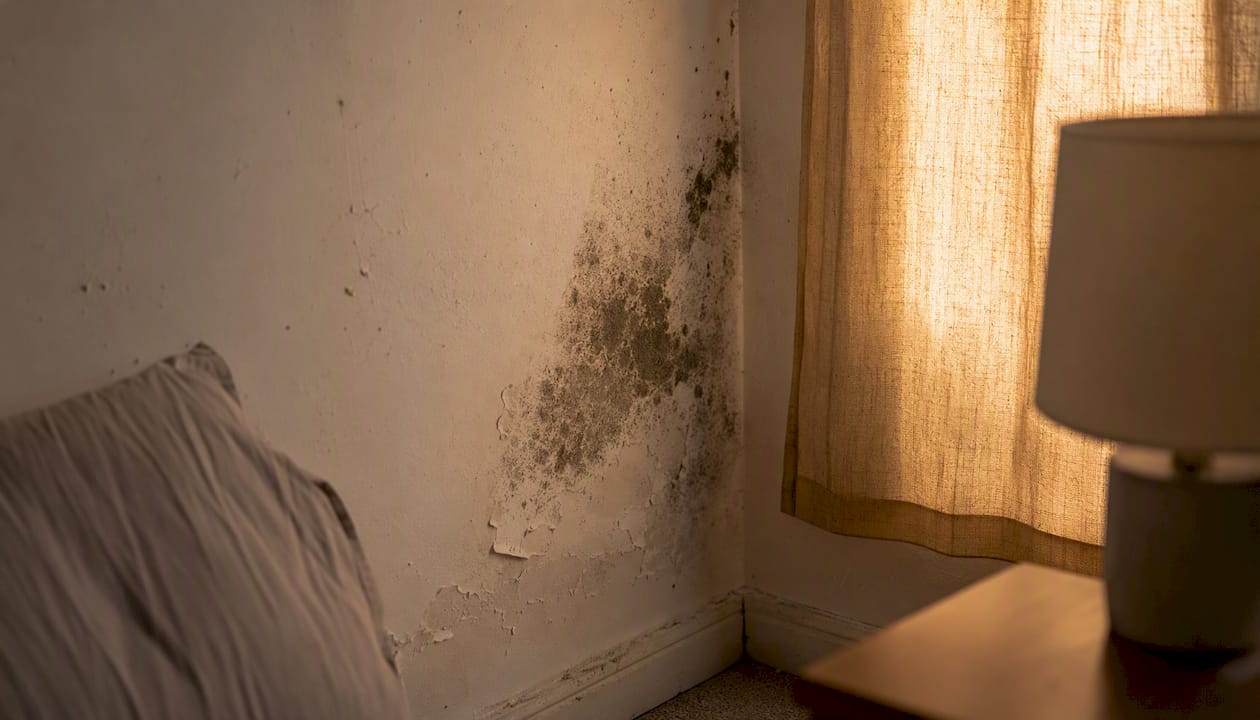
Visible mould in a bedroom is a moisture problem, and it needs action today. Small, isolated patches on a windowsill or wall corner can usually be cleaned safely by you this week. Widespread growth, mould that keeps returning, or staining that looks like it belongs to a leak rather than condensation, needs a professional inspection before you do anything else.
Take these steps in the next couple of minutes:
- Isolate the area. Keep children, older relatives, and anyone with asthma or a weakened immune system away from the affected bedroom until you’ve assessed it.
- Don’t touch or brush the mould yet. Disturbing it dry releases spores into the air you’ll then breathe.
- Open a window. A few minutes of airflow drops the humidity around the patch straight away.
- Strip back bedding and soft furnishings near the mould and move them elsewhere to dry or wash.
- Run a dehumidifier or open trickle vents if you have them, especially overnight.
- Note the size, colour, and exact location. A phone photo with a ruler or coin for scale is genuinely useful if you end up booking a survey.
Once the room is ventilated and nobody vulnerable is sleeping in it, you can move on to working out why the mould appeared and whether you can deal with it yourself.
Key Takeaways
Bedroom mould is almost always a moisture problem, not a hygiene one, and controlling humidity permanently solves it far more reliably than repeat cleaning ever will.
| Point | Details |
|---|---|
| Act immediately on visible mould | Ventilate the room, remove nearby bedding, and keep vulnerable people out until it’s assessed. |
| Know the humidity target | Keep indoor humidity between 30% and 50%; above 60% sharply raises mould risk. |
| Distinguish condensation from leaks | Speckled patches worse in winter suggest condensation; brown staining worse after rain suggests a leak. |
| Set a DIY limit | Clean small, non-porous patches yourself; book a survey once the area exceeds roughly 1 square metre. |
| Get a written diagnosis | Quay Point Plastering surveys identify the moisture source first, then proposes a scope of works with a written guarantee. |
Table of Contents
- What causes mould in a bedroom, and how does it grow?
- Is mould in your bedroom bad for your health?
- What are the common causes of bedroom mould?
- Where does bedroom mould typically appear, and how do you check safely?
- How do you remove mould from a bedroom safely?
- How do you prevent mould from coming back?
- Is it condensation or structural damp?
- When should you call a professional, and what does it cost?
- Why diagnosis matters more than another round of cleaning
- Get a written diagnosis instead of guessing again
- Frequently asked questions
- Sources
What causes mould in a bedroom, and how does it grow?
Mould is a fungus that grows from airborne spores landing on a damp surface with something to feed on, usually dust, paint, or the paper backing on plasterboard. Spores are everywhere, indoors and outdoors, and they’re mostly harmless until they find the right conditions to establish a colony. In a bedroom, that combination is almost always moisture plus a cold surface.
Indoor relative humidity sitting in a moderate range keeps most rooms safely below the threshold where mould takes hold. Higher humidity increases the risk of growth sharply, according to Gov. A bedroom is one of the easiest rooms in the house to push past that threshold, because you spend hours in it breathing and perspiring while the door and windows stay shut.
Two sleeping adults release moisture into a room overnight, purely through breathing and skin evaporation, per the same GOV.UK data. That moisture has nowhere to go if the window is closed, the trickle vent is shut, and the door stays sealed until morning. It settles as condensation on the coldest surface in the room, typically a window frame, an external wall, or a ceiling corner, and that’s where mould starts.
Other everyday habits add to the load:
- Drying laundry on an airer in the bedroom, which can release a substantial amount of water vapour into the air as it dries.
- Leaving wardrobes or beds pushed flush against an external wall, creating a pocket of still, cold air.
- Closing internal doors and trickle vents to keep draughts out, which traps the moisture you’re producing.
Pro Tip: If you’ve recently had double glazing or draught excluders fitted, you may have created exactly this problem without realising it. Airtight upgrades that stop draughts also stop the natural ventilation that used to carry moisture away, so you need to ventilate deliberately instead of relying on the house to do it for you.
Is mould in your bedroom bad for your health?
Yes, and the risk is higher in a bedroom than almost anywhere else in the house, simply because of how long you’re exposed. Most people spend six to nine hours a night in their bedroom, according to the NHS, which means sustained exposure to any spores in the air while you sleep, breathe slowly, and don’t move around to disturb them further.
The symptoms tend to be mild but persistent rather than dramatic:
- A cough that’s worse first thing in the morning
- Nasal congestion or a constantly blocked nose
- Sore throat or irritated eyes on waking
- Worsened asthma attacks or wheezing
- General fatigue that doesn’t have an obvious cause
Some people are considerably more vulnerable than others. Children, older adults, and anyone with asthma, allergies, or a weakened immune system should not sleep in a room with visible mould, particularly if the patch is large or black, until it’s been cleaned and the moisture source addressed.
Reducing humidity, improving ventilation, and treating any underlying leak are the core defences against mould’s effect on sleep and respiratory health, according to the Sleep Foundation.
This is general health guidance, not a diagnosis. If symptoms persist or worsen, particularly in children or anyone with existing respiratory conditions, see a GP, and don’t wait for the mould to reappear a second time before treating both the room and the person.
What are the common causes of bedroom mould?
Most bedroom mould is condensation related, not the result of a leak or rising damp. That distinction matters because the fix is completely different: condensation responds to ventilation and heating changes, while a leak needs finding and repairing before any cleaning will hold.
The typical chain runs like this: warm, moisture-laden air from breathing, sweating, or drying laundry drifts across the room until it meets a colder surface, usually an external wall, a window, or a ceiling near an unheated loft space. The air can’t hold that moisture at the lower temperature, so it condenses into tiny water droplets, and those droplets are exactly what mould spores need to establish a colony.
Run through this quick self-audit:
- Do you dry clothes on an airer in the bedroom rather than outside or in a tumble dryer?
- Is your wardrobe or bed pushed flush against an external wall?
- Are your trickle vents closed, taped over, or painted shut?
- Does the room feel noticeably colder than the rest of the house?
- Do you keep the bedroom door closed overnight with no other ventilation?
Answering yes to two or more of these points towards condensation as the likely cause, which is good news. It’s the easiest type of bedroom mould to control once you know what’s driving it, and prevention doesn’t require any building work.
Where does bedroom mould typically appear, and how do you check safely?
Check window reveals, the corners where an external wall meets the ceiling, behind wardrobes and headboards, and around any radiator on an external wall first. These are the coldest points in most bedrooms, and cold surfaces are where condensation lands.
Work through the room methodically rather than glancing at the obvious spots:
- Pull furniture away from external walls, particularly wardrobes and beds with headboards against the wall.
- Use a torch to check corners properly, since ceiling and wall junctions in poor light hide early staining.
- Look for peeling paint or wallpaper, discolouration, or a slightly fuzzy black, green, or grey texture.
- Smell for a musty odour, which often shows up before you can see anything, especially behind furniture.
- Note whether the patch appears worse in winter, which points to condensation, or worse specifically after heavy rain, which points to a leak.
A few practical notes on inspecting safely:
- Wear a mask if you’re getting close enough to disturb the surface, even lightly.
- Avoid sanding, scraping, or brushing the mould dry, since this is exactly what sends spores airborne.
- Photograph what you find with something for scale in shot, useful for tracking whether it’s spreading and essential if you later book a survey.
- Check behind wardrobes gently by sliding them out rather than shifting them repeatedly, which can disturb settled spores.
How do you remove mould from a bedroom safely?
Small patches on non-porous surfaces, painted plaster, tile, sealed woodwork, are generally safe to clean yourself. If the affected area is larger than a dinner plate, or the mould has taken hold on a porous material like unpainted plaster, exposed timber, or fabric, stop and arrange a professional inspection instead of pushing on.
Follow this sequence for a small, manageable patch:
- Ventilate the room first. Open the window and, if possible, the door to create airflow before you start.
- Put on PPE. An FFP2 mask, rubber gloves, and eye protection are the minimum for direct contact with mould.
- Dampen the area, don’t dry-brush it. Use a cloth lightly dampened with water and a mild detergent, or a proprietary anti-mould spray designed for the surface.
- Wipe, don’t scrub aggressively. Vigorous scrubbing or sanding disturbs spores rather than removing them cleanly.
- Dry the surface thoroughly once cleaned, since a damp surface will simply grow mould again within days.
- Bag contaminated materials. Any cloths, sponges, or disposable items used should go straight into a sealed bag before binning.
- Wash your clothes worn during cleaning separately, on a hot cycle, once you’re finished.
One warning worth repeating clearly: never mix bleach with any cleaning product containing ammonia. The combination produces toxic chloramine gas, and this happens more often than people expect when a bleach-based mould spray meets an ammonia-based glass or surface cleaner already on the same cloth.
Porous materials rarely respond to surface cleaning. A mattress, loft insulation, or a section of plasterboard that’s absorbed moisture usually needs replacing rather than treating, because spores establish inside the material, not just on top of it.
Pro Tip: If damp has crept into a small section of skirting board or plaster near a window, it’s often more cost-effective to cut out and replace that section than to keep repainting over it. A few centimetres of new plaster and a lick of anti-mould paint will outlast repeated cleaning by years.
Drying any water-damaged material within 24 to 48 hours is the single most effective step against mould establishing itself, according to the US EPA’s guidance on mould and moisture. Speed matters more than the cleaning product you reach for.
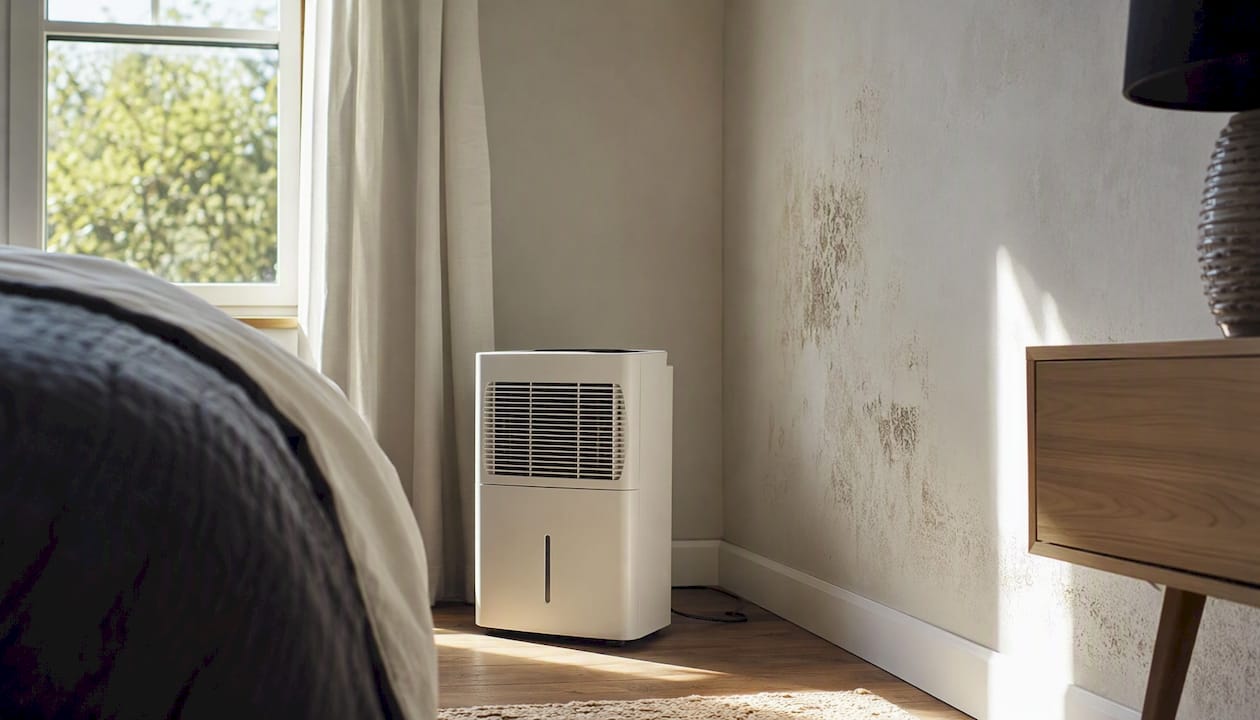
Call a professional rather than persisting with DIY if any of the following apply: the affected area exceeds roughly 1 square metre, the mould returns within weeks of cleaning, you notice staining that looks structural rather than surface-level, or anyone vulnerable is sleeping in that room while the problem continues.
How do you prevent mould from coming back?
Preventing mould means controlling moisture, permanently, not just cleaning it up once. The habits that stop condensation forming in the first place cost nothing beyond a slightly higher heating bill and a bit of routine.
Prioritise these changes:
- Keep the bedroom at or above 18°C overnight. A consistently warmer surface temperature keeps the wall above the dew point where condensation forms.
- Ventilate for 10 to 15 minutes every morning. Open the window as soon as you get up, even briefly, to clear the moisture that built up overnight.
- Use extractor fans elsewhere in the house properly, particularly in the bathroom, so moisture doesn’t migrate into bedrooms through open doors.
- Aim for 30–50% relative humidity and use a dehumidifier if the room consistently runs higher, especially through winter.
- Never dry laundry on an airer in the bedroom. Move it to a bathroom with the extractor running, or outside.
- Open trickle vents on windows rather than sealing or painting over them.
Furniture placement matters more than most people assume. Maintaining a gap between a wardrobe or bed and an external wall stops the still, cold pocket of air where micro-condensation forms behind furniture, according to guidance on thermal bridging and condensation. That small gap lets air circulate instead of sitting trapped against a cold surface, and it’s the reason mould so often appears in exactly that spot.
If your home has had energy efficiency upgrades, better draught-proofing, new windows, cavity wall insulation, you may need to ventilate more deliberately than before. Sealing a house tighter keeps the heat in, but it also traps the moisture you’d otherwise lose through natural draughts. An extractor fan that’s stopped pulling air properly is worth fixing quickly rather than living with; if yours has slowed down or stopped, a quick DIY fix for extractor fans can solve the problem in an afternoon. For a longer-term look at airflow across the whole house, a practical guide to improving indoor air quality covers mechanical ventilation options worth considering if condensation is a recurring issue in more than one room.
Is it condensation or structural damp?
Condensation mould tends to be speckled, sitting in cold corners and behind furniture, and it gets noticeably worse in winter. Damp caused by a leak or water ingress looks different: brown or yellow staining, plaster that feels soft or crumbles, and patches that flare up specifically after heavy rain rather than during cold weather generally.
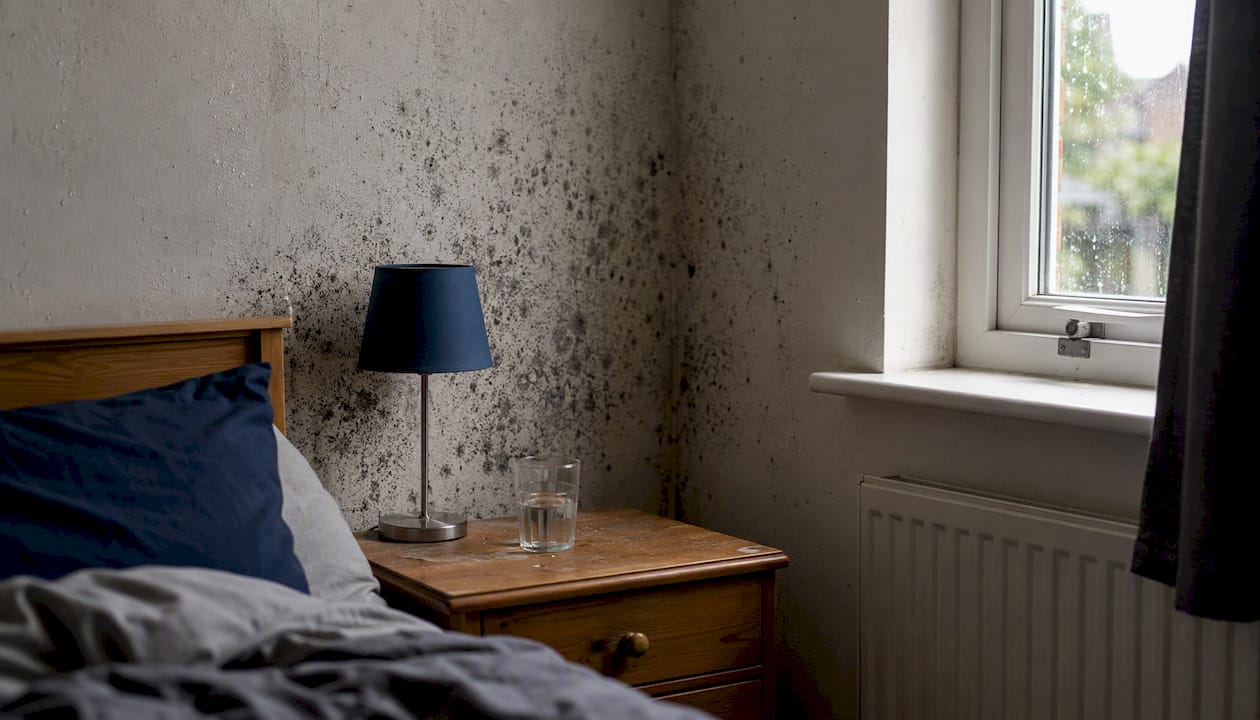
A simple home test helps separate the two: does the patch get worse in winter, or does it get worse after rain? Winter-driven mould is almost always condensation. Rain-driven staining points to water finding its way in from outside, according to guidance on distinguishing ceiling mould causes.
| Sign | Condensation | Water ingress / leak |
|---|---|---|
| Appearance | Speckled black or grey patches | Brown or yellow staining |
| Location | Corners, window reveals, behind furniture | Follows a pipe run, roofline, or external wall crack |
| Timing | Worse in winter and cold spells | Worse after or during heavy rain |
| Surface condition | Paint intact, surface dry to touch once cleaned | Plaster soft, crumbling, or bulging |
| Typical fix | Ventilation, heating, furniture placement | Locating and repairing the source of the leak |
Watch for these red flags that point firmly to a structural cause rather than condensation:
- Staining with a distinct brown or yellow tinge
- Plaster that feels soft, spongy, or is visibly crumbling
- A patch that grows noticeably after a period of heavy rain
- A persistent damp smell that spreads beyond one wall or corner
- Visible trails or tide marks suggesting water has run down a surface
Book a survey if mould keeps returning despite good ventilation, if you see any sign of material decay, or if the room houses anyone vulnerable while the cause remains unconfirmed. Guessing wrong here means treating the symptom while the actual source, a cracked render, a failed flashing, a blocked gutter, keeps feeding the problem.
When should you call a professional, and what does it cost?
Book a survey when the mould covers more than roughly 1 square metre, when it reappears after you’ve cleaned it properly, when you see staining or plaster damage that looks structural, or when a vulnerable person sleeps in that room. Beyond those thresholds, DIY cleaning becomes a repeat expense rather than a solution.
A proper damp and mould survey typically includes:
- A full visual inspection of the affected room and surrounding areas
- Moisture mapping to identify where and how deeply materials have absorbed water
- Thermal imaging, which shows cold bridges and hidden condensation patterns that aren’t visible to the eye
- A written report setting out findings in plain terms
- A defined scope of works before any treatment begins, so you know exactly what’s being proposed and why
Thermal imaging and moisture mapping are standard professional diagnostics precisely because they separate condensation from penetrating damp reliably, something DIY treatment can’t do, according to analysis of black mould on bedroom ceilings. Skipping that diagnostic step is the most common reason DIY mould treatment fails to hold.
Timelines and costs vary considerably depending on the extent of the problem and whether structural work is needed, but as a general shape: an initial survey is typically arranged within a few days to a couple of weeks of booking, and remediation itself runs through several phases, diagnosis, drying out, treatment, and any necessary repair or reinstatement, which can take anywhere from a few days for a straightforward condensation fix to several weeks where plaster or timber needs replacing. Treat any quote you receive without a prior inspection with caution; the range genuinely depends on what’s found once someone looks properly.
If you’d rather have a clear answer than keep guessing, request a written damp and timber survey before committing to any treatment.
Why diagnosis matters more than another round of cleaning
Repeat cleaning fails for a predictable reason: it treats the mould, not the moisture. Wipe down a patch behind a wardrobe without closing the 5 centimetre gap or improving ventilation, and the same cold surface will condense the same moisture within weeks. We’ve built our approach around that distinction because it’s the one that actually determines whether a problem stays solved.
Over more than 35 years working on damp, mould, and timber issues across Dorset, Hampshire, and Wiltshire, the pattern repeats: homeowners who’ve cleaned the same patch three or four times aren’t dealing with a cleaning problem, they’re dealing with an undiagnosed thermal bridge, a ventilation shortfall, or occasionally a leak that’s been mistaken for condensation from the start. A proper survey identifies which one it actually is before any treatment gets proposed, and that’s the step that separates a permanent fix from a temporary one.
Targeted insulation at a specific cold spot, a correctly sized extractor fan, or repairing a small section of failed render usually costs less over two or three years than repeatedly buying anti-mould spray and repainting the same corner. Diagnosis first, written scope of work second, guarantee on the finished job third. That order exists because skipping the first step is exactly why so many mould problems come back.
Get a written diagnosis instead of guessing again
If you’ve cleaned the same bedroom patch more than once, you’re already paying for a problem you haven’t actually solved. Quay Point Plastering starts every job with a proper inspection, not a treatment quote, so you get a documented diagnosis of whether you’re dealing with condensation, a thermal bridge, or a leak, before anyone touches your walls.

Our surveys cover the full range of what causes bedroom mould in practice: condensation treatment for humidity-driven patches, black mould removal for established growth, and penetrating damp investigation where staining points to water ingress rather than condensation. Every job follows the same order: book a survey, receive a written report setting out exactly what we found, then agree a scope of works before any treatment starts.
We work across Dorset, Hampshire, and Wiltshire, and every completed job carries a written guarantee on the workmanship. If your bedroom mould keeps returning despite your best efforts, start with our damp problems overview and request a survey.
Frequently asked questions
How quickly can mould grow in a bedroom? Mould can establish on a damp surface within 24 to 48 hours under the right conditions, which is why drying any wet material quickly is more effective than any cleaning product.
Can mould in a bedroom make you ill even if you don’t have allergies? Yes. Coughing, congestion, and fatigue linked to mould exposure can affect people with no known allergies, simply because of the sustained six to nine hours of nightly exposure a bedroom involves.
Is it safe to sleep in a bedroom with a small mould patch while you arrange cleaning? For a healthy adult and a genuinely small, isolated patch, generally yes for a night or two, but children, older people, and anyone with asthma should sleep elsewhere until it’s cleaned and ventilated.
Does painting over mould get rid of it? No. Painting over mould without cleaning and drying the surface first traps moisture underneath, and the mould will usually reappear through or around the new paint within weeks.
Will a dehumidifier alone solve bedroom mould? A dehumidifier helps manage humidity day to day, but it won’t fix a cold thermal bridge or a leak causing the problem, which is why persistent cases still need a proper inspection.
This article is general information, not a substitute for advice from a qualified doctor. Consult a qualified healthcare professional about your own circumstances before acting on anything here.
Sources
- Gov
- A brief guide to mold, moisture and your home | US EPA
- Mold in the bedroom: how it impacts sleep and health (Sleep Foundation)