
45–55% Indoor Humidity for UK Homes: Winter 35–50% and When to Survey
45–55% Indoor Humidity for UK Homes: Winter 35–50% and When to Survey
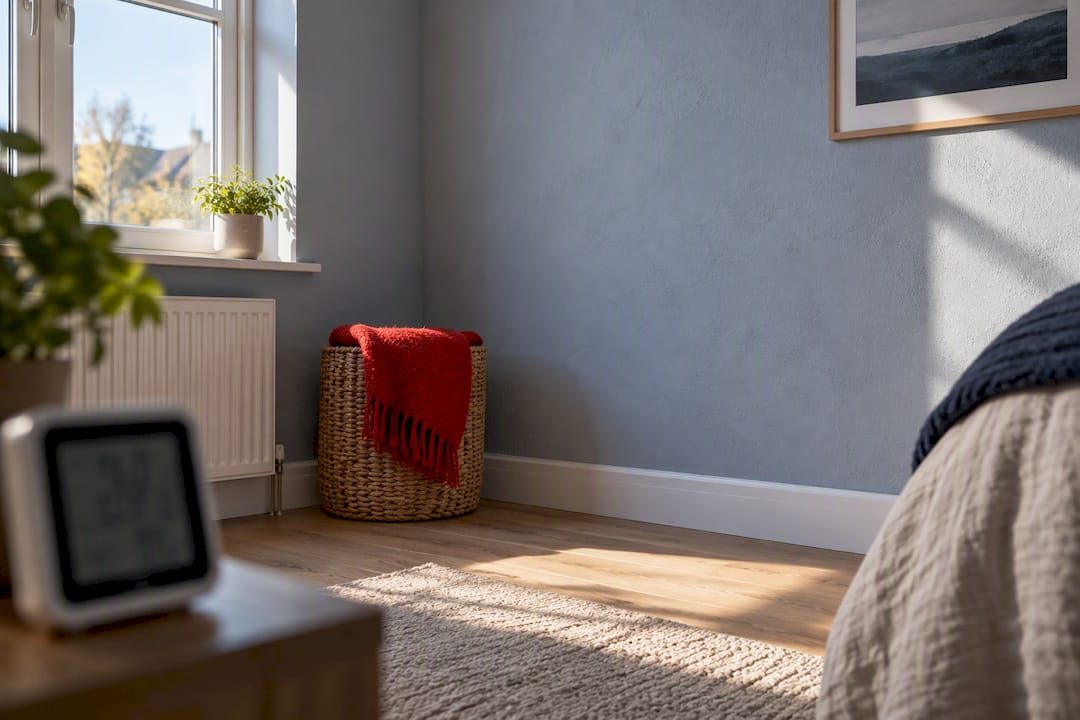
Once you have a target, the next step is simple: measure what your home is actually doing before you change anything.
TL;DR:
- Maintaining indoor humidity between 40-60% year-round helps prevent mould growth and damage, especially on timber surfaces, which absorb moisture slowly.
- During winter, reducing humidity to about 35-50% minimizes condensation on cold surfaces like windows and external walls.
- Proper placement and continuous logging of a digital hygrometer over 24 to 48 hours are essential to accurately track humidity patterns and identify problem areas.
- Ventilation fixes, such as extractor fans and positive input ventilation systems, should vent outside and run long enough to clear moisture effectively; dehumidifiers are a secondary option if ventilation alone fails.
- Persistently high readings above 60% RH despite behavioral changes and ventilation upgrades indicate the need for a professional moisture survey to diagnose potential dampness within building fabric.
Table of Contents
- Ideal indoor humidity UK: recommended ranges and seasonal adjustments
- Room-by-room humidity targets and normal spikes
- Why humidity that’s too high or too low actually matters
- How to measure indoor humidity properly
- Ventilation, dehumidifiers, and the fixes that actually work
- When high humidity signals a damp problem, not just poor air
- Why survey-led diagnosis beats guesswork
- Book a damp and timber survey with Quay Point Plastering
- Sources
- FAQ
Ideal indoor humidity UK: recommended ranges and seasonal adjustments
Most UK guidance converges on the same working range. Within that band, industry commentary and appliance experts point to 45-55% as the practical sweet spot for occupied rooms.
Winter changes the maths. Cold external walls and single-glazed windows sit at a lower surface temperature than the air around them, so moisture condenses there long before the room itself reaches high humidity. Oxford City Council’s guidance recommends dropping to roughly 35-50% RH in winter, nudging toward 35-40% if you’re already seeing condensation on glass.
Two technical bodies underpin this thinking:
- CIBSE guidance on building services treats condensation risk as a function of surface temperature, not just room humidity, which is why insulation quality changes your personal target.
- ASHRAE and building science literature frame 25-60% as a defensible technical range, but stress that interior humidity shouldn’t push surfaces past 70% RH, the point where mould spores start to germinate.
Treat 40-60% as your year-round anchor, then let the season and your windows adjust it down.
Room-by-room humidity targets and normal spikes
Humidity isn’t uniform across a house, and it shouldn’t be. Bedrooms and living rooms should sit closest to your whole-home target of 45-55%, since these are the rooms where comfort and sleep quality matter most.
Bathrooms and kitchens behave differently by design:
- A shower or a boiling pan can push a bathroom or kitchen to 50-70% RH within minutes, and that’s normal.
- With proper extraction running, readings should fall back to baseline within about 30 minutes.
- If a bathroom is still reading 65% two hours after a shower, extraction isn’t doing its job.
Basements, cellars, and utility rooms carry the highest structural risk because they’re often poorly ventilated and closest to ground moisture.
Why humidity that’s too high or too low actually matters
It also makes a room feel colder than the thermostat suggests, which tempts people to turn the heating up rather than address the actual air quality.
High humidity carries the bigger long-term cost for a property. Sustained readings above 60% significantly raise the risk of mould growth and dust-mite proliferation, and once a surface itself reaches 70% RH, biological growth becomes far more likely regardless of what the room’s air sensor shows. Timber is particularly vulnerable: joists, skirting, and floorboards absorb ambient moisture slowly, so damage often shows up weeks after the humidity spike that caused it.
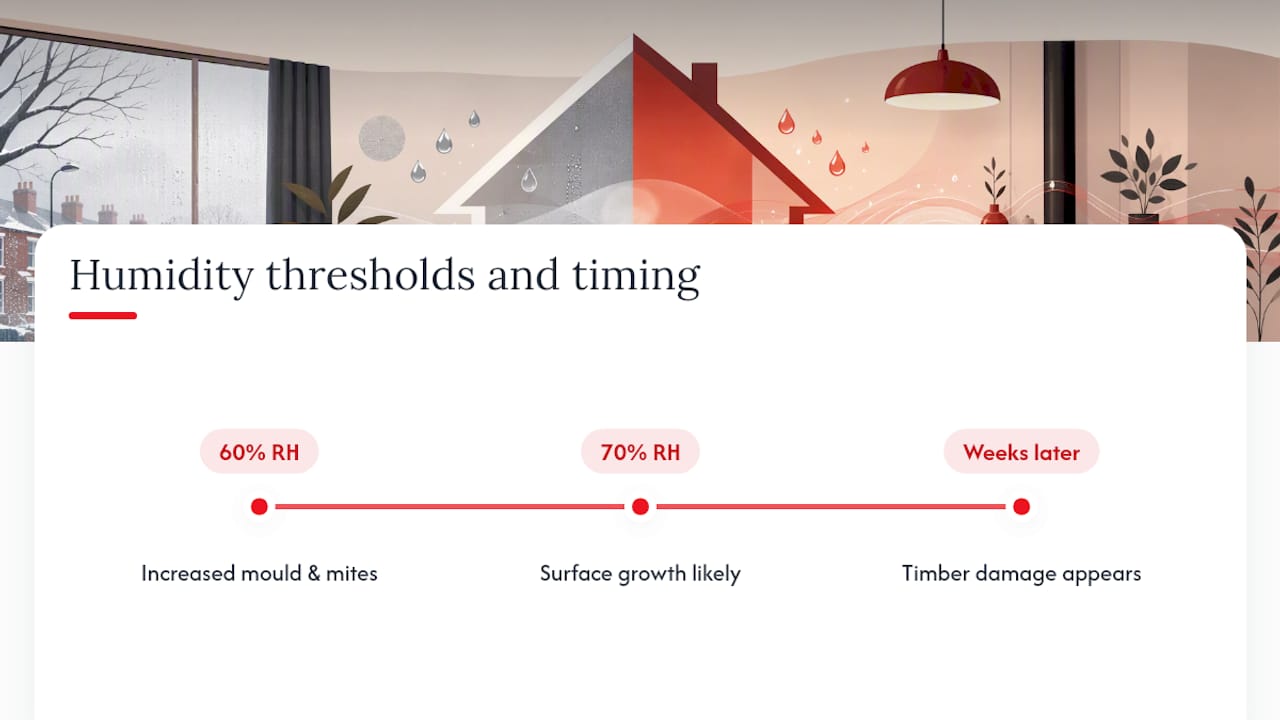
What matters more than any single reading is duration.
How to measure indoor humidity properly
You need real data before you make any changes, and that starts with the right instrument.
- Buy a digital hygrometer, not the cheap analogue dial type. Digital sensors are markedly more accurate, and many double as dataloggers that record readings over days.
- Site it correctly. Place it at roughly chest height, away from direct sunlight, radiators, extractor fans, or open windows, all of which skew the reading.
- Log over 24 to 48 hours minimum. Note the time, the reading, and what was happening in the room (cooking, showering, drying laundry).
- Compare event spikes against baseline. A kitchen jumping from 50% to 68% during dinner and back down within the hour is normal. A living room stuck at 62% with no obvious cause is not.
- Watch the dew point, not just the percentage. Relative humidity changes with temperature, so a fixed RH reading means something different in a warm kitchen than a cold hallway. Our guide to dew point in homes explains why this figure is often more useful than RH alone.
Pro Tip: Log humidity readings at the same three times each day (morning, after cooking, before bed) for a week. A pattern across seven days tells you far more than a single high reading ever will.
Ventilation, dehumidifiers, and the fixes that actually work
Start with behaviour, because it costs nothing and often solves the problem outright. Dry laundry outdoors or in a room with the door shut and a window cracked, keep lids on pans while cooking, and run extractor fans during and for fifteen minutes after every shower.
If behaviour alone isn’t enough, ventilation is the next step:
- Extractor fans in bathrooms and kitchens should vent outside, not into a loft space, and should run long enough to clear steam fully.
- Positive Input Ventilation (PIV) systems draw in filtered outdoor air and push it through the home, diluting moisture-laden air throughout, and tend to suit homes with widespread, low-level condensation rather than a single damp room.
- Trickle vents and window design also matter. If you’re weighing up bathroom door and window choices to cut moisture transfer between rooms, this guide to bathroom doors covers practical options.
Dehumidifiers earn their place when a room runs persistently high and ventilation upgrades aren’t feasible or fast enough. Use them, but treat a dehumidifier that never gets to switch itself off as a warning sign, not a fix. It may be masking a damp problem in the building fabric rather than solving a purely airborne one.
If you’ve tried source control, ventilation, and a dehumidifier, and a room still won’t hold below 60% for more than a few days at a time, that’s the point to stop adjusting appliances and start asking whether the building itself is holding moisture.
When high humidity signals a damp problem, not just poor air
If extraction is running, laundry is drying outside, and the number still won’t move, the air isn’t the problem. Repeated condensation on the same window reveal or external corner despite consistent airing is a frequent early sign that thermal bridging or insulation gaps need addressing, not humidity management. A musty smell that returns after a dehumidifier is switched off for a day is another.
A proper survey doesn’t start with a treatment plan. It starts with a moisture probe reading the actual water content of plaster, gypsum board, or masonry, known as the weight-in-moisture-equivalent (WME). If those materials read damp even when the air humidity looks reasonable, the building fabric itself is holding water, and no amount of dehumidifying will resolve it permanently. A thorough inspection also checks for thermal bridging with a camera or probe, since cold spots are where condensation forms first regardless of average room humidity.
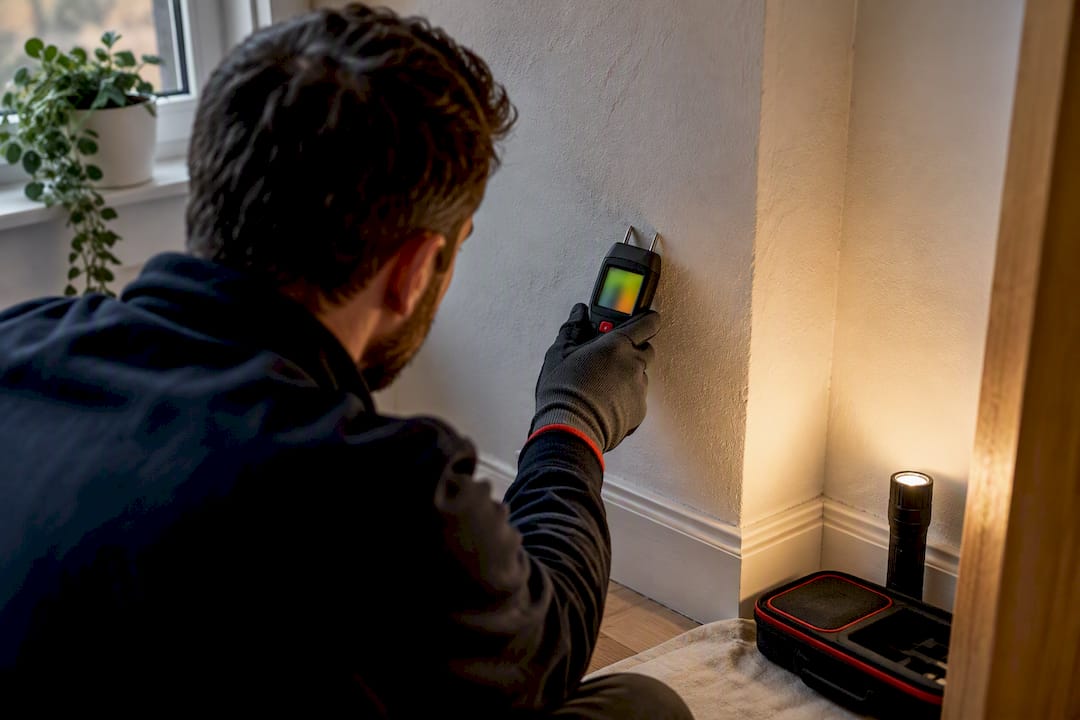
From there, the surveyor documents findings with photographs and a written report before recommending any work; whether that’s improved ventilation, damp-proofing, or timber treatment depends entirely on what the readings show. A scoped, guaranteed job beats guesswork, because you know exactly what was found and what the fix is meant to achieve.
Why survey-led diagnosis beats guesswork
Humidity readings tell you something is happening. They rarely tell you why on their own. Over 35 years working across Dorset, Hampshire, and Wiltshire homes, the pattern repeats: air humidity looks fine, yet the timber or plaster underneath is still wet. That’s why we diagnose before we treat.
A week of hygrometer readings and the behavioural fixes above are a sensible first move for almost anyone. Book a survey once you see the red flags, not before.
— Quay
Book a damp and timber survey with Quay Point Plastering
If your own readings keep coming back high despite proper ventilation and behavioural fixes, the next step isn’t a bigger dehumidifier, it’s a proper diagnosis. A professional damp and timber survey service offers an alternative to guessing your way through appliance settings: every job starts with a survey that measures actual building moisture (WME), checks for thermal bridging, and documents findings in photographs and a written report before any treatment is proposed. Treatment is only done once the issues are clearly understood and a solution defined, sometimes with guarantees.

That approach covers the full range of what tends to follow a persistent high-humidity reading, from condensation and mould treatment and positive input ventilation to timber assessment where damp has sat long enough to affect joists or skirting. If your logged readings won’t settle below 60% in a heated, ventilated room, or you’re seeing condensation return on the same wall week after week, book a damp and timber survey and get a documented answer rather than another appliance to manage.
Sources
- RR-0203: Relative humidity — Building Science Corporation
- What is normal humidity in a house? — Homebuilding
FAQ
Is 70% humidity in a room too high?
Yes, for anything beyond a short spike. A bathroom or kitchen can briefly hit 70% during use, but a room holding above 60% for sustained periods raises the risk of mould and dust mites, and 70% held for hours or days is a clear signal to investigate ventilation or damp.
Is 77% humidity in a house bad?
Yes, if that reading is sustained rather than a brief cooking or showering spike. At this level, surfaces are likely close to or past the 70% surface RH threshold where mould growth becomes far more likely, so this warrants immediate ventilation and, if it persists, a professional inspection.
Is 50% humidity too high for a bedroom?
No, 50% sits comfortably within the recommended 45-55% comfort band for lived-in rooms and is well below any risk threshold. It’s a reasonable target for sleeping comfort year-round, though you might nudge it toward the lower 40s in winter if you notice condensation on bedroom windows.
Is 80% humidity high for the UK?
If a hygrometer logs above 70% for more than an hour outside of active steam or cooking, treat it as a sign of a ventilation failure or an underlying damp issue rather than something to wait out.
What is the ideal indoor humidity for a UK home in winter?
Aim for roughly 35-50% RH in winter, lower than the summer range, because cold windows and walls condense moisture at lower air humidity levels than warmer surfaces do.