
Dew point in homes: what UK homeowners must know
Dew point in homes: what UK homeowners must know

The dew point is the temperature at which the air in your home holds as much moisture as it can and begins to deposit that moisture as liquid water on any surface that falls below that threshold. For most UK homes, keeping the indoor dew point within a range that is generally considered comfortable and reduces mould risk is advisable. Three things you can do right now: measure the dew point with a hygrometer, run extractor fans in your kitchen and bathroom, and run a dehumidifier if readings are persistently high.
- Measure first. A combined temperature and humidity hygrometer costs under £20 and gives you the data you need.
- Target 30–50% relative humidity at an indoor temperature of around 20°C, which corresponds to a dew point of roughly 4–10°C.
- Act on ventilation immediately. Open windows briefly after cooking or showering, and use extractor fans on boost mode.
Key takeaways
Keeping your indoor dew point between 4°C and 10°C, combined with adequate ventilation, is the most reliable way to prevent condensation and mould in a UK home.
| Point | Details |
|---|---|
| Target dew point range | Aim for 4–10°C indoors (30–50% RH at 20°C) to stay below mould-risk thresholds. |
| Measure before you act | Use a hygrometer and the formula Td ≈ T − (100 − RH) ÷ 5 to get a reliable baseline. |
| Ventilate and dehumidify | Run extractor fans during and after cooking and showering; set a dehumidifier to 50% RH. |
| Retrofit with care | Any insulation or glazing upgrade must be paired with managed ventilation or cavity risk increases. |
| Quaypointplastering survey | Persistent or hidden condensation warrants a survey with documented findings and written guarantees. |
Table of Contents
- What is dew point and how does it differ from relative humidity?
- Where condensation appears in UK homes and the risks it carries
- What dew point should you aim for in your home?
- Practical ways to reduce dew point and stop condensation
- When should you call a professional surveyor?
- The part most homeowners miss
- Persistent condensation or mould? Quaypointplastering can help
- Useful sources for further reading
What is dew point and how does it differ from relative humidity?
Dew point is the temperature at which air, at constant pressure and moisture content, becomes fully saturated. Below that temperature, water vapour turns to liquid. Relative humidity (RH) tells you how full the air is as a percentage of its maximum capacity at the current temperature. The key difference: RH changes whenever the temperature changes, even if no moisture is added or removed. Dew point stays constant unless the actual amount of water vapour in the air changes.
That makes dew point the more reliable indicator of real moisture load. A room at 20°C and moderate relative humidity has a dew point that reflects the moisture content in the air. Heat that same room to 25°C without adding any moisture and the RH drops to about 43%, yet the dew point stays at 12°C. The moisture content has not changed at all.
A practical illustration: a cold glass of water on a warm day collects droplets on its outside surface. The glass has cooled the air immediately around it below the dew point, so the vapour condenses. The same process happens on your windows, external walls, and inside wall cavities every winter.
Where condensation appears in UK homes and the risks it carries
Problem locations, roughly in order of frequency:
Windows and glazing are the most common and least structurally dangerous site, but persistent condensation on frames causes timber decay and paint failure over time.
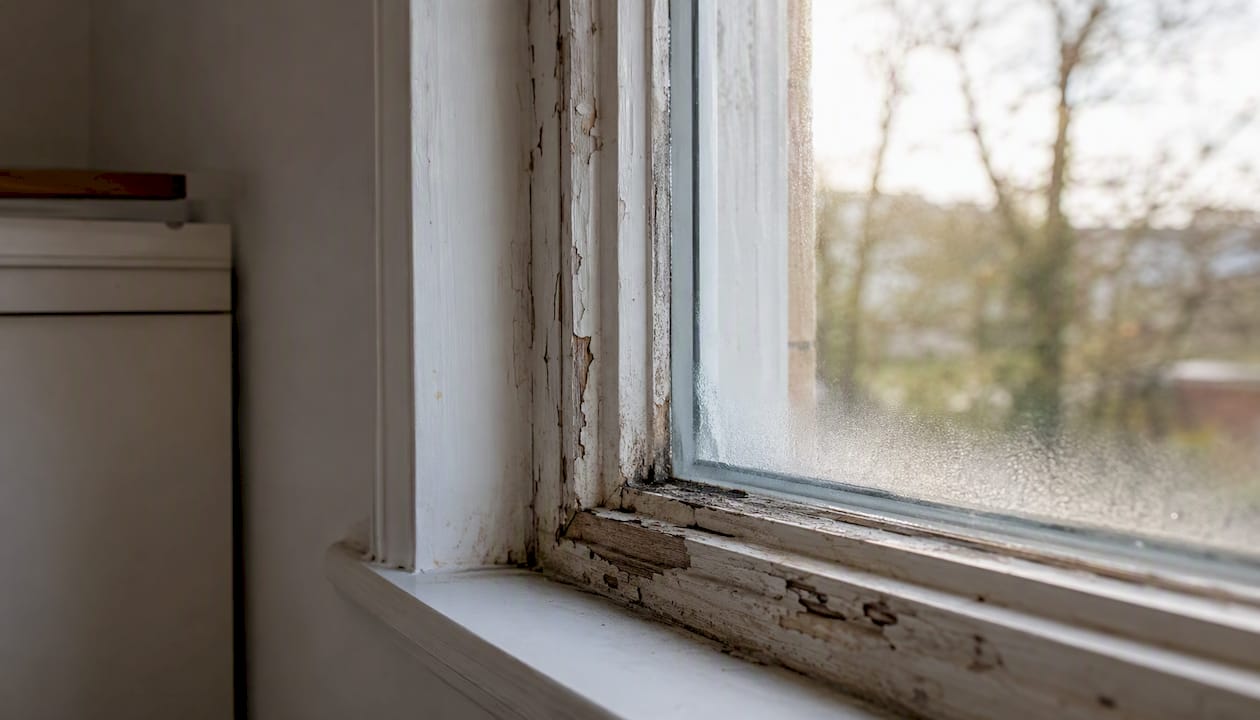
Behind furniture on external walls is where mould behind furniture tends to develop unnoticed. The furniture restricts warm air circulation, the wall stays cold, and the dew point is crossed repeatedly through autumn and winter.
Bathrooms and kitchens generate the highest moisture loads in any home. Without adequate extraction, cooking and showering can raise the indoor dew point by several degrees within minutes.
Lofts are at risk when warm air escapes from the living space below, meets the cold roof structure, and condenses. Poorly fitted insulation at joist level is a common cause.
Basements and cellars sit in contact with ground that stays at roughly 8–12°C year-round, making condensation on walls and floors almost inevitable when indoor air is warm and humid.
Wall cavities are the highest-risk location for structural damage. Condensation inside a cavity can saturate insulation, corrode wall ties, and cause timber lintels and plates to rot before any interior sign appears. Condensation inside wall assemblies can cause rot and mould long before visible signs develop on the interior surface.
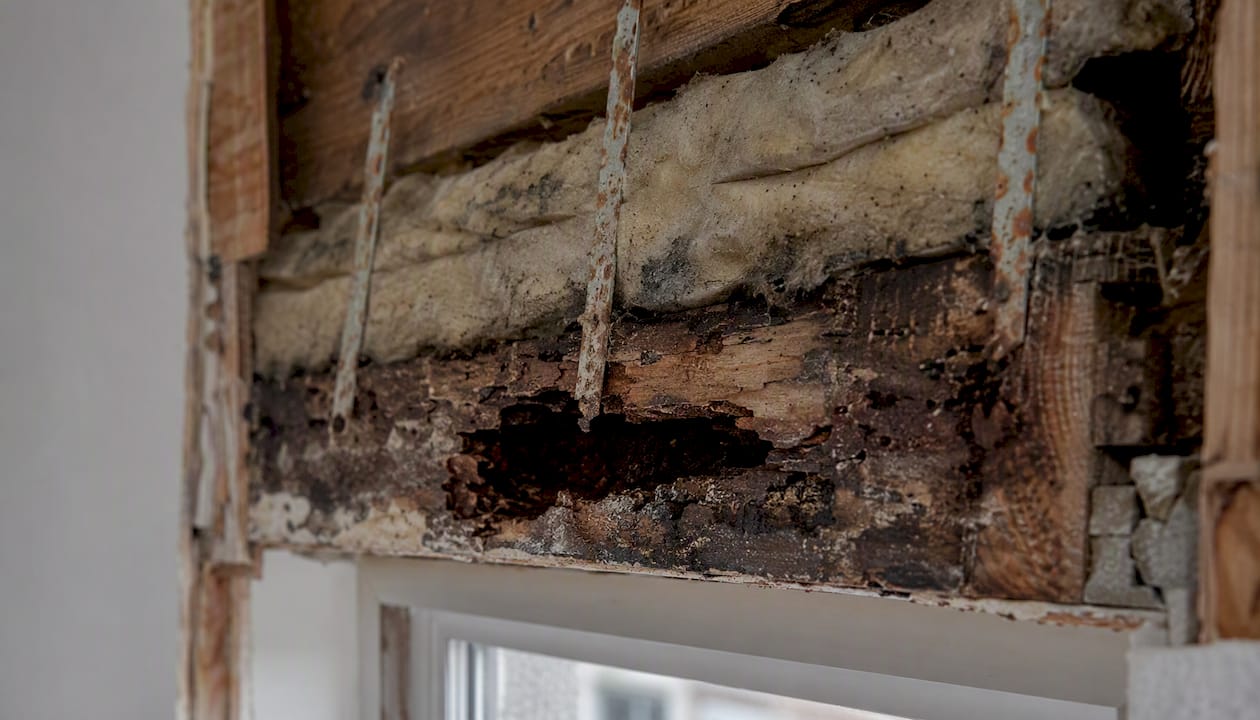
Mould growth linked to condensation carries documented health risks, particularly for those with asthma or respiratory conditions. Structurally, persistent moisture accelerates timber decay, which is why a timber survey is often warranted alongside a damp investigation when condensation has been present for more than one season.
Seasonal variation matters. Winter brings the highest risk: outdoor temperatures are low, surfaces are cold, and heating raises indoor vapour levels. Summer condensation is less common but can occur in basements and on cold-water pipes during warm, humid spells.
What dew point should you aim for in your home?
Guidance linking indoor dew point to comfort and mould risk suggests that keeping the dew point below approximately 10°C indoors significantly reduces condensation risk on typical UK wall and window surface temperatures. Above 16°C, most people find the air noticeably humid and uncomfortable. Above roughly 18°C, mould risk increases substantially on any surface that dips below that threshold.
| Dew point (°C) | Approximate RH at 20°C | Comfort / mould risk |
|---|---|---|
| Below 4°C | Below 30% | Dry; may cause dry skin or static |
| 4–10°C | 30–50% | Comfortable; low mould risk |
| 10°C | 50–60% | Acceptable; monitor cold surfaces |
| — | 60% | Humid; condensation risk on cold surfaces |
| Above 16°C | Above 60% | High mould and condensation risk |
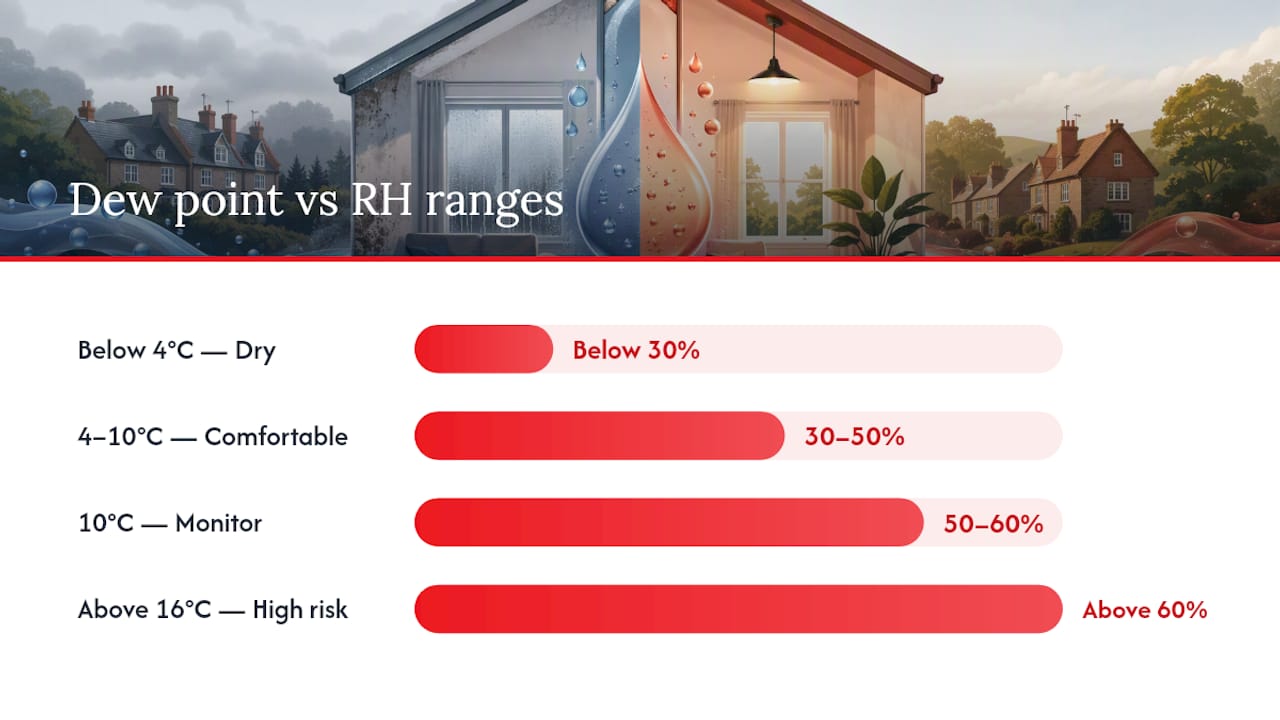
For UK winter conditions, aim for a dew point within a moderate range to reduce condensation risk (corresponding to roughly 30–50% RH at 20°C). In summer, slightly higher dew points may be acceptable if surfaces remain warm enough. The critical caveat: even air with a healthy dew point of 8°C will condense on a window surface sitting at 5°C. Surface temperature matters as much as the indoor dew point figure.
Pro Tip: Track both RH and dew point together. A hygrometer that displays both gives you a complete picture. RH alone can mislead you in winter when a cold room reads a low RH but the absolute moisture content is still high enough to cause condensation on the coldest surfaces.
Practical ways to reduce dew point and stop condensation
Immediate actions
- Run extractor fans in kitchens and bathrooms during and for 15–20 minutes after cooking or showering. Ventilation, dehumidification, and prompt drying are the core measures recommended for indoor moisture control.
- Keep lids on pans while cooking to reduce steam output.
- Open windows briefly (10–15 minutes) to flush moist air, even in winter. Short, effective ventilation loses less heat than leaving a window ajar all day.
- Move large furniture at least 50mm away from external walls to restore air circulation.
Short-term, low-cost fixes
- Fit a humidity-controlled extractor fan in bathrooms. These switch on automatically when RH rises above a set threshold and off when it falls, removing the need to remember.
- Run a portable dehumidifier set to maintain 50% RH or a dew point of around 8–10°C. Dehumidifiers and correct heating are among the most practical homeowner tools for dew-point control.
- Fit draught-proof letterboxes and seal gaps around service penetrations to reduce uncontrolled air infiltration, but only alongside adequate ventilation.
Longer-term measures
Insulation keeps structural surfaces warmer, which raises them above the dew point. External wall insulation is particularly effective because it keeps the masonry warm rather than cold. Indicative UK costs for common interventions:
- Full damp and condensation survey with documented findings: — £200–£500 typically, with remedial works quoted separately
These are indicative ranges, not formal quotes. Costs vary by property size, access, and the extent of any existing damage.
Pro Tip: Never insulate without reviewing ventilation at the same time. Adding insulation or airtight glazing without compensating ventilation shifts the moisture problem from visible surfaces into wall cavities, where it is far harder and more expensive to fix.
When should you call a professional surveyor?
Self-measurement and ventilation improvements resolve many straightforward condensation problems. A professional survey is warranted when:
- Condensation or mould returns repeatedly despite ventilation and dehumidification improvements.
- You cannot identify the source of a damp patch, cold spot, or musty odour.
- Timber shows signs of decay: soft spots in floorboards, staining on joists, or a hollow sound when tapped.
- Mould appears inside wall cavities or behind plasterboard after recent works.
- You are planning a major retrofit and want to confirm the dew-point behaviour of the proposed assembly before committing.
- A property purchase is involved and you need documented findings before exchange.
A professional inspection typically covers:
- Visual inspection of all accessible surfaces, including loft, basement, and sub-floor voids.
- Hygrometer and dew-point mapping across rooms and at problem locations.
- Infrared surface thermography to identify cold spots and thermal bridges.
- Moisture meter readings in plaster, masonry, and timber.
- Assessment of air leakage routes and ventilation provision.
- Review of insulation continuity and any vapour control layers.
A written report should include documented findings, a defined scope of remedial work, cost estimates, and where applicable, written guarantees on workmanship. Broad UK timelines: survey appointment within one to two weeks of booking, written report within five to seven working days, remedial works typically commencing within two to four weeks of a signed agreement.
Quaypointplastering’s damp and timber survey follows exactly this process: visual diagnosis first, documented findings, a clear scope of work, and written guarantees. No treatment is recommended without a thorough inspection first.
The part most homeowners miss
Most of the condensation calls we receive follow the same pattern. A homeowner has wiped down windows for two winters, painted over mould twice, and bought a dehumidifier. The visible problem improves. Then, during a survey for something unrelated, we find the real moisture load sitting inside the wall cavity or beneath the floor, where no amount of surface wiping was ever going to reach it.
The reason this happens is straightforward. Surface condensation is the symptom you can see. Interstitial condensation is the process you cannot. When moist air finds a gap around a socket, a pipe run, or a poorly sealed loft hatch, it travels into the structure and condenses on the first surface it meets that sits below the dew point. That surface might be the back of a plasterboard sheet, a timber joist, or a cavity wall tie. By the time the moisture works its way back to a visible surface, the structural damage is often already done.
Documented findings and a defined scope of work are not bureaucratic formalities. They are the difference between treating the right problem and spending money on the wrong one.
Persistent condensation or mould? Quaypointplastering can help
If ventilation improvements and a dehumidifier have not resolved recurring condensation or mould in your Dorset, Hampshire, or Wiltshire home, a survey-led diagnosis is the logical next step.

Quaypointplastering’s approach starts with a thorough visual inspection, hygrometer and dew-point mapping, infrared surface thermography, and moisture meter readings. Every survey produces documented findings, a clear scope of remedial work, and written guarantees on workmanship. No treatment is recommended without that inspection first.
Whether you are dealing with black mould that keeps returning, unexplained damp patches, or planning a retrofit and want to understand the dew-point implications, the team covers Dorset, Hampshire, and Wiltshire. Book a damp and timber survey or call 01202 287134 to discuss what you are seeing.
Useful sources for further reading
The following sources provide authoritative technical detail and official guidance for homeowners who want to go deeper:
- Why your walls get wet: building science and dew point guide — Ecohome
- Dew point — Wikipedia
- Once air reaches the dew point, will the rate of condensation change if the temperature is lowered? — MIT School of Engineering
- Dewpoint — American Meteorological Society glossary
- Dew point simply explained — Stadlerform
- What are the main ways to control moisture in your home? — US EPA
- Ecohome – condensation and dew point explanation
- Your Home Might Have A Dew Point Problem. — The Gaines Group Architects
These sources are starting points. Site-specific conditions, construction type, and occupancy patterns all affect how dew-point condensation behaves in your home. A professional survey gives you answers that no general guide can.
This article provides general information for educational purposes. For advice specific to your property, consult a qualified damp and timber surveyor or building professional.