
Basement waterproofing options for UK homeowners
Basement waterproofing options for UK homeowners
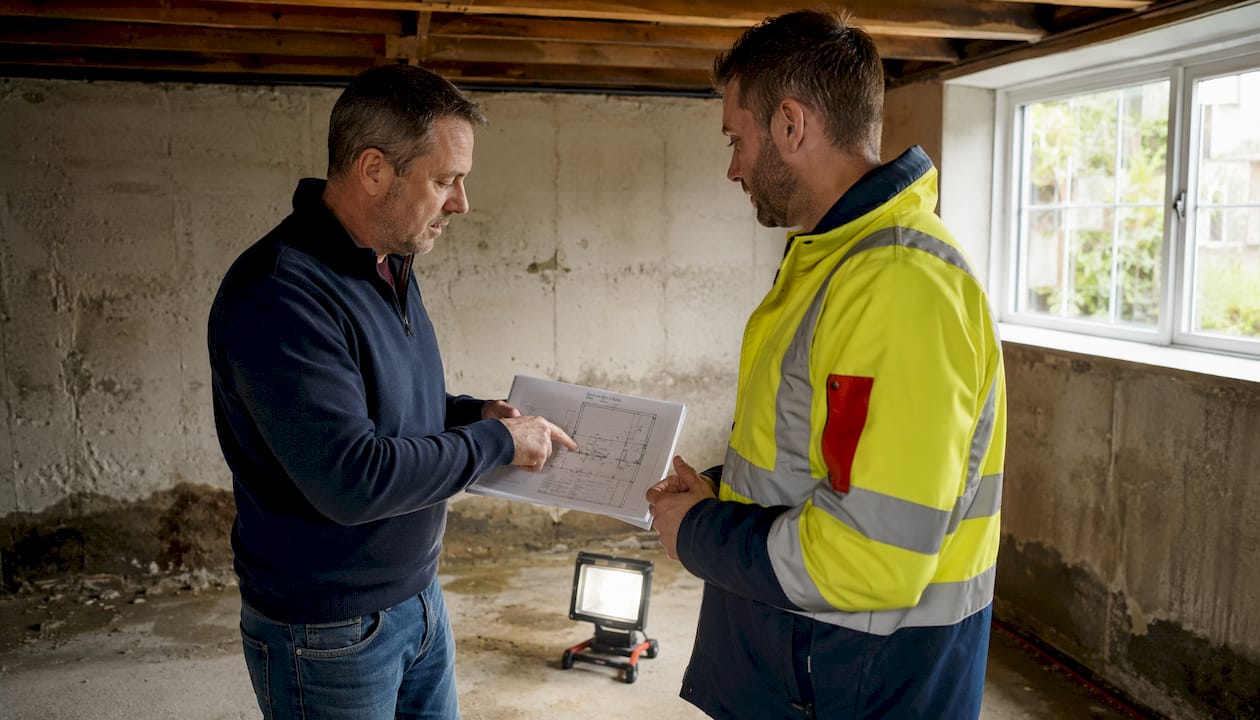
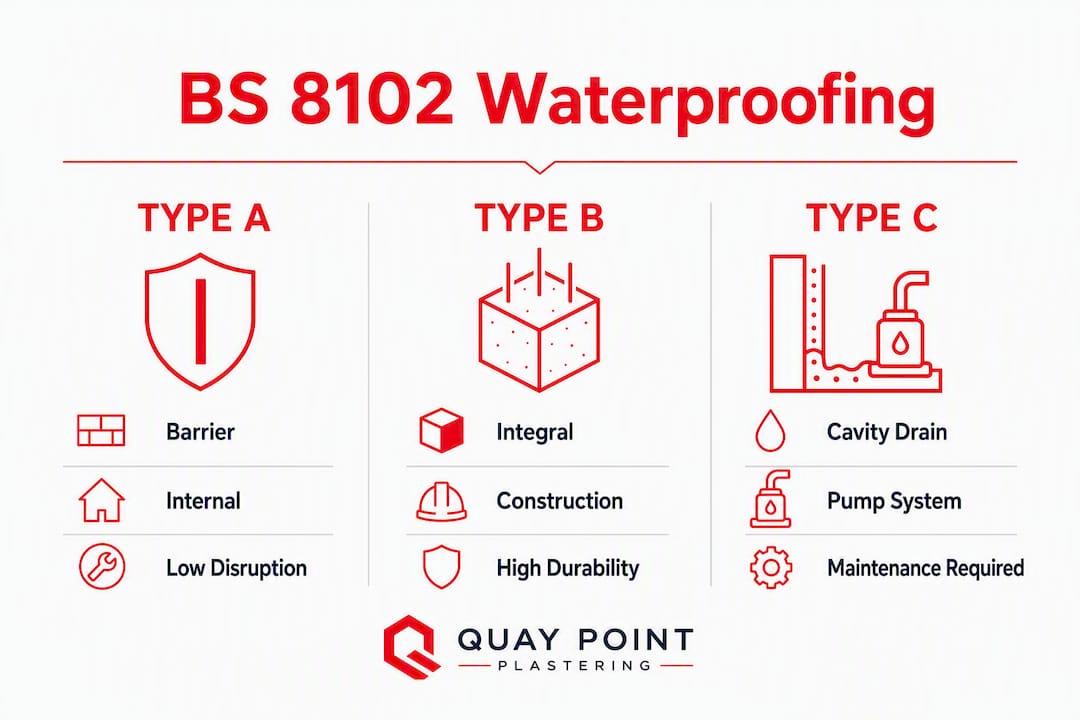
The three main basement waterproofing options under BS 8102 are Type A (barrier/tanking), Type B (structurally integral), and Type C (cavity drain with active drainage). Before you select any of them, commission a professional damp and waterproofing survey with documented findings and a defined scope of work. Choosing a system without a survey is the single most common cause of wasted expenditure on UK basements. Quaypointplastering carries out exactly this kind of survey-led diagnosis across Dorset, Hampshire, and Wiltshire, identifying the moisture source before recommending any remedy.
At a glance — which type fits your situation:
- Type A (tanking/barrier): Suitable for low ingress, minimal hydrostatic pressure, and dry-ish walls with isolated damp patches.
- Type B (structurally integral): Applicable to new builds or major reconstruction where waterproofing is designed into the structure from the outset.
- Type C (cavity drain/drained system): The preferred retrofit for existing UK basements with active water ingress, high water tables, or flood risk — requires a cavity drain membrane, perimeter drainage channel, and a sump pump.
A written survey report will confirm which type is appropriate for your property and ground conditions. Without it, you are guessing.
Table of Contents
- What are the three BS 8102 basement waterproofing options?
- How each waterproofing system is installed
- How do you choose the right waterproofing system?
- What do basement waterproofing systems cost in the UK?
- Common mistakes to avoid when choosing a waterproofing method
- What does BS 8102 compliance mean for your guarantee?
- How a survey-led approach works in practice
- Key takeaways
- The case for survey-first waterproofing
- Quaypointplastering: survey-led waterproofing in Dorset, Hampshire, and Wiltshire
- Useful sources and further reading
What are the three BS 8102 basement waterproofing options?
BS 8102 classifies below-ground waterproofing into three system types, and that classification underpins every credible design decision for UK basements. Understanding what each type does — and where it fails — is the starting point for any sensible shortlist.
Type A: barrier/tanking
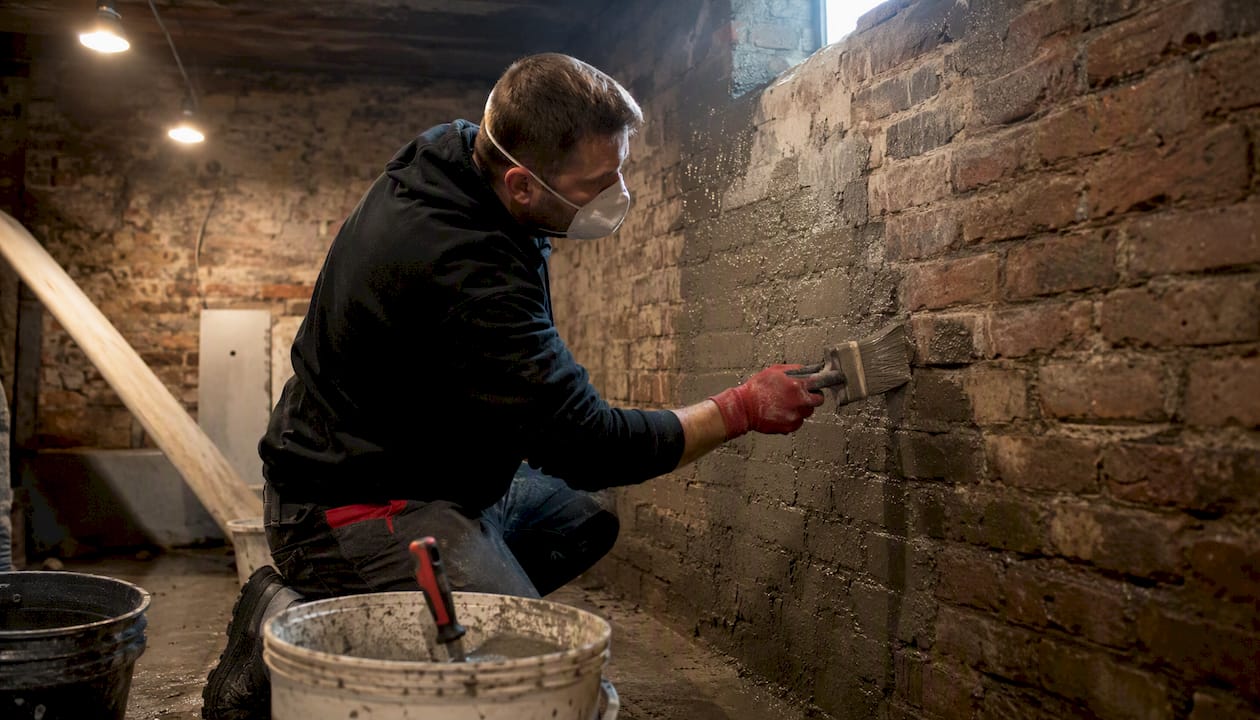
Type A works by applying a physical barrier to the structure to resist water penetration. In practice, this means liquid-applied cementitious coatings, bituminous slurries, or sheet membranes bonded directly to the wall or floor substrate. The barrier carries the water load itself.
Pros and cons:
- Relatively low cost and straightforward to apply internally or externally
- No ongoing mechanical maintenance required
- Suitable for low ingress and walls with minimal hydrostatic pressure
- Can fail under sustained groundwater pressure: coatings de-bond or crack when the water load exceeds what the barrier can resist
- Not recommended for high water table sites or basements subject to periodic flooding
- Failure is often invisible until water breaks through, at which point reinstatement is disruptive
Type A is best suited to walls with occasional damp patches, isolated penetrating damp, or as a supplementary measure alongside another system.
Type B: structurally integral waterproofing
Type B waterproofing is built into the structure itself. Dense, low-permeability concrete with admixtures, carefully detailed construction joints, and designed-in drainage paths are the tools. The structure resists water by its own integrity rather than by a separate applied layer.
Pros and cons:
- Highly durable when correctly designed and constructed
- No separate membrane to maintain or replace
- Applicable to new builds, basement extensions, or major reconstruction where the structure is being formed or substantially rebuilt
- Not a retrofit option for most existing UK basements without significant structural intervention
- Requires specialist structural design input and careful quality control during the pour
- Construction joints and service penetrations remain the primary vulnerability
Type C: cavity drain/drained system
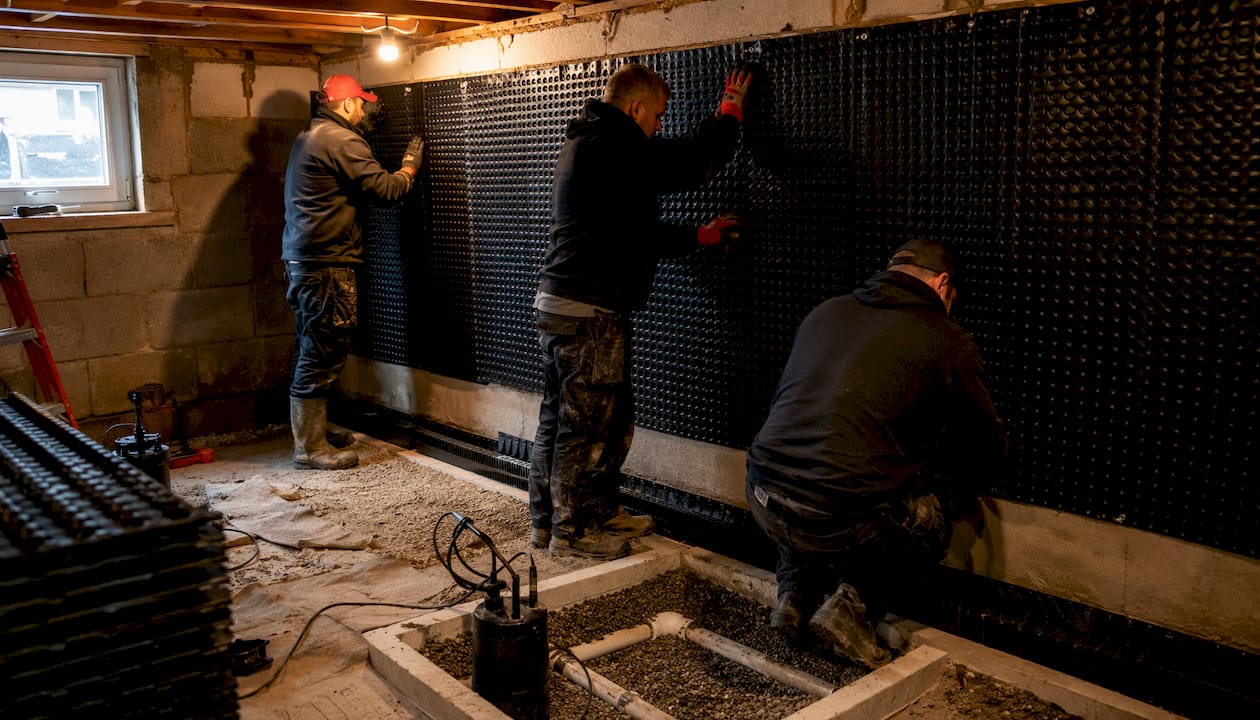
Type C does not attempt to stop water entering the structure. Instead, a studded cavity drain membrane (CDM) is fixed to the wall face, creating an air gap that allows water to track down behind the membrane into a perimeter drainage channel. That channel feeds a sump, and a pump discharges the collected water away from the building.
Pros and cons:
- Manages groundwater pressure rather than resisting it, making it suitable for high water table sites
- Tolerates ongoing water ingress without structural risk
- Reversible and compatible with heritage structures; Delta MS20 is specifically cited for high groundwater and reversible installations
- Requires a functioning pump: power failure or pump failure means water accumulates
- Perimeter drainage channels need routine flushing to prevent silt and lime build-up
- Ongoing maintenance is a genuine commitment, not optional
A cavity drain membrane without perimeter drainage and a sump pump is incomplete and ineffective. The membrane alone simply conceals water rather than removing it.
| System | Best for | Typical failure mode | Disruption | Maintenance | Lifetime/guarantee | Internal or external |
|---|---|---|---|---|---|---|
| Type A (tanking) | Low ingress, minimal pressure | De-bonding under hydrostatic load | Low–moderate | None mechanical | Typical warranty periods vary by contractor and product | Either |
| Type B (structurally integral) | New build, major reconstruction | Construction joint defects | High (structural works) | Minimal | Design life of structure | External (built-in) |
| Type C (cavity drain) | Active ingress, high water table, retrofit | Pump failure, blocked channels | Moderate (internal) | Annual pump check, channel flush | Expected lifespan depends on system components | Internal |
How each waterproofing system is installed
Understanding what installation actually involves helps you plan for disruption, access, and the ongoing responsibilities that come with each system.
Internal tanking (Type A, internal application)
- Strip internal plaster or render back to the masonry substrate.
- Prepare the surface: rake out cracks, apply hydraulic cement to active leaks, and allow to cure.
- Apply cementitious tanking slurry in two or three coats, working into corners and around pipe penetrations.
- Allow full curing time before any reinstatement (typically 24–72 hours per coat depending on conditions).
- Reinstate plaster, render, or dry lining over the cured coating.
Internal tanking is relatively low-disruption and can usually be completed within a few days for a standard cellar room. It does not require garden access or excavation.
External tanking (Type A, external application)
External application is warranted when walls are bowing, when structural repair is needed alongside waterproofing, or when severe hydrostatic pressure makes internal barrier methods impractical. The sequence involves:
- Confirm structural need via a professional survey before committing to excavation.
- Excavate around the affected wall with temporary works to support the structure.
- Clean and prepare the external wall face; repair cracks and defects.
- Apply the external membrane (bituminous sheet, liquid-applied coating, or similar).
- Install a footing drain and granular backfill to manage groundwater at the base.
- Reinstate ground, landscaping, and any affected drainage.
External waterproofing is more disruptive and more costly than internal approaches and is reserved for structural or severe hydrostatic cases. Expect significant disruption to gardens, paths, and boundary structures, and a programme measured in weeks rather than days. Before accepting a quote for external excavation, check whether foundation cracks or structural movement genuinely justify it.
Cavity drain system installation (Type C)
- Fix the studded cavity drain membrane to the wall face using manufacturer-specified plugs and laps, following the technical requirements set out in datasheets such as the RIW Cavity Drain R7.
- Install a perimeter drainage channel at the base of the wall, connecting membrane to channel continuously.
- Excavate a sump chamber at the lowest point; install the sump liner and submersible pump.
- Connect the pump discharge pipe to an appropriate outfall (soakaway, drain, or external ground level).
- Provide a dedicated electrical supply with RCD protection for the pump.
- Install maintainable access points (flushing eyes) in the drainage channel for future servicing.
- Reinstate floor screed over the drainage channel and apply dry lining or plasterboard over the membrane.
The pump requires an annual test and the drainage channels need periodic flushing to clear silt and lime deposits. Without this, channels lose capacity and the pump runs continuously or fails. Checking and clearing downspouts and surface drainage around the property also reduces the volume of water the system must manage.
Structurally integral measures (Type B)
Type B is not a retrofit option for most existing UK basements. It applies during construction: dense concrete with waterproofing admixtures, carefully formed and sealed construction joints, and designed drainage paths. If you are planning a basement conversion or new-build basement, a structural engineer and a waterproofing specialist should be involved from the design stage. Retrofitting Type B measures into an existing structure without major reconstruction is generally not feasible.
How do you choose the right waterproofing system?
The correct system follows from the diagnosis, not from a contractor’s preferred product. A professional survey should confirm the following before any system is specified.
Survey criteria to establish:
- Source of moisture: is it hydrostatic groundwater pressure, penetrating damp through cracks, rising damp, or condensation? Misdiagnosing condensation as ingress leads to entirely inappropriate treatment.
- Water table level and seasonal variation at the site.
- Wall construction: stone rubble, brick, concrete block, or poured concrete each respond differently to barrier coatings.
- Finish requirements: will the basement be a habitable room, a utility space, or storage? This affects the acceptable disruption level and the finish specification.
Questions to ask any contractor before signing:
- Will you provide a written survey report with documented findings?
- Which BS 8102 type do you propose, and what is your reasoning?
- Is a sump and pump included, and what maintenance does it require?
- Do you supply written workmanship guarantees and manufacturer installation certificates?
- What is the guarantee period, and who backs it if your company ceases trading?
Red flags in proposals:
- A cavity drain membrane quoted without a perimeter drainage channel and sump pump.
- External excavation recommended without survey evidence of structural need or severe hydrostatic pressure.
- No written guarantee or BS 8102 compliance statement in the proposal.
- A single system recommended for every property without reference to site-specific conditions.
Decision checklist:
- Condensation confirmed as the cause → address ventilation and thermal bridging first; waterproofing is not the answer.
- Low-level damp, no active water flow, minimal hydrostatic pressure → Type A internal tanking may be sufficient.
- New build or major structural reconstruction → Type B designed in from the outset.
- Active water ingress, high water table, existing structure → Type C cavity drain with sump and pump is the standard retrofit recommendation.
- Bowing walls or structural failure confirmed → external excavation plus structural repair before any waterproofing.
What do basement waterproofing systems cost in the UK?
Cost varies considerably with site conditions, system type, and the extent of reinstatement required. The figures below are indicative ranges for UK residential properties and should be treated as a starting point for budgeting, not a fixed price.
| System | Typical UK cost range | Programme | Key cost drivers |
|---|---|---|---|
| Internal tanking (Type A) | — | 2–5 days | Wall area, crack repairs, reinstatement finish |
| Cavity drain system (Type C) | — | 3–7 days | Basement perimeter, pump specification, slab reinstatement |
| External excavation + membrane | — | 2–6 weeks | Depth, access, structural repairs, landscaping reinstatement |
Interior approaches are substantially less costly than full external excavation, which is reserved for structural failures or severe hydrostatic pressure cases.
What drives the price:
- Extent and source of water ingress (a single crack versus a fully saturated perimeter)
- Need for structural repairs before waterproofing can begin
- Access constraints (narrow access, listed building restrictions, proximity to boundaries)
- Pump specification and alarm system requirements
- Reinstatement finish: a habitable room costs more to reinstate than a utility space
- Ground conditions and depth of excavation for external works
Comparing quotes — what line items should appear:
- Written survey report and documented findings
- Materials specification (membrane type, pump model, channel specification)
- Pump warranty period and servicing schedule
- Workmanship guarantee duration and who backs it
- Maintenance handover notes and access point locations
A quote that omits the survey report or the guarantee terms is incomplete. Do not authorise work on that basis.
Common mistakes to avoid when choosing a waterproofing method
Several errors recur across UK basement waterproofing projects, and most are avoidable with a proper survey and an informed brief.
- Confusing condensation with water ingress. Condensation forms on cold surfaces when warm, moist air meets them. It produces similar staining and mould to penetrating damp but requires a completely different remedy: improved ventilation, thermal lining, or a dehumidifier, not a waterproofing membrane. A moisture meter and thermal imaging during a survey will distinguish the two.
- Installing a cavity drain membrane without active drainage. A membrane fixed to the wall with no perimeter channel and no sump pump does not remove water. It redirects it to the floor where it accumulates. This is one of the most frequently cited installation errors in the industry.
- Choosing Type A tanking for a high water table site. A Type A coating applied to a wall under constant hydrostatic pressure will eventually de-bond or crack. Engineers generally prefer to manage groundwater with a drained system rather than attempt to resist it with a barrier coating when retrofitting an existing structure.
- Accepting a quote without BS 8102 reference or written guarantees. A credible proposal will state which BS 8102 type is being installed and include a written workmanship guarantee and manufacturer installation certificates for membranes and pumps.
- Neglecting pump maintenance. Type C systems depend on a functioning pump. An untested pump in a flooded sump is a common cause of system failure. Annual testing and channel flushing are not optional extras.
- Assuming external excavation is always the superior solution. External works are more disruptive, more costly, and justified only when structural problems or wall-face ingress demand them. For most existing UK basements with groundwater issues, a well-installed Type C system is the appropriate and maintainable answer.
Pro Tip: A professional survey typically costs a fraction of the remedial works. It identifies whether the problem is condensation, rising damp, penetrating damp, or hydrostatic ingress — and that distinction determines the entire treatment plan. Spending on a survey before committing to a system is the single most cost-effective step you can take.
What does BS 8102 compliance mean for your guarantee?
BS 8102 is the British Standard Code of Practice for the protection of below-ground structures against water ingress. It defines the three system types, sets out design principles, and states that a waterproofing specialist should be included as part of the design team so that an integrated waterproofing solution is created. Conformity with BS 8102 is the benchmark against which UK contractors and specifiers work.
What a genuine guarantee should include:
- A written workmanship guarantee with a clearly stated duration (typically 10–30 years depending on system and contractor)
- Manufacturer installation certificates for the membrane and pump confirming the products were installed to the manufacturer’s specification
- A documented survey report with moisture readings, identified cause, and recommended BS 8102 system type
- A written scope of works with materials specified by product name and grade
- A maintenance schedule stating what checks are required, how often, and by whom
Trust signals to request before authorising work:
- Documented survey report with before photographs and moisture meter readings
- Written confirmation of which BS 8102 type is being installed and why
- Manufacturer certificates for membranes (e.g. BBA Agrément Certificate for Newton CDM 508, which carries a 30-year guarantee against deterioration)
- After photographs on completion
- Clear written warranty period and the name of the guaranteeing party
A written guarantee is only as strong as the contractor behind it. Ask who backs the guarantee if the installing company ceases trading, and whether the manufacturer’s certificate provides independent cover. For long-term peace of mind, manufacturer-backed certificates matter as much as the contractor’s own warranty.
How a survey-led approach works in practice
A property in Dorset presented with persistent damp staining on the lower half of the cellar walls, visible efflorescence, and a musty odour. The owner had previously had a cementitious coating applied by another contractor, which had blistered and partially de-bonded within two years.
Quaypointplastering carried out a specialist damp survey that included moisture meter readings at multiple heights, visual inspection of the external ground levels, and a check of the drainage around the property. Findings documented in writing:
- Active hydrostatic ingress through the base of the wall, consistent with a seasonally high water table
- The previous cementitious coating had failed under sustained groundwater pressure, as Type A coatings typically do in this scenario
- No evidence of condensation as a contributing factor
- Wall construction: solid brick, no cavity
Recommended system: Type C cavity drain with perimeter drainage channel and sump pump, specified to manage the identified water volume. Type A was ruled out given the confirmed hydrostatic pressure. External excavation was not warranted as the walls showed no structural movement.
What the survey pack included:
- Written findings with moisture readings and photographic evidence
- Recommended BS 8102 system type with reasoning
- Alternative options considered and why they were discounted
- Written scope of works with materials specified by product name
- Cost estimate and programme
- Workmanship guarantee terms and maintenance handover notes
Works were completed within five days. The sump pump was installed with an audible alarm and a dedicated electrical supply. The owner received a written workmanship guarantee and manufacturer installation certificates for the membrane and pump, along with a maintenance schedule for annual pump testing and channel flushing.
Key takeaways
The most effective basement waterproofing decision starts with a professional survey that identifies the moisture source and confirms the appropriate BS 8102 system type before any work begins.
| Point | Details |
|---|---|
| Three BS 8102 system types | Type A (tanking), Type B (structurally integral), and Type C (cavity drain) each suit different site conditions and ingress levels. |
| Survey before system | A professional damp survey identifies whether the cause is hydrostatic ingress, penetrating damp, or condensation — the diagnosis determines the remedy. |
| Type C for most retrofits | Active water ingress in existing UK basements with a high water table is best managed by a Type C cavity drain system with a sump pump, not a barrier coating. |
| Pump maintenance is non-negotiable | Type C systems require annual pump testing and periodic channel flushing; neglecting this leads to system failure. |
| Quaypointplastering | Provides survey-led basement waterproofing across Dorset, Hampshire, and Wiltshire with written guarantees and manufacturer certificates. |
The case for survey-first waterproofing
The pattern I see most often is a homeowner who has already spent money on a remedy that did not work. A cementitious coating applied to a wall under hydrostatic pressure. A membrane fixed without drainage. A dehumidifier running continuously because the actual source of moisture was never identified. Each of these outcomes has the same root cause: a system was chosen before the problem was understood.
Type C with active drainage is, in my experience, the safer and more maintainable retrofit for existing UK basements where groundwater is involved. It manages pressure rather than resisting it, and it gives you a visible, testable system: you can hear the pump run, check the alarm, and flush the channels. That transparency matters for long-term confidence in the installation.
External excavation is sometimes the right answer, but only when a survey confirms structural need. Recommending it without that evidence is not conservative — it is unnecessary disruption and cost. The same applies in reverse: recommending a barrier coating for a wall that is under constant groundwater pressure is not a cheaper option, it is a failed one waiting to happen.
Annual pump checks and channel flushing take an hour. Skipping them for several years and then dealing with a flooded basement does not. Build the maintenance into your calendar from day one.
Quaypointplastering: survey-led waterproofing in Dorset, Hampshire, and Wiltshire
A waterproofing survey from Quaypointplastering gives you something most contractors do not offer before the work starts: documented findings, moisture readings, before photographs, a confirmed BS 8102 system type with written reasoning, and a defined scope of works with a cost estimate. You know exactly what is being done and why, before you sign anything.
Every waterproofing contract includes materials specified by product name, a pump warranty, a written workmanship guarantee, and a maintenance handover so you know what to check and when. There are no vague verbal assurances — the guarantee and the manufacturer certificates are in writing and handed over on completion.
Quaypointplastering serves homeowners and property managers across Dorset, Hampshire, and Wiltshire, with over 35 years of field experience in damp, mould, and timber diagnosis. If you have a damp basement and you are not sure what you are dealing with, the right starting point is a specialist damp survey — not a product, not a quote, and not a guess.
Call 01202 287134 or book online to arrange your survey.
Useful sources and further reading
The following resources support the technical content in this guide and are worth consulting for product specifications, standards references, and further detail.
| Source | What it covers |
|---|---|
| BS 8102 (via Newton Waterproofing overview) | BS 8102 Code of Practice for below-ground waterproofing; system type definitions and design principles |
| RIW Cavity Drain R7 datasheet | Manufacturer installation guidance for a Type C cavity drain membrane: fixings, laps, drainage channel details |
| Delta MS20 product page | High-density polymer CDM for high groundwater and reversible/heritage installations |
| Sika Cavity Drainage System | Type C system components including polypropylene studded membrane and CD channel and pump system |
| Quaypointplastering: basement waterproofing | Survey-led approach, common errors, and what to expect from a professional waterproofing contract |
| Quaypointplastering: cavity drain membranes | Technical overview of Type C systems and full cavity drain installation |
| Quaypointplastering: damp advice library | Articles on rising damp, penetrating damp, condensation, and correct diagnosis |
| Permagard: which system is best? | Practical comparison of Type A, B, and C systems with guidance on selection criteria |