
Gravimetric Moisture Test: How It Works and What It Tells You
Gravimetric Moisture Test: How It Works and What It Tells You
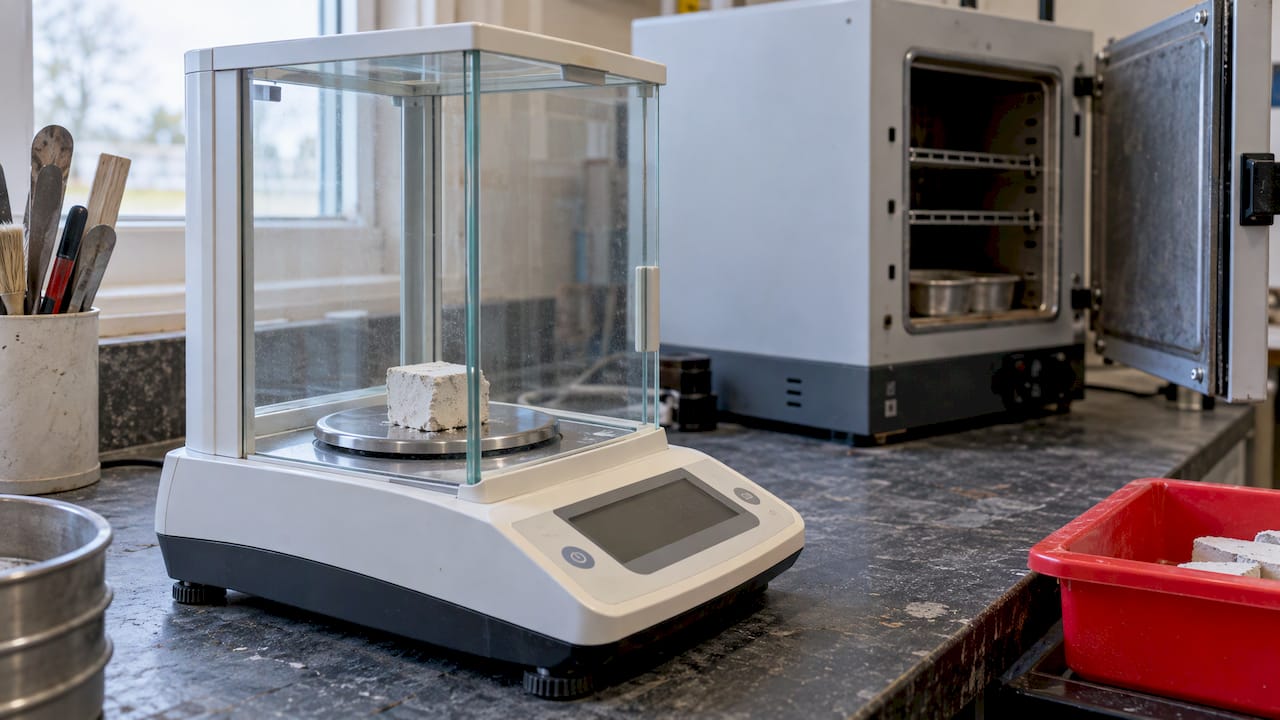
A gravimetric moisture test finds how much water a material holds by weighing a sample, drying it fully and weighing it again. The weight lost is the water. It is the reference method that quicker tools, such as a handheld damp meter, are checked against. That is why it matters if you have persistent damp: a meter reading is an indication, while a weighed result is a measurement. Turning either into a diagnosis and a scope of work is a surveyor’s job, and a survey-led approach, where findings are documented before any treatment is proposed, is how you avoid paying for the wrong repair.
TL;DR
- A gravimetric test weighs a sample wet, dries it to a constant weight, weighs it again, and expresses the water lost as a percentage of the dry weight.
- The standard laboratory drying temperature is 105°C, but samples from plaster and salt-contaminated masonry are dried at a much lower temperature to avoid false results.
- Handheld damp meters are quick but indirect. The weighed method is the reference they are calibrated against.
- A percentage on its own does not tell you the cause. Rising damp, penetrating damp, condensation and leaks need a visual diagnosis alongside the figure.
- If you are dealing with damp in Dorset, Hampshire or Wiltshire, a documented survey tells you what the readings mean before you spend on treatment.
Table of Contents
- What the test actually measures
- The formula, with a worked example
- How the laboratory procedure runs, step by step
- Why building materials are dried differently
- Other sources of error to know about
- Gravimetric testing versus a damp meter
- What the number means for a wall
- Gravimetric versus volumetric: a note on the terms
- Moisture in floors and finishes
- When a test leads to repair
- Book a survey that explains the readings
- Our view on weighing, measuring and diagnosing
- FAQ
- Sources
What the test actually measures
Gravimetric means “by weight”. The test does not detect moisture through an electrical signal. It removes the water and measures what is left. The COSMOS guide from the UK Centre for Ecology & Hydrology defines gravimetric water content as the mass of water in a sample divided by the mass of the dry material. Because it is a ratio of two masses, it has no units and is usually quoted as a percentage.
Note the denominator. The percentage is water relative to the dry weight, not the wet weight. A sample that is 100 g dry and holds 10 g of water is 10% moisture content, even though the water is only about 9% of the wet weight. Mixing up the two bases is one of the commonest ways to misread a result.
The method is most often described for soil, which is why search results for this phrase are full of agricultural and laboratory pages. The same principle is used on building materials. Historic England’s guidance on assessing damp describes the oven and balance method for samples of plaster, brick and mortar taken from walls.
The formula, with a worked example
The calculation is simple:
Moisture content (%) = (wet mass − dry mass) ÷ dry mass × 100
In practice you weigh a container as well, so the container’s mass is subtracted from both weighings. The FAO standard operating procedure for soil moisture content sets this out as the mass of container plus moist sample, minus the mass of container plus oven-dry sample, divided by the dry sample mass, multiplied by 100.
A worked example from a University of the West of England soil mechanics page uses these figures:
| Item | Mass (g) |
|---|---|
| Container | 16.16 |
| Container + wet sample | 37.82 |
| Container + dry sample | 34.68 |
Water lost is 37.82 − 34.68 = 3.14 g. Dry sample mass is 34.68 − 16.16 = 18.52 g. Dividing gives 0.169, so the water content is 16.9%.
How the laboratory procedure runs, step by step
The FAO procedure is the clearest published version, and it shows how many places a careless test can go wrong. Here is the sequence with the pitfall at each stage.
- Prepare the containers. Label them and pre-dry them at 105°C for at least an hour, then cool them in a desiccator (a sealed container with a drying agent). Pitfall: a damp container adds water to the result.
- Weigh the empty container. The FAO procedure weighs to ±0.001 g. Pitfall: an ordinary kitchen scale cannot resolve the small differences involved in a small sample.
- Add the sample and weigh at once. The procedure uses 10 to 50 g of moist soil, weighed immediately and covered. Pitfall: the IAEA field guide lists water lost between taking the sample and first weighing as a main error source. Sealing the sample on site matters.
- Dry to constant mass. The FAO procedure dries uncovered at 105°C ± 5°C for about 24 hours, until the loss is below 0.1% per hour. Pitfall: stopping early leaves water in the sample, and drying too hot or too long can drive off water that is chemically part of the material.
- Cool in a desiccator. Cooling takes at least 2 hours, with the lid on. Pitfall: the University of Nebraska extension guide explains that cooling in moist air lets the dry sample reabsorb water, and that warm samples create convection currents that disturb the balance.
- Reweigh and calculate. Use the formula above and record the drying temperature and time with the result.
That last point is a requirement, not a courtesy. The UK Standing Committee of Analysts’ guidance on sample pre-treatment states that the drying process and temperature used must be reported with the results. A moisture percentage without its drying conditions cannot be compared with another.
Why building materials are dried differently
A soil laboratory dries at 105°C. A wall sample is a different matter. Historic England’s guidance warns that plaster and salts in a sample can contain bound water, called water of crystallisation. If that is driven off, it produces an erroneously high moisture figure. For samples that may contain plaster or salts it suggests drying at a low temperature of 20 to 30°C until the weight stops changing. For uncontaminated brick or mortar, 80 to 90°C can be used.
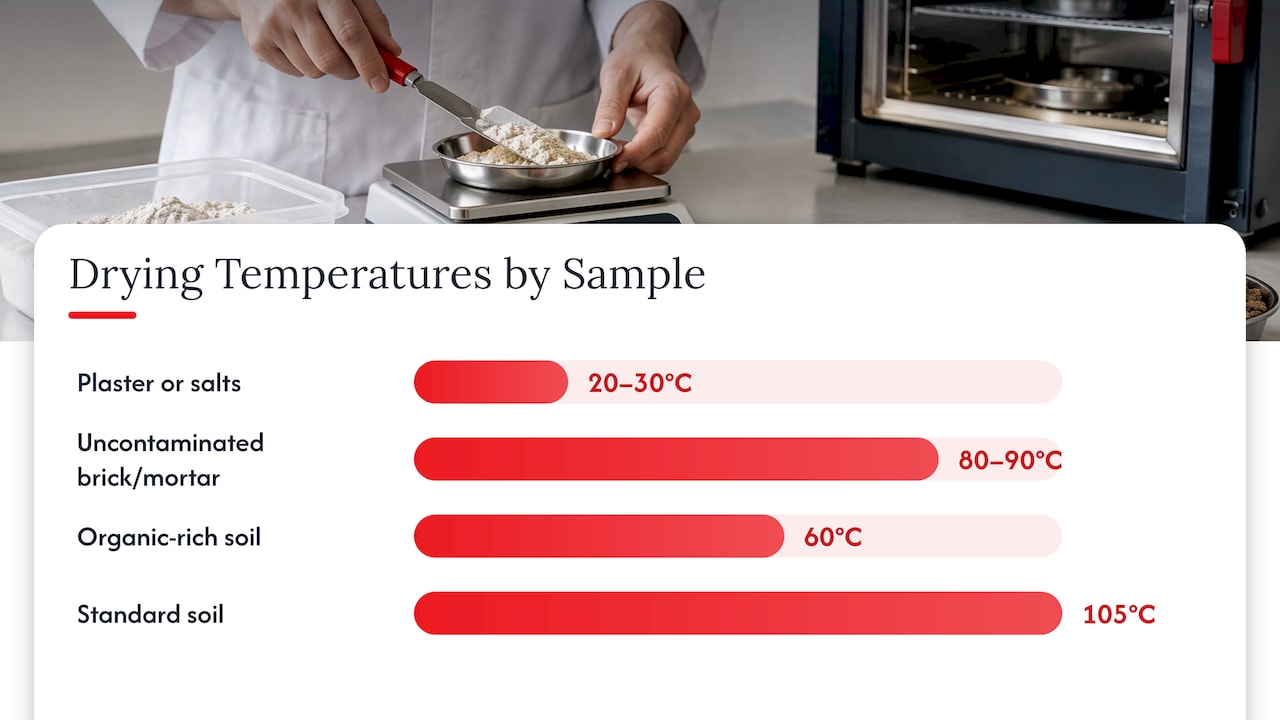
The FAO procedure makes the same point from the soil side: soils with significant organic matter should be dried at 60°C rather than 105°C, because higher temperatures burn off organic compounds that would then be counted as lost water. The COSMOS guide adds the opposite limit: 105°C is not hot enough to remove tightly bound water, so that water stays in the dry mass.
The lesson for a homeowner is practical. The right drying temperature depends on what the sample is made of, and the wrong choice shifts the answer. This is why the sample type, the temperature and the time should be written down with the number.
Other sources of error to know about
The National Physical Laboratory’s literature review of loss-on-drying methods describes oven drying as fundamental, in the sense that it needs no calibration, and notes that it is used as the reference for faster indirect techniques. It also identifies the weak points:
- The method is not specific to water. Other volatile substances, such as solvents and oils, can be lost during drying and counted as moisture.
- Sample preparation and handling are the greatest source of uncertainty.
- Reproducibility can be affected by oven temperature and humidity.
Two further limits matter for buildings. First, a sample is a tiny part of a wall. The Nebraska guide recommends at least 20 samples for a representative estimate across a field, and the principle carries over: one sample at one point tells you about that point. Second, drilling a sample is destructive, so it is used where a number is needed, not for scanning a whole room.
Gravimetric testing versus a damp meter
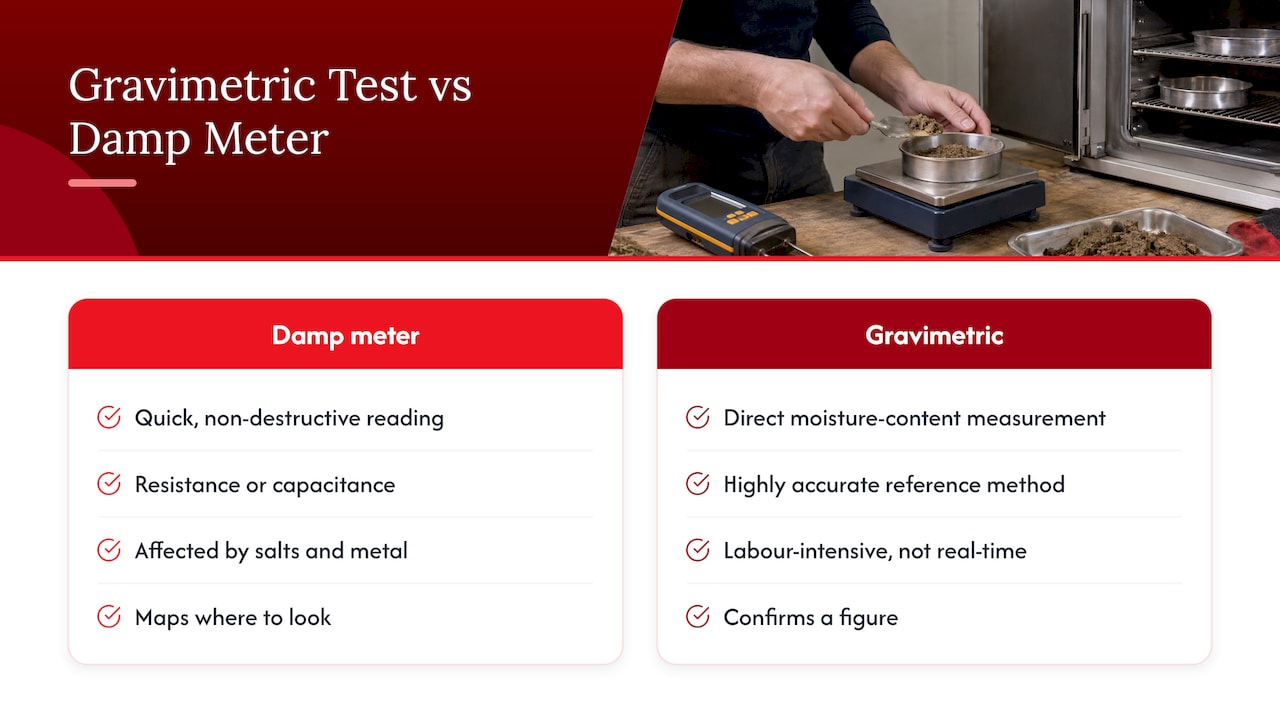
A handheld meter reads electrical resistance or capacitance at or near the surface. It is quick and non-destructive, which makes it useful for finding where to look. But it responds to salts, metal, foil-backed plasterboard and surface condensation as well as water in the material. Historic England’s guidance lists readings affected by salts and material properties, and uncertainty about the depth of measurement, among the limitations of indirect readings. You can read more on this in our guide to the 6-step damp meter test and when to call a surveyor.
The weighed result is a direct measurement of moisture content, which is why it is used to calibrate sensors. The Oregon State University guide describes gravimetric sampling as highly accurate and a reference method, though labour-intensive and not real time. The practical reading for a homeowner is that the two approaches work together: meters map the problem, and a weighed sample can confirm a figure where it matters.
What the number means for a wall
A percentage is only useful against a benchmark and in context. Historic England cites the BRE (Building Research Establishment) view that a moisture content below 5% at the floor and wall junction makes rising damp unlikely. That is a screening threshold for one situation, not a pass mark for the whole house, and it applies to a properly taken sample at the right height.
The pattern of readings carries as much information as the figure itself:
| What you see | What it may point to |
|---|---|
| Moisture highest at the base of the wall, tapering with height | Rising damp, or salts at the base holding moisture |
| Patches that follow rain, near gutters, sills or roof junctions | Penetrating damp |
| Moisture on the surface of cold walls, with mould in corners and behind furniture | Condensation |
| A damp patch that persists in dry weather and near pipework | A leak |
None of these rows is a diagnosis. Salts in a wall can hold moisture from the air, which makes a wall read damp without active rising damp. Historic England’s own case study reached that kind of conclusion for a wall base. That is exactly why a number should be read by someone who has also looked at the building: its drainage, its gutters, its ventilation, its history of repairs. You can see how this works in our page on how professionals test for damp in a wall.
Gravimetric versus volumetric: a note on the terms
If you have searched this topic you will have met both words. Gravimetric content is water mass over dry mass. Volumetric content is water volume over total volume, including air-filled pores. The COSMOS guide links the two through bulk density: volumetric content equals gravimetric content multiplied by the material’s bulk density divided by the density of water. The IAEA guide gives an example where a bulk density of 1.6 and a gravimetric content of 0.14 give a volumetric content of 0.23.
For a damp survey you will almost always meet the gravimetric figure, the percentage by dry weight. The volumetric version belongs mainly to soil science and irrigation, where it is measured with probes.
Moisture in floors and finishes
Moisture testing is not limited to walls. Floors that are damp or have not dried out will affect whatever goes on top, so the reading should be settled before new finishes go down. If you are planning new floor coverings after a damp repair, this flooring compatibility guide covers how different surfaces and transitions need to be matched. The order of work is the same in every case: confirm the moisture source is fixed and the substrate has dried, then reinstate.
When a test leads to repair
Once the cause is identified, the repair follows from it. Rising damp may call for a damp-proof course injection and replastering. Penetrating damp needs the entry point found and fixed first, which is the subject of our penetrating damp investigation page. Where plaster has been contaminated, damp re-plastering reinstates the wall. Timber that has been exposed to long-term moisture is a separate assessment, covered by our timber survey.
If you are a new-build owner, the timing of drying is a separate question; see our article on new build homeowners and damp as a defect.
Book a survey that explains the readings
A moisture figure is the start of a diagnosis. Our approach is survey-led: we diagnose from the visible symptoms, set out clear, documented findings and a defined scope of work, and propose treatment only after inspection. Written guarantees back our workmanship, and we have more than 35 years in the industry across Dorset, Hampshire and Wiltshire.
If you have persistent damp, mould or timber decay, our damp and timber survey is the place to start. Tell us what you can see, and call 01202 287134 or visit our site to book an inspection.

We also cover the specialist treatments that follow a diagnosis, from rising damp to cellar tanking, and where a problem sits outside our remit we say so and refer you on.
Our view on weighing, measuring and diagnosing
We think a damp number should always travel with its context. A percentage taken from a wall tells you how wet one point was on one day. It does not tell you why.
That is why our work starts with looking. We look at the symptoms, the building, the drainage and the ventilation, and we write down what we find. The findings and the scope of work are documented before anyone discusses treatment, and original project photography keeps the record accountable.
Readings and samples are part of that evidence, not a substitute for it. A reference method such as weighing gives confidence in a figure, and a survey gives confidence in what to do about it.
We would rather you paid once for the right repair, with a written guarantee on the workmanship, than several times for treatments aimed at the wrong cause.
Quay
FAQ
What is a gravimetric moisture test in simple terms?
It is a weigh, dry and reweigh test. You weigh a sample, dry it until its weight stops falling, and weigh it again. The weight lost is water, and it is expressed as a percentage of the dry weight.
What is the formula for gravimetric moisture content?
Moisture content (%) equals wet mass minus dry mass, divided by dry mass, multiplied by 100. The container mass is subtracted from both weighings. In the UWE worked example, 3.14 g of water in 18.52 g of dry material gives 16.9%.
Why is 105°C used, and is it right for plaster?
It is the usual temperature for soil, as set out in the FAO procedure. For plaster and salt-contaminated masonry, Historic England advises a much lower temperature of 20 to 30°C, because bound water in salts can otherwise be counted as moisture. The temperature should always be reported with the result.
Is a gravimetric test better than a damp meter?
They do different jobs. A meter is quick and shows where to look, while the weighed method gives a direct moisture content and is the reference meters are calibrated against. Together with a visual survey, they give the full picture of what is happening in the wall.
Sources
- How is soil moisture measured? COSMOS, UK Centre for Ecology & Hydrology
- Standard operating procedure for soil moisture content, FAO
- Field Estimation of Soil Water Content, IAEA
- Soil mechanics, University of the West of England
- Preparation and pre-treatment of potentially contaminated soils, Standing Committee of Analysts
- Soil-Water Potential and Soil-Water Content Concepts, University of Nebraska
- Report on literature review of recent development in loss on drying, National Physical Laboratory
- Assessing Damp in Historic Buildings, Historic England