
Flat roof condensation: causes, signs and fixes
Flat roof condensation: causes, signs and fixes
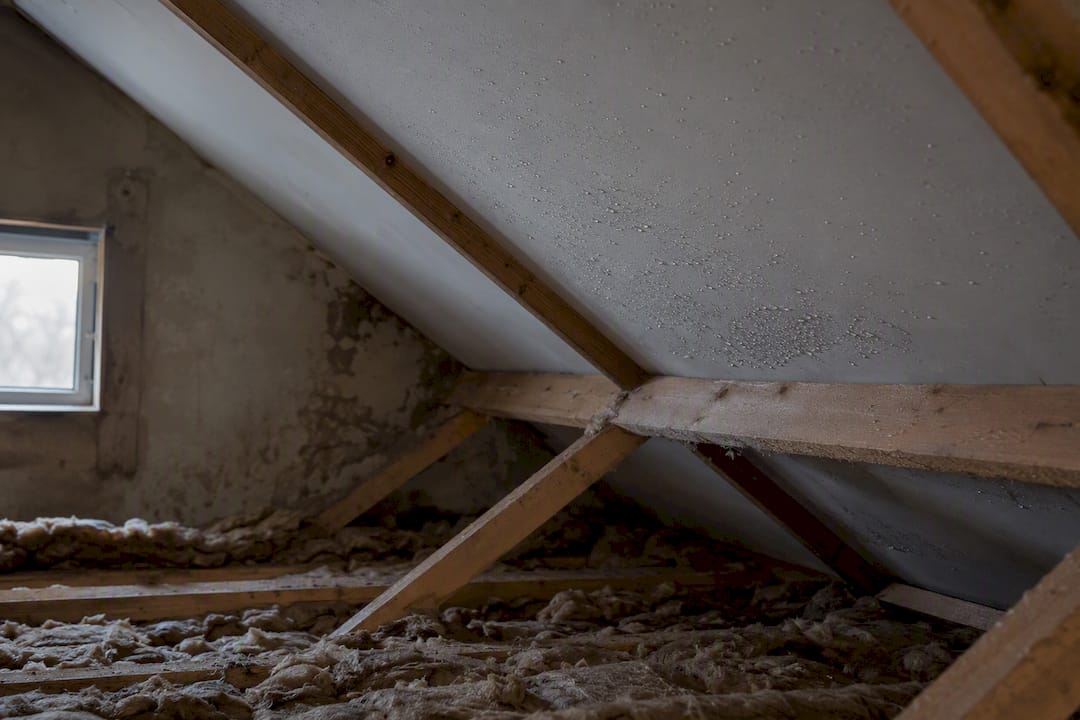
If you’re seeing stains, drips indoors, or mould with no obvious external leak, it’s usually condensation rather than a defect in the roof covering itself. Reduce indoor humidity, check that drains and outlets aren’t blocked, and ventilate the room in question for a few days. If the marks fade, you’ve likely solved it.
- Open a window or run extraction in bathrooms and kitchens for longer after use
- Check gutters, scuppers and drainage outlets for leaves or debris
- Look for standing water on the roof surface after rain has stopped
Pro Tip: Take a photo of any stain today and check it again in a week. Condensation marks often change shape or size with the weather; a leak mark usually just grows.
Book a survey if you notice structural staining, a sagging ceiling, damp timbers you can press your thumb into, or mould that keeps returning after cleaning. Those signs point to a problem inside the roof build-up itself, not just the air in the room below.
Key Takeaways
Flat roof condensation is best resolved by identifying the type of condensation, correcting roof build-up issues especially vapour control layer position, and confirming diagnosis with an expert survey and a written work guarantee.
| Point | Details |
|---|---|
| Verdict first | Stains or drips with no external leak usually point to condensation, not a leaking roof covering. |
| Two types differ | Surface condensation dries with ventilation; interstitial condensation forms inside the build-up and needs a survey. |
| Warm-deck reduces risk | Insulation above the deck with the VCL correctly positioned cuts interstitial condensation risk against Part L U-value targets. |
| VCL errors are common | Misplaced or breached vapour control layers are the leading cause of hidden condensation damage in cold-deck and hybrid roofs. |
| Quay Point Plastering approach | Every job starts with a survey and moisture readings, followed by a written scope of work and guarantee. |
Primary guidance and technical references
- BS 5250 condensation guidance: condensation risk analysis in roof design.
- BMI Group condensation risk analysis: modelling vapour movement through roof layers.
Table of Contents
- What causes condensation on a flat roof?
- What are the warning signs of roof condensation?
- Why does the roof build-up affect condensation risk?
- What does a professional condensation survey involve?
- How do you fix and prevent flat roof condensation?
What causes condensation on a flat roof?
Condensation is water vapour turning to liquid when it meets a surface colder than the dew point of the surrounding air. On a flat roof, that happens in two distinct ways, and knowing which one you’re dealing with changes the fix entirely.
Surface condensation forms on the underside of the ceiling or roof finish, usually overnight, when warm moist air inside the room touches a cold surface. It’s visible, it dries once ventilation improves, and it rarely signals a structural problem.
Interstitial condensation forms inside the roof build-up itself, between layers you can’t see, where warm internal air has migrated through the ceiling and hit the cold underside of the deck or insulation. This is the more damaging type because it can soak insulation, rot timber decking and go unnoticed for months.
Three things drive both types:
- Indoor moisture load from cooking, showering, drying laundry indoors, and even breathing (a household of four can add several litres of water vapour to the air daily through everyday activity).
- Heating cycles, particularly the autumn switch-on, when warm air rises against a roof deck that’s still cold from summer nights. Condensation risk spikes in cool weather as this seasonal mismatch takes hold.
- Poor vapour control, where the vapour control layer (VCL) is missing, damaged, or positioned incorrectly within the roof’s layers.
BS 5250, the British Standard covering condensation in buildings, now treats a documented condensation risk assessment as central to good design rather than an optional extra. That shift matters because it means a competent survey should be calculating risk, not guessing at it.
What are the warning signs of roof condensation?
Some symptoms are obvious the moment you walk into a room. Others hide inside the roof build-up until the damage is well advanced.
Visible signs to check first:
- Brown or yellow staining spreading across the ceiling, often in a rough circle
- Blistering or bubbling in the roof membrane, visible if you can access the roof
- Drips appearing indoors during cold, still weather rather than during rain
- Black or green mould around the ceiling edges, especially in corners with poor air movement
Hidden signs that need a closer look:
- A soft or slightly springy feel when you press the ceiling, suggesting swollen decking underneath
- A musty, earthy smell that persists even after cleaning visible mould
- Damp insulation, which loses most of its performance once wet and stays wet for a long time
Pro Tip: Note exactly which room the staining appears in and whether it’s near a bathroom, kitchen, or laundry area. Moisture-heavy rooms directly beneath a flat roof are consistently the first to show symptoms.
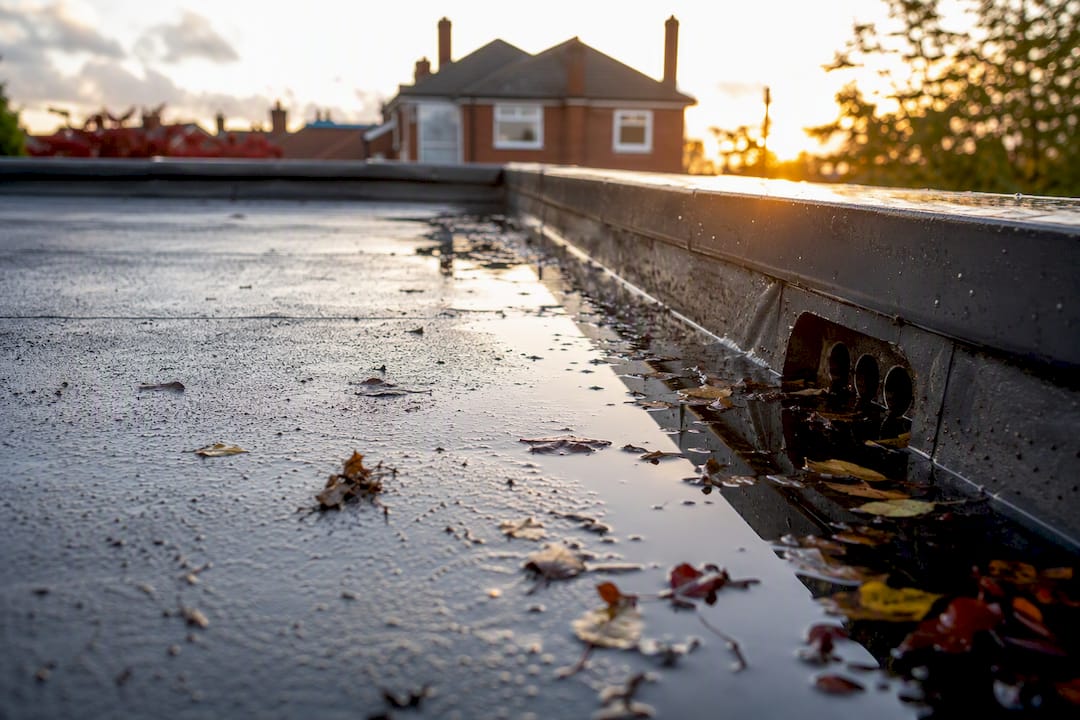
Check drainage outlets and scuppers for blockages, and go back out after a heavy rain to see whether water is pooling rather than running away. Ponding water adds weight, slows drying, and often masks a slow membrane failure that’s easy to miss until it isn’t.
Why does the roof build-up affect condensation risk?
Not all flat roofs are built the same way, and the construction method is the single biggest factor in how much condensation risk you’re carrying.
- Warm-deck construction places all insulation above the structural deck, with the VCL positioned immediately above the deck and below the insulation. This keeps the deck itself warm, well above dew point, which sharply cuts the chance of interstitial condensation forming inside the build-up. Building Regulations set a U-value target of 0.18 W/m²K for new dwelling roofs, and warm-deck build-ups are generally the easiest way to hit that figure without depending on ventilation to manage moisture.
- Cold-deck construction, still common in older properties, puts insulation below the deck with a ventilated void above it. It relies entirely on that ventilation working properly, and trade guidance on BS 6229 shows cold-deck roofs fail far more often in practice because vents get blocked, painted over, or were never sized correctly to begin with.
- Inverted and hybrid roofs sit insulation above a waterproof membrane, or mix elements of warm and cold approaches. These can perform well but only when detailed precisely, since any deviation from the specified layer order reopens the same risks warm-deck construction is designed to close.
The single most common detailing error across all of these is VCL placement: get it on the wrong side of the insulation, or leave laps unsealed, and you’ve built interstitial condensation into the roof from day one. Real-world failures on cold-deck and hybrid systems tend to come from small VCL breaches and gradually blocked ventilation rather than one dramatic defect, which is exactly why they go unnoticed for so long.
What does a professional condensation survey involve?
A proper survey looks well beyond the stain on your ceiling. It’s built to establish whether you’re dealing with surface condensation, interstitial condensation, or something else entirely, such as penetrating damp from a failed detail.
- Visual inspection of the affected area, the roof void where accessible, and the external roof covering
- Moisture meter readings taken across the ceiling, timbers and, where possible, the insulation itself
- Checks on VCL condition and position, along with insulation thickness and drainage performance
- A review of ponding, scuppers and outlets to rule out water ingress as a contributing factor
Where the picture isn’t clear from a visual and moisture-meter survey alone, a computerised condensation risk calculation following the Glaser method in BS 5250 models how vapour moves through each layer of the roof under UK seasonal conditions. BMI Group’s guidance on condensation risk analysis is a useful reference point for how this modelling is applied in practice.
A written survey report should set out exactly what was found, room by room and layer by layer, with a defined scope of work attached. Anything less leaves you guessing at what you’re actually paying to fix.
That written report, backed by a guarantee on the work carried out, is what separates a diagnosis you can trust from a quote based on a quick look from the ground.
How do you fix and prevent flat roof condensation?
Some fixes are within reach today. Others need a specialist because they involve reworking the roof build-up itself.
- Reduce the moisture load by improving extraction in bathrooms and kitchens, drying laundry outside or in a ventilated space, and running a dehumidifier in badly affected rooms during winter. A partner guide on humidity control covers how mechanical dehumidification fits alongside ventilation for persistent problems.
- Clear the drainage by removing leaves and debris from gutters, scuppers and outlets, and checking again after the next heavy rain to confirm ponding has gone.
- Repair VCL laps and seals where a survey has identified a specific breach, which can resolve interstitial condensation without a full roof strip.
- Add insulation above the deck where the roof geometry allows, moving a cold-deck build-up closer to warm-deck performance without full reconstruction.
- Replace saturated insulation and decking, and re-detail upstands and parapets, when moisture has already done structural damage. This is usually paired with a full warm-deck conversion so the same failure doesn’t recur.
Pro Tip: Don’t paint over a mould patch and call it fixed. Painting seals in moisture and hides the early warning sign you need to act on the underlying cause.
Most flat roofs that reach the “replace the decking” stage started as a small, ignored VCL breach years earlier.
A note from Quay Point Plastering
Over 35 years of survey-led diagnosis across Dorset, Hampshire and Wiltshire has taught us that condensation is rarely random. It follows the build-up, the ventilation, and the habits inside the property. A written survey with a defined scope and a guarantee on the work means you’re fixing the actual cause, not just repainting a symptom.
— Quay
How Quay Point Plastering diagnoses and fixes roof condensation
Quay Point Plastering is the alternative to a guess-and-patch quote for condensation in Dorset, Hampshire and Wiltshire: every job starts with a survey, not a sales pitch, so you know exactly what’s wrong before anyone touches your roof.

Our damp and timber survey covers visual inspection, moisture meter readings, VCL and insulation checks, and a review of drainage and ponding, all documented in a written report with a clearly defined scope of work. Where condensation has already taken hold, our condensation treatment service addresses the cause identified in the survey, whether that’s a VCL repair, added insulation, or a full warm-deck conversion, and every job carries a written guarantee. If mould has appeared alongside the staining, our condensation and black mould page explains how the two are treated together.
Book a survey and get a written diagnosis before you commit to any repair work.