
Damp proofing cost UK 2026: what to budget
Damp proofing cost UK 2026: what to budget
Most UK homeowners should budget between £500 and £5,000 for damp proofing, depending on the type of damp, the area affected, and how much replastering is required. At the lower end, condensation treatment and ventilation improvements usually cost £200–£800. A mid-range rising damp repair with DPC injection and replastering typically runs £1,500–£4,000. At the top end, full physical DPC replacement can exceed £7,000, while basement tanking can range from £4,000 to £14,000. The main cost drivers are the type of damp, the number of walls affected, whether replastering is needed, and your location.
Before you request a single quote, commission an independent damp and timber survey. Independent surveys typically cost a moderate amount, often a few hundred pounds. and are the most cost-effective step you can take, because they identify the actual problem and reduce the risk of being sold unnecessary work.
Immediate triage steps:
- Move furniture and soft furnishings away from affected walls and photograph any tide marks, staining, or mould growth.
- Note which rooms are affected, whether symptoms appear after rain or year-round, and whether skirting boards or timber feel soft.
- Do not redecorate or apply surface treatments until the cause has been diagnosed.
Table of Contents
- What does damp proofing cost? A quick reference
- How does damp type affect the cost of treatment?
- What factors push your damp proofing quote up or down?
- What does a typical damp repair job cost, line by line?
- DIY vs professional damp proofing: is it worth attempting yourself?
- How to get accurate, comparable quotes
- How long does damp proofing take, and what disruption should you expect?
- How to avoid misdiagnosis and overcharging
- Why a survey-led specialist gives you a more reliable result
- Key takeaways
- The single mistake that costs homeowners most
- Book a survey with Quaypointplastering
- Useful sources and further reading
What does damp proofing cost? A quick reference
The table below gives ballpark figures for the most common treatments. Read the notes beneath it before using any figure in a budget.
| Treatment type | Typical price range | What it usually covers | Disruption level |
|---|---|---|---|
| Independent damp survey | £150–£500 | Visual inspection, moisture readings, written report | Low — half to full day |
| Condensation treatment / ventilation | £200–£800 | PIV unit or extractor fans, basic mould wash | Low |
| Rising damp: DPC injection only | £500–£2,500 | Chemical injection per linear metre, no plaster | Medium |
| Rising damp: injection + replaster | £1,500–£4,000 | Injection, hack-off, salt-resistant render and skim | High |
| Penetrating damp repair | £300–£2,500 | External masonry repair, repointing, or render; internal dry-lining | Medium–high |
| Physical DPC replacement + plastering | £1,100–£7,000+ | Full mortar-course DPC, replastering, making-good | High |
| Cellar / basement tanking | £4,000–£14,000 | Cementitious slurry or cavity drain membrane, sump and pump | Very high |
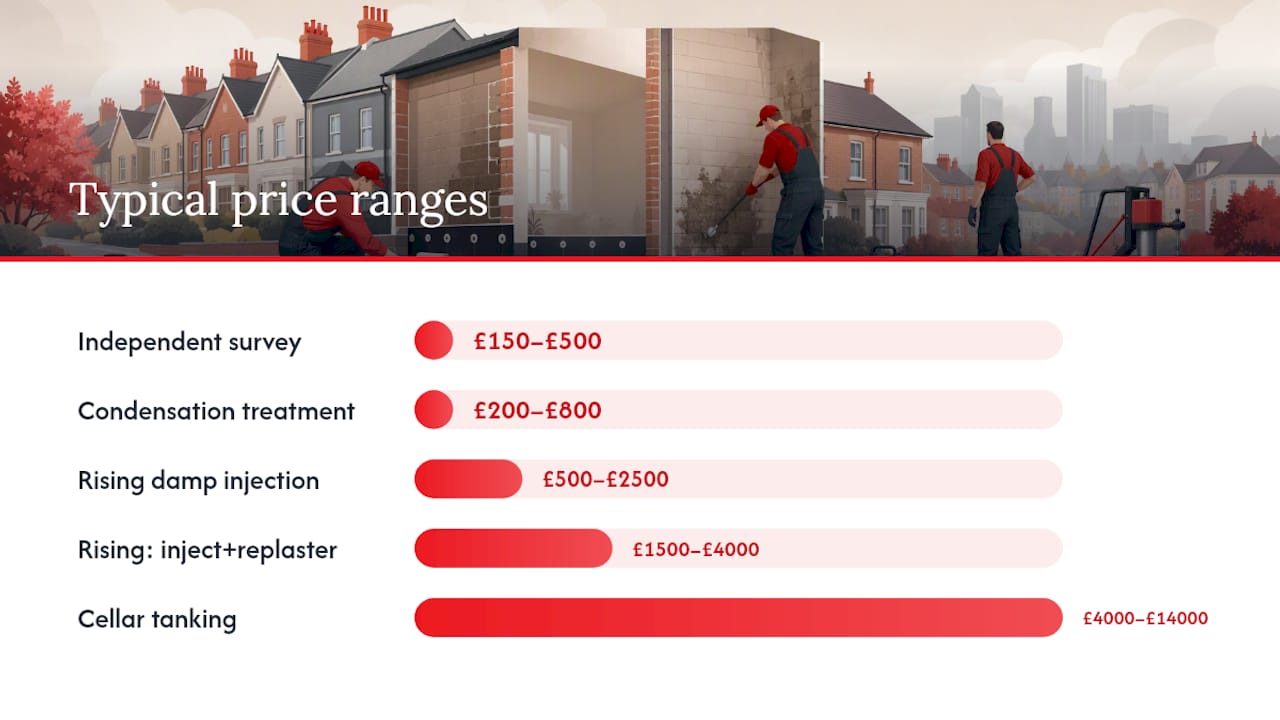
Most homeowners pay between £500 and £2,500 for a single problem area; whole-house chemical DPC plus replastering typically sits around £1,500–£4,000.
When does a job escalate into the higher price band?
- The survey reveals salt contamination requiring full plaster removal rather than a localised patch.
- Timber decay is found in joists, skirting, or window frames, adding a separate timber treatment scope.
- The property has solid stone walls, which require longer drying times and more plaster preparation.
- Access requires scaffolding or excavation around external ground levels.
- The property is listed, requiring specialist materials and consent.
Pro Tip: Per-metre injection prices are useful for quick comparisons, but the full cost picture requires including drying time, plaster removal, and reinstatement. Many quotes exclude these costs, so always ask for an all-in figure.
How does damp type affect the cost of treatment?
The type of damp determines the remediation method, and the method determines the cost. Getting the diagnosis right before work starts is the single most important step.
Rising damp
Rising damp occurs when groundwater travels up through masonry via capillary action, usually because the original damp proof course has failed or was never installed. Symptoms include tide marks up to about one metre from floor level, salt deposits (efflorescence), and soft or blown plaster.
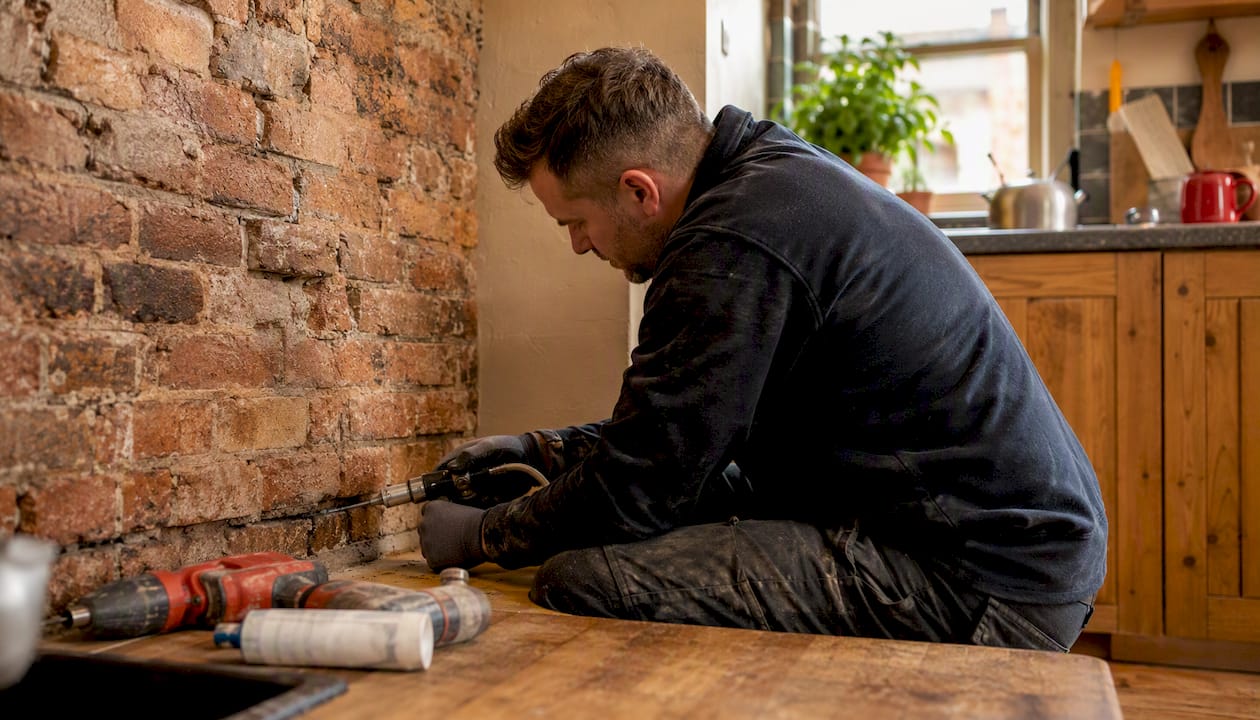
The standard remedy is chemical DPC injection, where a silicone-based fluid is injected into a drilled course of mortar to create a water-repellent barrier. Chemical DPC injection is typically priced at around £70–£120 per linear metre, but this injection-only figure frequently excludes replastering, which is where most of the real cost sits.
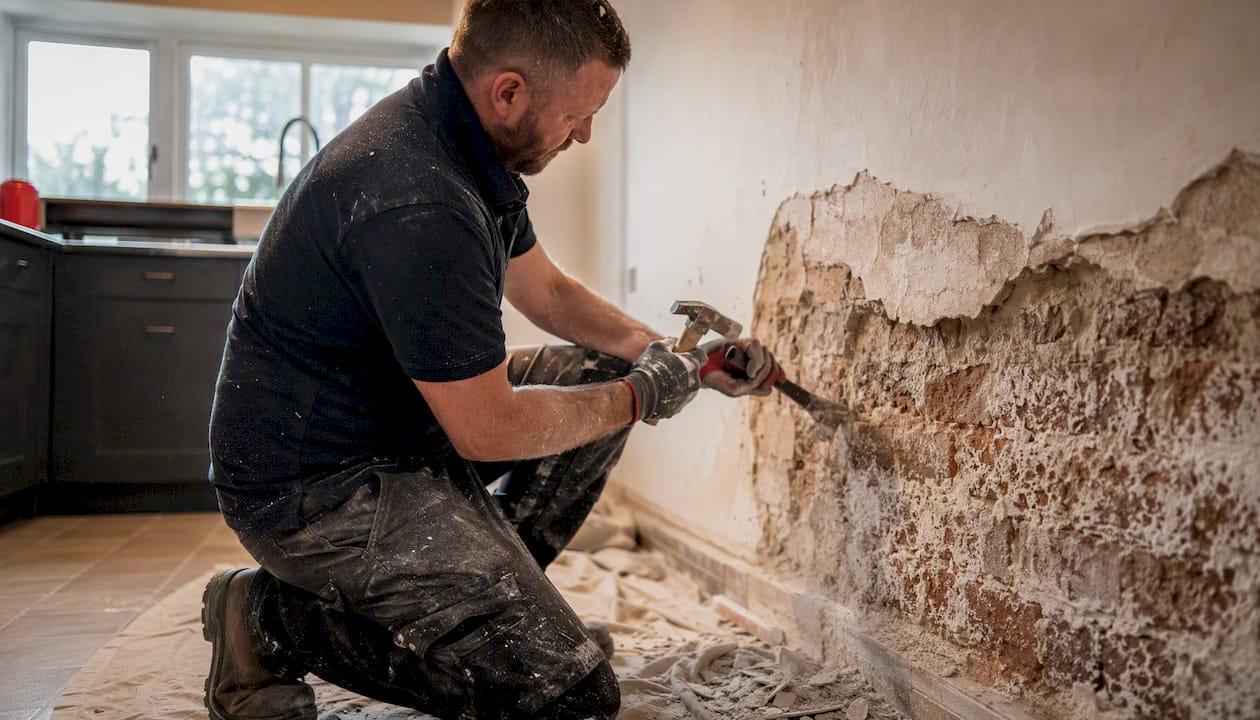
Plaster removal and replastering after a rising damp treatment typically costs £350–£700 per wall; full-room replastering often starts from £1,200. Salt-contaminated plaster must be removed entirely, not patched over.
| Scenario | Approximate cost |
|---|---|
| Single 5m wall: injection only | £350–£600 |
| Single 5m wall: injection + replaster | £900–£1,600 |
| Ground-floor living room perimeter (12m): injection + replaster | £1,500–£4,000 |
| Typical 3-bed semi, full ground floor: injection + replaster | £1,500–£4,000 |
| Physical DPC replacement (mortar-course method) | £1,100–£7,000+ |
A physical DPC replacement, where a new damp proof membrane is inserted into a cut mortar course, is recommended when chemical injection has already failed, when the wall construction makes injection impractical, or when a structural engineer specifies it. Small injection jobs commonly start around £1,100 while full physical DPC replacement with plastering can exceed £7,000.
Penetrating damp
Penetrating damp enters horizontally through walls, roofs, or around openings, typically after rain. Common causes include failed pointing, cracked render, defective guttering, or poorly sealed window frames. You can read more about identifying the signs on the damp after rain page.
Costs depend on the external repair needed. Repointing a single elevation typically costs £300–£800; render repair or replacement adds more. Internal remediation (dry-lining or specialist plaster) adds a further £500–£2,000 depending on area. External trades such as roofers or joiners will be required if the source is a failed roof detail or defective window, and their costs sit outside the damp proofer’s quote.
Condensation and mould
Condensation is the most common form of damp in UK homes and is frequently misdiagnosed as rising damp. It produces black mould on cold surfaces, particularly in poorly ventilated rooms. Treatment focuses on ventilation improvement and, where mould is established, specialist black mould removal.
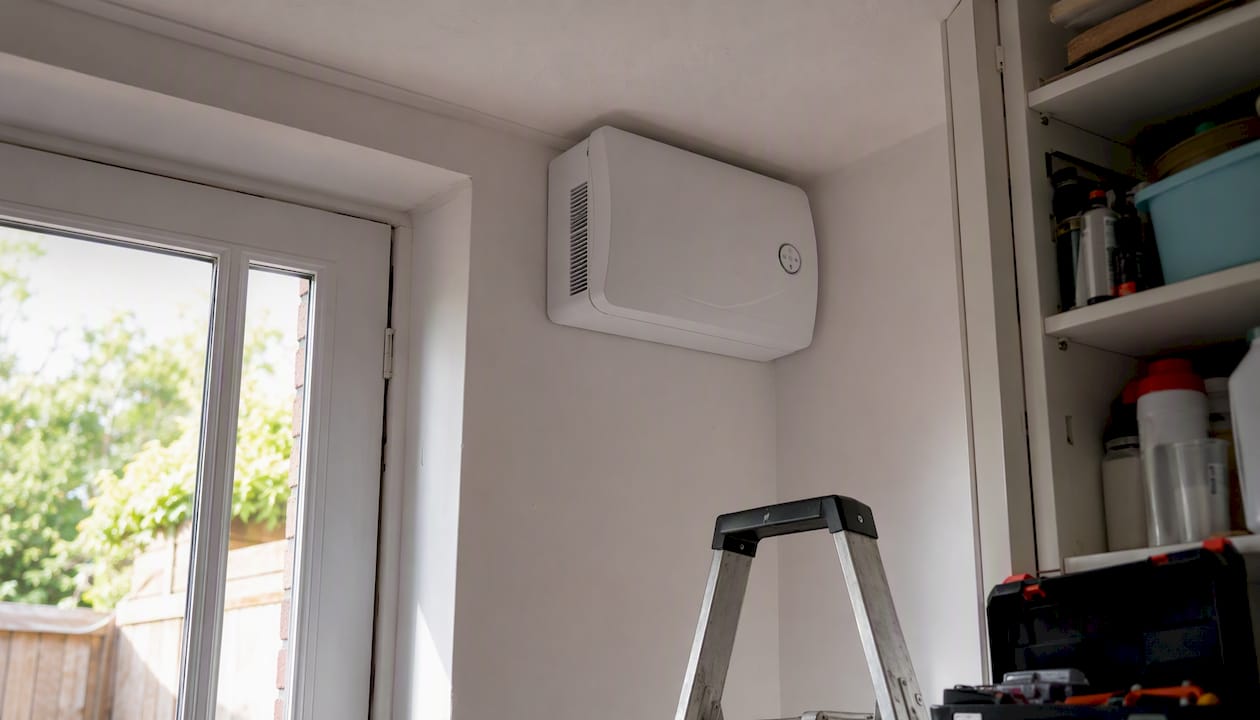
A positive input ventilation (PIV) unit costs £200–£500 installed. Extractor fans in kitchens and bathrooms typically cost £80–£200 each. Mould wash and surface treatment adds £100–£400 depending on the area affected. Total condensation treatment costs usually fall in the £200–£800 range, making it the most affordable damp type to address when correctly diagnosed.
Cellar and basement tanking
Basement waterproofing is the most complex and costly category. Two main systems are used: cementitious tanking slurry (roughly £40–£100 per m²) and cavity drain membrane with sump and pump (roughly £80–£150 per m²). Full basement projects commonly range from £4,000 to £14,000, with the final figure depending on floor area, wall height, drainage requirements, and whether structural repairs are needed alongside waterproofing.
Additional trades that shift cost bands:
- Roofers for failed flashings, valley repairs, or parapet details driving penetrating damp.
- Joiners for replacement skirting, window boards, or structural timber affected by rot.
- Drainage contractors for excavation around external ground levels or installation of French drains.
- Structural engineers for listed buildings or where physical DPC work requires structural input.
What factors push your damp proofing quote up or down?
Understanding what drives price variation helps you judge whether an estimate is realistic and spot line items that may be missing.
- Timber decay. If damp has reached structural timber, a combined damp and timber survey is needed. Timber treatment or replacement sits on top of the damp proofing cost.
- Replastering and making-good. This is where most homeowners are caught out. Injection-only prices exclude the plaster removal, salt-resistant render, and skim coat that follow. Replastering often adds several hundred pounds per wall, and a realistic budget must include these costs rather than treating injection as the full price.
Pro Tip: An independent survey carried out before you invite contractors to quote reduces the risk of being sold unnecessary DPC work. A surveyor with no financial interest in the remediation will tell you what the problem actually is, not what generates the most work.
What does a typical damp repair job cost, line by line?
The table below shows a sample line-item breakdown for two common scenarios. Use it to check that any quote you receive covers all the same items.
| Line item | Small terrace front room (5m wall) | Average semi ground floor (12m perimeter) |
|---|---|---|
| Independent damp survey | £150–£300 | £200–£400 |
| DPC injection (chemical) | £350–£600 | £350–£700 |
| Plaster removal (hack off) | £150–£400 | £350–£600 |
| Salt-resistant render and skim | £350–£600 | £900–£1,600 |
| Skirting board replacement | £80–£150 | £200–£400 |
| Waste removal | £100–£200 | £200–£350 |
| Decoration (optional, separate) | £150–£400 | £400–£900 |
| Estimated total (ex. decoration) | £1,200–£2,000 | £2,500–£4,000 |
A few points worth noting. VAT at 20% applies to most damp proofing work carried out by VAT-registered contractors; always confirm whether a quote is inclusive or exclusive of VAT. Some contractors include materials and basic plastering in their DPC price, but this is not standard practice. Ask explicitly whether the quote covers plaster removal, salt-resistant render, and a finish skim coat, or whether those are priced separately.
Common hidden costs to watch for:
- Decoration is almost never included in a damp proofing quote; budget separately.
- Replacement skirting boards and window boards are often quoted as extras.
- Structural timber treatment, if required, is a separate scope.
- Scaffolding is rarely included in a standard injection quote.
DIY vs professional damp proofing: is it worth attempting yourself?
DIY damp proofing kits are available from builders’ merchants and online suppliers. A chemical DPC injection kit for a 5m wall typically costs £50–£150 in materials. That compares with a professional rate of £350–£600 for injection only on the same wall, rising to £900–£1,600 when replastering is included.
The material cost saving is real, but the risks are significant.
Common DIY pitfalls that lead to repeat work:
- Misdiagnosis: treating what appears to be rising damp when the actual cause is condensation or penetrating damp. The injection does nothing, the damp returns, and you have spent money on the wrong fix.
- Incorrect drill pattern: holes drilled at the wrong angle, spacing, or depth allow fluid to miss the mortar course entirely.
- Inadequate salt removal: applying new plaster over salt-contaminated substrate causes the new plaster to fail within months.
- Insufficient drying time: replastering before the wall has dried adequately traps moisture and causes the new plaster to blow.
- No written guarantee: DIY work carries no warranty, which matters if you are selling the property or making an insurance claim.
For condensation and minor surface mould, a well-informed homeowner can make meaningful improvements with improved ventilation and mould-resistant paint. For anything involving rising damp, penetrating damp through masonry, or basement water ingress, professional diagnosis and treatment is the reliable route to a permanent result.
How to get accurate, comparable quotes
Getting three quotes for the same scope is the minimum. Getting an independent survey first is what makes those quotes genuinely comparable.
Steps to take before and during quoting:
- Commission an independent damp and timber survey from a surveyor with no financial interest in the remediation. This gives you a written diagnosis and a defined scope of work.
- Photograph all affected areas, measure wall runs, and note any associated timber (skirting, joists, window boards) that appears soft or discoloured.
- Share the survey report with all three contractors and ask each to quote against the same scope.
- Request itemised quotes that separate injection, plaster removal, replastering, joinery, waste, and any external works.
- Ask each contractor for evidence of PCA membership or CSRT/CSSW surveyor credentials, and request a sample written guarantee before work starts.
Questions to ask each supplier:
- Does your quote include plaster removal, salt-resistant render, and a finish skim coat?
- What drying time do you allow before replastering, and how is that managed?
- What guarantee do you offer, how long does it run, and what does it cover?
- Are you VAT-registered, and is this quote inclusive or exclusive of VAT?
- Who carries out the work: your own operatives or subcontractors?
- What happens if additional damp or timber decay is found once the plaster is off?
Red flags to watch for:
- Pressure to sign on the day, often accompanied by a claim that the problem is urgent.
- A vague scope with no mention of plaster removal or salt treatment.
- No written guarantee offered, or a guarantee that covers materials only.
- A quote that is significantly lower than the others but does not explain what it excludes.
- No mention of drying time or a proposal to replaster immediately after injection.
Quote comparison template:
How long does damp proofing take, and what disruption should you expect?
Timescales vary considerably by treatment type. The table below gives realistic durations for common jobs.
| Treatment | Typical duration | Key disruption points |
|---|---|---|
| Independent survey | Half to full day | Minimal — surveyor accesses all rooms |
| Single-wall DPC injection (no replaster) | 1 day | Drilling, dust, furniture moved |
| Single-wall injection + replaster | 3–5 days | Drilling, hack-off, drying, replastering |
| Whole-house ground floor injection + replaster | 1–3 weeks | Room-by-room, furniture out, drying periods |
| Physical DPC replacement | 3–7 days per elevation | Possible scaffolding, structural disruption |
| Cellar / basement tanking | 1–3 weeks | Full basement clearance, drainage installation |
Drying times are the most commonly underestimated part of the process. After DPC injection, walls typically need 4–6 weeks to dry before salt-resistant render is applied, and a further 4–6 weeks before a finish skim coat. Redecoration should not begin until the plaster has fully cured, which can be 6–12 weeks after the initial treatment depending on wall thickness and ventilation.
- Scaffolding, where required, adds 1–2 days for erection and striking, and may restrict access to windows or doors during that period.
- Basement tanking requires the space to be fully cleared; sump and pump installation may require temporary power arrangements.
- Timber treatment, if combined with damp work, adds drying and ventilation requirements that extend the overall programme.
Pro Tip: If you are planning other decorating or renovation work, sequence it after the damp treatment and drying period. Combining replastering with a wider redecoration project reduces the number of trades on site and can lower the overall cost.
How to avoid misdiagnosis and overcharging
Condensation is the most common form of damp in UK homes, but it is frequently misdiagnosed as rising damp. The two conditions look similar on a wall, but they require completely different treatments. Treating condensation with a chemical DPC injection achieves nothing and costs the homeowner money for no benefit.
Common overcharging and upsell tactics to watch for:
- A free survey that immediately recommends a full DPC injection without moisture readings or salt analysis.
- Quoting rising damp treatment on a property where the symptoms are clearly condensation-related (mould on cold external walls, no tide marks, no salt deposits).
- Adding unnecessary timber treatment to a scope where no timber decay has been confirmed.
- Recommending full basement tanking when the water ingress is caused by a simple drainage fault outside.
Action steps before you commit:
- Ask the surveyor to show you the moisture readings and explain what they indicate.
- Where rising damp is claimed, ask for a salt report confirming the presence of hygroscopic salts (nitrates and chlorides) in the plaster.
- Verify credentials: look for PCA membership or a CSRT (Certificated Surveyor in Remedial Treatment) or CSSW (Certificated Surveyor in Structural Waterproofing) qualification.
- Read the specialist survey vs RICS survey guidance to understand which type of survey is appropriate for your situation.
Documents to request before work starts:
- A written scope of work describing every line item.
- A sample guarantee document showing what is covered, for how long, and under what conditions.
- An itemised invoice or quote that separates materials, labour, and any subcontracted work.
- Confirmation of the contractor’s public liability insurance.
Why a survey-led specialist gives you a more reliable result
The damp proofing industry has a well-documented problem with overselling. Free surveys carried out by contractors who profit from the remediation they recommend create an obvious conflict of interest. The solution is to separate diagnosis from treatment.
Quaypointplastering operates on a survey-first model across Dorset, Hampshire, and Wiltshire. Every job begins with a paid, independent inspection that produces documented findings and a defined scope of work. Treatment is only recommended when the survey confirms it is necessary, and every remediation job is backed by a written guarantee on workmanship.
Trust signals to look for in any damp proofing specialist:
- An independent survey report with moisture readings, photographs, and written findings.
- PCA membership or a surveyor holding CSRT or CSSW accreditation.
- A written guarantee that covers workmanship (not just materials) for a defined period.
- A clear reinstatement scope that specifies whether replastering, joinery, and making-good are included.
- Positive reviews that reference the survey process and the quality of the finished result, not just the sales experience.
You can read more about what a guarantee should include on the damp proofing guarantee explained page. Typical guarantee lengths for chemical DPC injection range from 10 to 30 years; basement waterproofing guarantees are commonly 10–25 years depending on the system.
Key takeaways
Correct diagnosis before treatment is the single most important factor in getting damp proofing right and avoiding unnecessary cost.
| Point | Details |
|---|---|
| Budget range | Most single-area jobs cost £500–£2,500; whole-house DPC injection with replastering typically runs £1,500–£4,000. |
| Include replastering | Injection-only prices exclude plaster removal and replastering, which often add £350–£700 per wall. |
| Survey first | An independent damp survey (£150–£500) identifies the actual problem and reduces the risk of paying for the wrong treatment. |
| Add a contingency | Budget 15–20% above any estimate to cover additional findings once plaster is removed. |
| Quaypointplastering | Offers survey-led damp, mould, and timber inspections across Dorset, Hampshire, and Wiltshire, with documented findings and written guarantees. |
The single mistake that costs homeowners most
The most expensive mistake in damp proofing is not choosing the wrong contractor. It is agreeing to treatment before the diagnosis has been properly established.
Homeowners see a damp wall, get a free survey from a contractor who sells DPC injection, and receive a quote for injection and replastering. The work is done. The damp returns six months later because the actual cause was condensation, or a leaking gutter, or a bridged cavity. The injection was irrelevant to the problem.
The behaviour change is straightforward: pay for an independent survey before you invite anyone to quote for remediation. The survey cost is modest relative to the treatment cost, and it gives you a diagnosis that no contractor can argue with. When you then invite three contractors to quote, you are comparing prices for the same defined scope, not three different interpretations of what your wall needs.
Book a survey with Quaypointplastering
Quaypointplastering gives you a clear diagnosis before any treatment is recommended. A paid damp and timber survey produces documented findings, moisture readings, and a defined scope of work, so you know exactly what needs doing and why before you commit to any expenditure.

The service covers Dorset, Hampshire, and Wiltshire. Every survey is carried out by an experienced specialist, and all remedial work is backed by a written guarantee on workmanship. Whether you are dealing with rising damp, penetrating damp, condensation, mould, or timber decay, the starting point is always the same: a thorough inspection that tells you the truth about your property.
To book a survey or discuss your situation, visit the damp and timber survey page or call 01202 287134.
Useful sources and further reading
- Damp Proof Course Replacement Cost 2026 UK Guide | BookaBuilderUK.com
- Damp Proofing Cost UK 2026: Surveys, Rising Damp, Plaster | BookaBuilderUK.com
- Damp Proofing Cost UK 2026: Rising Damp, DPC, Tanking & Survey Prices
- How Much Does Damp Proofing Cost in the UK?
- How much does damp proofing cost?