
Cob Wall Damp: Causes, Diagnosis and Repair
Cob Wall Damp: Causes, Diagnosis and Repair
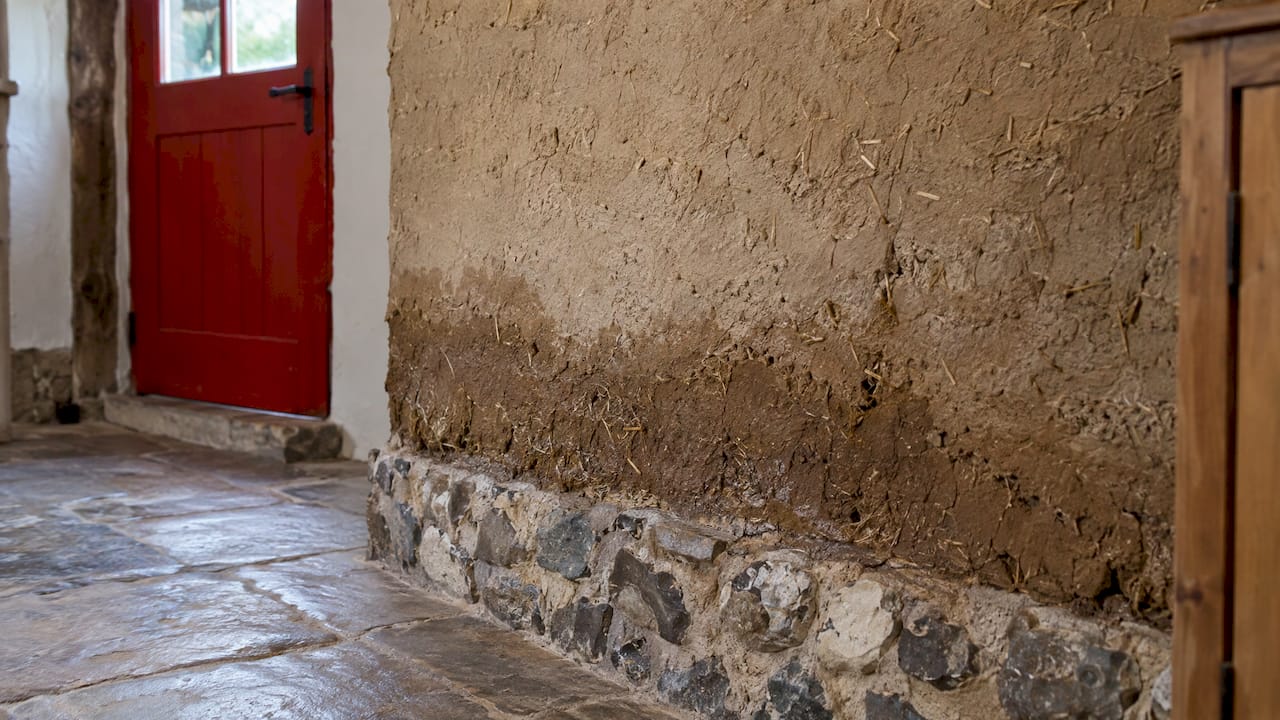
Damp in a cob wall is not treated like damp in a brick house. Cob is earth, often mixed with straw, and it loses strength when it stays wet. The right order is to find where the water is coming from, then repair with materials that let the wall dry. Many standard damp treatments do the opposite. A survey-led diagnosis before any work is proposed is the safest route, and that is how we approach every property across Dorset, Hampshire and Wiltshire, with a specialist damp survey giving you written findings and a defined scope of work.
TL;DR
- Cob walls need to dry out through their surface. Cement render, plastic-based paint and floor membranes trap water and can weaken the wall.
- Find the source first: rain getting in at the top, ground levels built up at the base, a leaking pipe or condensation. Each leaves a different pattern.
- Repair like-for-like, with lime or earth-based finishes, and fix the cause before you repair the damage.
- Soft, crumbling or slumping cob, or damp that keeps coming back, needs a specialist assessment.
- Ask for diagnosis to be separate from the quote for work, and for findings in writing.
Table of Contents
- Why cob behaves differently when it gets wet
- Signs of damp in a cob wall
- What causes damp in cob walls
- How damp in cob is properly diagnosed
- Treatments that harm cob
- Repairing damp-damaged cob
- When to call a specialist
- Preventing damp coming back
- Perspective
- Getting a survey for a cob wall
- FAQ
- Sources
Why cob behaves differently when it gets wet
Cob is a traditional mix of subsoil, sand or chalk, and usually straw, built up in thick layers. It is common in Dorset and the New Forest area of Hampshire. Cob buildings are nearly always built on a masonry plinth of flint, stone or brick, typically 300 mm to 600 mm high. If moisture rises above that plinth for a long period, or is trapped behind an impermeable surface, the cob begins to disintegrate through slippage, collapse or rodent infestation.
The strength loss can be steep. One traditional-building guide says that once moisture content passes roughly 10 to 12%, the strength of cob drops dramatically. That is why a damp patch on cob is more than a cosmetic problem.
Straw matters too. Where there is no straw reinforcement, Historic England says a cob building is at risk of collapse if saturated for more than 24 hours. This is mainly a flood concern, but it shows how much the wall relies on staying in a workable moisture range.
Signs of damp in a cob wall
Look for:
- Damp patches, staining or green algal growth on the wall face, especially low down or under window sills and eaves.
- Soft or crumbling cob behind peeling paint or render.
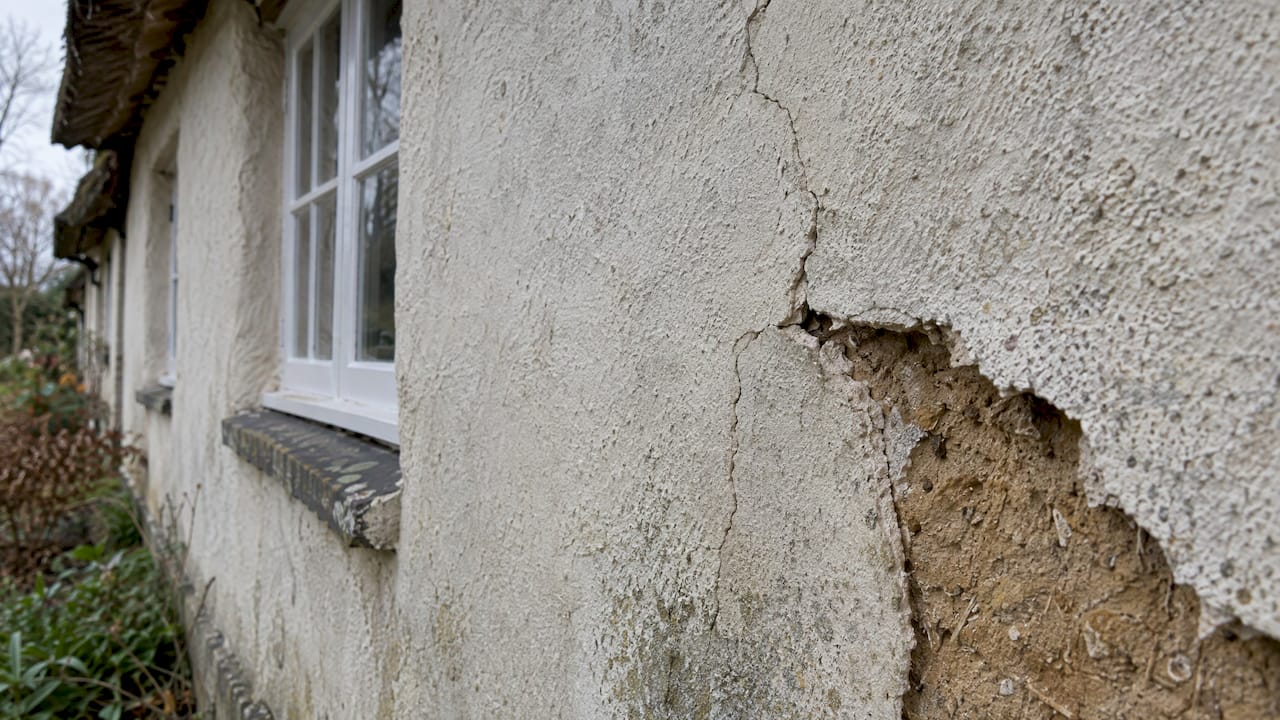
- Bulging, hollow-sounding or cracked render, often cement render.
- Slumping or leaning sections of wall, which can happen suddenly.
- Salt deposits or powdery surfaces where moisture is evaporating.
- Musty smells or mould inside, which can point to condensation as well as penetration.
Histic England advises that damp patches, staining and algal growth on earthen walls should be probed with a sharp tool or penetrometer. If it goes in easily, the material is very weak and at risk of collapse. Do not push a tool into a wall you suspect is structurally weak. If the cob feels soft, stop and get it assessed.
What causes damp in cob walls
The SPAB groups damp sources into liquid moisture and moisture from the air. Liquid moisture covers rain through roofs, chimneys, openings or blocked gutters, below-ground moisture, and leaks from pipes, tanks, radiators and appliances. Moisture from the air means condensation, high humidity and salts that attract water.
For cob, Dorset Council’s guidance lists the main causes of wall failure:
- inadequate weather protection at the top of the wall
- ground levels built up over the years, stopping the plinth drying
- cement renders and modern impervious paints
- vegetation against the wall
- hard paving that causes splashback at the base
Cement render: the most common culprit
Cement is dense and heavy for a soft earth wall. The same guidance says it frequently detaches, and its hair-line cracks let rainwater in between render and cob. The water sinks to the bottom and changes the cob’s consistency, which can cause sudden, dramatic slumps. The wall looks sound from outside until it is not.
Roof and gutter water
A cob wall depends on its roof. The New Forest National Park says a cob wall needs a roof overhang of 400 mm to 700 mm to throw rainwater clear. Failed gutters, slipped slates and poor wall capping all send water straight into the earth. If walls go damp after rain, our guide to why walls get damp after rain explains the pattern.
Plumbing leaks
A slow leak from a pipe or radiator can mimic rising damp. Readings tend to be localised rather than spread along the wall. See whether a plumbing leak can look like damp.
Condensation
Condensation can also occur inside a wall’s thickness, known as interstitial condensation, at thermal bridges or gaps in insulation. Historic England notes that porous materials absorb the condensate, so their moisture content rises without any visible sign.
How damp in cob is properly diagnosed
Diagnosis comes before treatment. The SPAB’s approach is staged. Start with sight, feel and smell, considering the building’s age, exposure, the weather and the location, shape and colour of the patch. Then use electrical moisture meters, whose reading patterns point to the source: a sharp tail-off suggests rain or below-ground moisture, localised readings suggest a plumbing leak, and a gentle tail-off suggests condensation. Detailed investigation then adds salt tests, hygrometers, infrared cameras and listening sticks for leaks.

Why meter readings on cob need care
Surface meters can mislead. Condensation and absorbent salts can give high readings in essentially dry walls, so moisture is best measured at the centre of the wall with a core reading. A single number from a meter is a prompt for further investigation, not a verdict.
The foil test for condensation
Historic England describes a simple check: tape metal foil to the suspect area. Droplets on top of the foil point to condensation. Dampness underneath means moisture is coming through the wall.
Render removal: slowly
If you want to see what lies behind defective render, Dorset Council advises a “softly-softly” approach: remove small amounts progressively from high to low level, since dampness in the cob tends to increase towards the bottom. Serious dampness should prompt immediate professional help.
Keep diagnosis separate from the quote
The SPAB says diagnosis is often skipped or wrong, leading to unnecessary and expensive work, including treatment for rising damp that does not exist. It strongly advises taking diagnostic advice separately from quotations for remedial work. That fits how we work: findings are documented first, then a scope is defined.
Treatments that harm cob
Some common fixes make cob damp worse:
- Damp-proof membranes in the floor. The SPAB warns that these in a cob or other earth-walled building can increase wall dampness so much that the walls collapse.
- Dense plasters, PVA and impervious paint. These trap moisture and can cause spalling or powdering.
- Brick or concrete block repairs. Differing densities cause differing absorption and drying rates, moisture imbalance and cracking, according to the New Forest National Park.
The principle is that old absorbent walls rely on evaporation. Remedial action should ideally replace impervious materials with permeable ones, and where removal would cause more damage, the wall must be kept as dry and well ventilated as possible.
Repairing damp-damaged cob
Fix the cause first. The New Forest National Park stresses that it is not enough to repair visible damage; the underlying cause must be identified and rectified before repair. Then:
- Stop the water. Repair gutters, roof edges and wall capping, mend leaks, cut back vegetation and lower built-up ground against the wall.
- Deal with the base. Replace hard paving at the wall base with gravel and a shallow French drain at a safe distance from the structure, as Dorset Council suggests.
- Remove impervious finishes carefully. Where cement render still adheres well, removal needs careful thought because it may cause further damage. When it comes off, the SPAB says it can sometimes be fractured into small units with a hammer, as levering off large sheets damages soft material beneath.
- Allow drying time. Saturated solid walls may take many months or even years to dry, and salts left by drying can cause breakdown. Poulticing or a protective finish may be needed to draw salts out.
- Repair like-for-like. Use soil matching the original with straw, and finish with lime- or earth-based render, limewash or lime plaster, rather than cement, gypsum or emulsion. Pre-made cob blocks are a practical repair because they do not shrink.
- Protect the surface. A bare wall can take a sacrificial limewash coat, re-applied every few years.
Lime plaster cures slowly: roughly one month per millimetre of thickness, so a 20 mm coat can take over 20 months to fully carbonate. Plan finishes and decoration around that.
When to call a specialist
Book an assessment if you see any of the following:
- cob that is soft, crumbling or slumping
- damp that returns after you have repaired or redecorated
- cement render coming away from a damp wall
- timber in contact with the wall showing decay, such as skirting, lintels or joist ends
- mould and musty smells that do not clear with ventilation
- a pending purchase of a cob property
Damp in cob often travels with timber problems, so a combined damp and timber survey is worth considering where beams, floors or roof timbers meet the walls. Buying a cob home? A pre-purchase damp survey records the condition before you commit. Landlords and managers can use a landlord damp and mould inspection.
Preventing damp coming back
- Keep gutters, downpipes and roof edges clear and working.
- Keep ground level below the top of the plinth, and avoid soil or paving banked against the wall.
- Where no plinth shows above ground, the New Forest guidance suggests a shallow channel with land drains, pea shingle and loose-weave fabric around the base.
- Use breathable finishes only.
- Keep heating and ventilation steady to limit condensation.
- Check walls each year after winter, and repair small defects early.
Perspective
Most cob walls we are asked about have been treated for the wrong problem. A chemical course, a cement patch or a tanking layer goes on, the wall stays wet, and the damp reappears somewhere else.
Our view is that a cob wall deserves a diagnosis based on what is visible and measurable: where the patches sit, what the readings do across the wall, what the roof, gutters, ground and pipework are doing. We record that in writing, with original photographs, and define the scope of work from it. Treatment follows the findings, not the other way round.
Where a problem sits outside our remit, such as structural input, we say so and refer on rather than stretching beyond it. Written guarantees on our workmanship and aftercare come after the work is complete.
Dan, Director / Surveyor
Quay
Getting a survey for a cob wall
We are a survey-led damp, mould and timber business covering Dorset, Hampshire and Wiltshire, with over 35 years in the industry. For cob walls we start with a visual diagnosis, document the findings, define the scope and only then propose treatment. Our work includes penetrating damp repairs, damp re-plastering and masonry repairs, with written guarantees on workmanship.

Tell us what you can see: where the damp is, what the wall is finished with and when it appears. Book an inspection through quaypointplastering.co.uk or call 01202 287134.
FAQ
Can I use a chemical damp-proof course in a cob wall?
It is rarely the answer. Cob damp usually comes from rain, ground levels, leaks or trapped moisture rather than a failed damp-proof course. The SPAB warns that irrelevant treatments for non-existent rising damp are a common result of misdiagnosis. A survey establishes the source first.
How high does rising damp go?
The SPAB says rising damp usually extends only 10 to 50 mm above internal floor level, though it can reach 900 mm or more depending on ground levels, masonry type, water table and evaporation. Damp well above that often has another cause, such as rain or a leak.
Should I remove cement render from my cob house?
Often yes, but not in a rush. Where the render still adheres well, removing it may cause further damage, so it should be considered carefully. Remove it in small areas, working from high to low, and have serious dampness assessed straight away.
Can I fill cracks or holes myself?
Small cracks can be stitched with cob tiles bonded in cob slurry with a little lime, according to the New Forest National Park. Large holes and any area where the wall is soft or moving should be assessed first, since the cause of movement must be found before repair.
How long will a cob wall take to dry out?
Saturated solid walls may take many months or even years to dry, according to the SPAB. The pace depends on the wall thickness, exposure, ventilation and whether the water source has been stopped.
Sources
- Historic England: Earthen Structures
- Historic England: Earth, Brick & Terracotta
- Historic England: Assessing Damp in Historic Buildings
- SPAB: Control of Dampness
- SPAB: Control of Dampness, revised edition
- SPAB: The Need for Old Buildings to Breathe
- SPAB: Unbaked earth walling
- Dorset Council: Cob Walls in East Dorset
- New Forest National Park: Chalk and clay cob
- Traditional Building Maintenance guide