
Window condensation fix: survey-led solutions for lasting results
Window condensation fix: survey-led solutions for lasting results
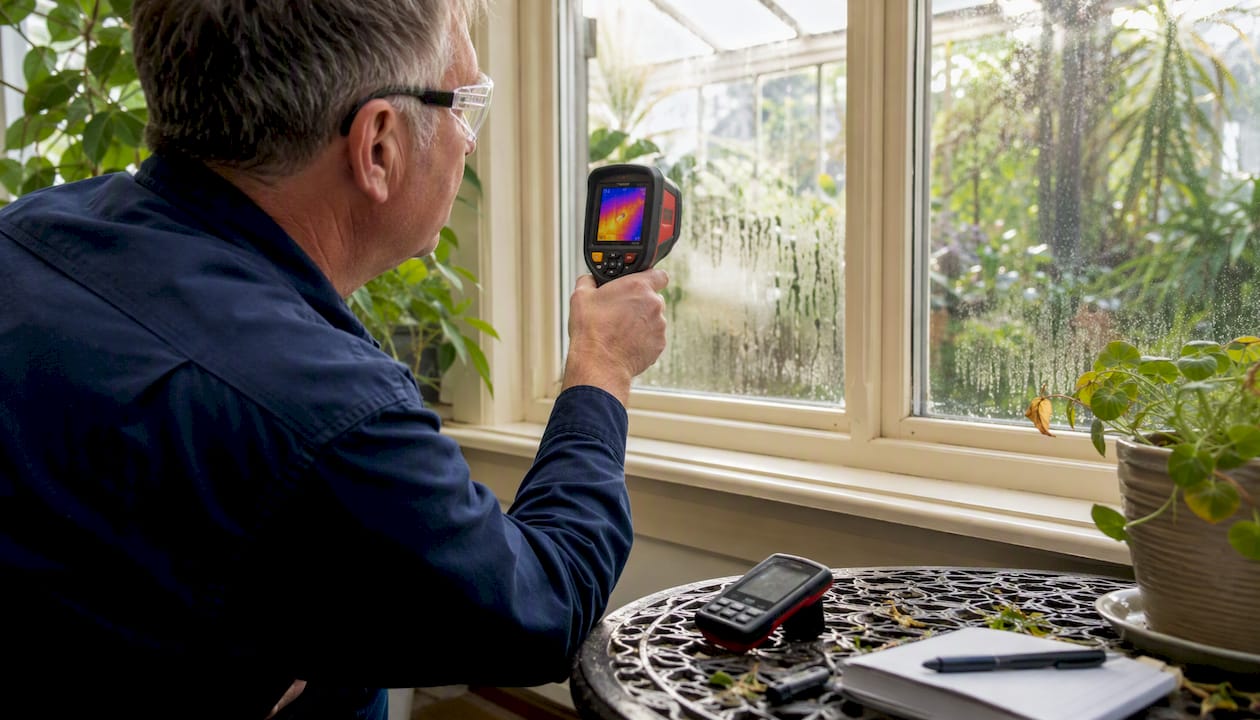
Persistent condensation on your windows is rarely just a surface problem. When moisture reappears after wiping, when mould grows at window reveals, or when timber sills soften, the underlying cause needs a proper diagnosis. A permanent window condensation fix requires a specialist damp and timber survey followed by targeted remedial works delivered under a written scope and workmanship guarantee. Book a survey, supply your property history, and arrange access to loft spaces and floor voids before the surveyor arrives. RICS consumer guidance and the Property Care Association Code of Practice both set the standard for what that survey must include. Quaypointplastering carries out exactly this type of investigation across Dorset, Hampshire and Wiltshire, with many years of local experience and documented, guaranteed remedial work.
Table of Contents
- What does a specialist damp and timber survey actually cover?
- Why a specialist survey beats a general building survey for damp
- How do surveyors tell condensation apart from penetrating or rising damp?
- What remedial measures does a survey typically recommend?
- What are the indicative costs and timelines?
- Why landlords need a professional damp survey
- How to choose the right specialist for a window condensation fix
- Quaypointplastering: local survey-led damp and timber specialists
- Practical next steps before your survey
- Key takeaways
- Why the survey always comes before the treatment
- Quaypointplastering: guaranteed survey-led investigations in Dorset, Hampshire and Wiltshire
- Useful sources
What does a specialist damp and timber survey actually cover?
A specialist damp survey is a forensic inspection, not a visual walk-round. Each of the following checks contributes to a complete picture of why condensation is forming and where moisture is travelling.
- Room-by-room visual inspection with timestamped photographs and written notes at every affected location.
- Thermal imaging to locate cold spots, thermal bridges at window reveals and lintels, and any hidden leaks behind plasterwork.
- Moisture mapping using calibrated meters and hygrometers. Relying on a single electronic damp meter is not sufficient; high-quality reports combine meter readings with gravimetric or chemical testing to distinguish condensation from rising damp or salt contamination.
- Ventilation and airflow assessment, covering extractor fan performance, trickle vent condition, and whole-house air movement patterns.
- Timber inspection for wet rot, dry rot, and evidence of insect attack, with borescope checks where concealed voids are suspected.
- Salt testing or chemical analysis where rising damp or salt contamination cannot be ruled out from meter readings alone.
- Whole-house context checks: gutters, DPC lines, external pointing, ground levels and rainwater goods, because external defects frequently drive internal condensation patterns.
Pro Tip: Ask your surveyor to confirm that thermal imaging and hygrometric readings will both be included. A report built on meter readings alone misses the hygrothermal data needed to size a ventilation solution correctly.
Why a specialist survey beats a general building survey for damp
RICS advises that general building surveys and mortgage valuations are often too superficial to diagnose damp reliably. A HomeBuyer Report or Level 2 survey will flag visible moisture but will not carry out the instrument testing, salt analysis or ventilation assessment needed to identify the root cause. Acting on that partial picture frequently leads to symptom-only repairs: a coat of anti-mould paint over a cold bridge, or a DPC injection where the real problem is inadequate extract ventilation.
The Joint Position Statement (JPS 2022), produced jointly by RICS and the Property Care Association, sets the benchmark for damp and mould reporting. A JPS-compliant report separates condensation from structural damp, documents the evidence chain, and specifies remedial works proportionate to the actual defect. Without it, you may pay for treatment that does not address the cause.
Requesting a JPS 2022-compliant report is the single most effective way to protect yourself from misdiagnosis. It requires the surveyor to evidence every finding with instrument data, not opinion, and to distinguish condensation from other damp types before recommending any treatment. RICS guidance also notes that RICS membership alone does not guarantee building pathology experience — always confirm the surveyor has demonstrated damp and mould expertise.
Pro Tip: Before instructing any surveyor, ask directly: “Will your report comply with the Joint Position Statement 2022?” If they are unfamiliar with it, look elsewhere. See our guide on specialist vs RICS surveys for a full comparison.
How do surveyors tell condensation apart from penetrating or rising damp?
Diagnosis uses multiple corroborating tests rather than a single reading. A surveyor following a structured approach works through four stages.
- Gather history: previous repairs, recurring smells, seasonal patterns, tenant behaviour and heating regimes. Providing this history significantly increases the value of the inspection and reduces the risk of missed defects.
- Visual pattern mapping: condensation typically concentrates on non-absorbent surfaces such as window glass, external corners and lintels where air movement is restricted. Penetrating damp follows rain events and tracks from specific external defects. Rising damp produces a tide mark with salt efflorescence at low level.
- Instrument tests: thermal imaging identifies cold bridges; hygrometers measure relative humidity and dew point; calibrated moisture meters map distribution. Where ambiguity remains, gravimetric or laboratory salt analysis separates rising damp and salt contamination from surface condensation.
- Targeted intrusive checks: borescope inspection of concealed voids, or core samples through walls, confirm or rule out hidden leaks.
A practical example: a north-facing bedroom window with persistent condensation and mould at the reveal. Thermal imaging shows a cold bridge at the window frame. The hygrometer records relative humidity above 70% in the room. The extractor fan in the adjacent bathroom is drawing below its rated airflow. The diagnosis is condensation driven by a thermal bridge combined with failed mechanical extract, not structural damp. The remedial scope is extractor replacement and targeted thermal-bridge sealing, not a DPC injection. Understanding how to distinguish rising, penetrating and condensation damp prevents exactly this kind of costly misidentification.
What remedial measures does a survey typically recommend?
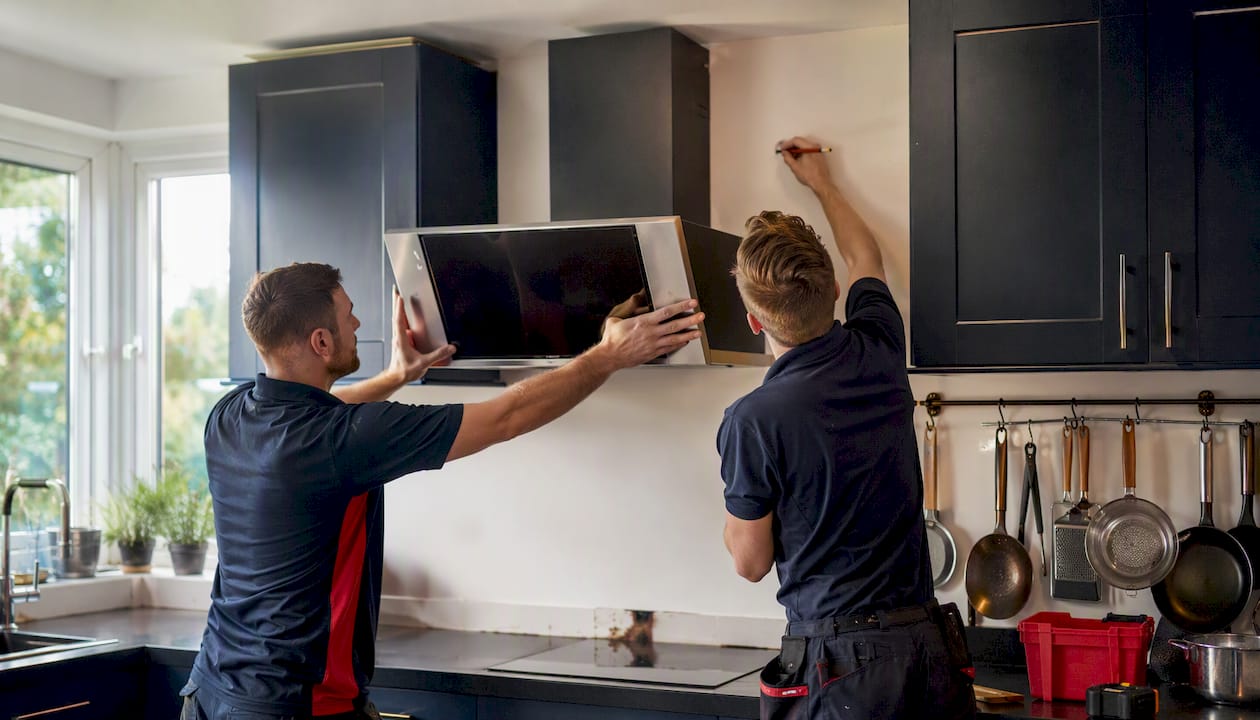
BS5250:2021 confirms that surface condensation is controlled by raising surface temperatures above the dew point and providing adequate ventilation. Remedial works follow directly from the survey findings.
Common remedial actions include:
- Extractor fan replacement or upgrade to restore rated airflow.
- Positive Input Ventilation (PIV) or Mechanical Ventilation with Heat Recovery (MVHR) installation for whole-house humidity control.
- Targeted thermal-bridge sealing at window reveals, lintels and external corners.
- Insulation adjustments where modern upgrades have created new cold bridges in older building fabric.
- Window sealing and sill repairs where frame gaps allow cold air infiltration.
- Mould remediation and plaster reinstatement where surface contamination has penetrated the substrate.
- Timber treatment or replacement where decay is confirmed.
| Remedy | Principal problem addressed |
|---|---|
| Extractor replacement / PIV / MVHR | Inadequate ventilation and high indoor humidity |
| Thermal-bridge sealing and insulation adjustment | Cold surfaces causing condensation at reveals and corners |
| Window sealing and sill repair | Cold air infiltration and water ingress at frame junctions |
| Mould remediation and plaster reinstatement | Mould colonisation and substrate damage from prolonged moisture |
| Timber treatment or replacement | Wet rot, dry rot or insect attack caused by sustained moisture |
Ventilation upgrades and thermal-bridge work are typically complete within one to three days. Plaster reinstatement requires a drying period before decoration, usually two to four weeks depending on substrate and conditions. Written workmanship guarantees should cover the remedial works themselves; where monitoring is specified, the surveyor will confirm the review interval.
What are the indicative costs and timelines?
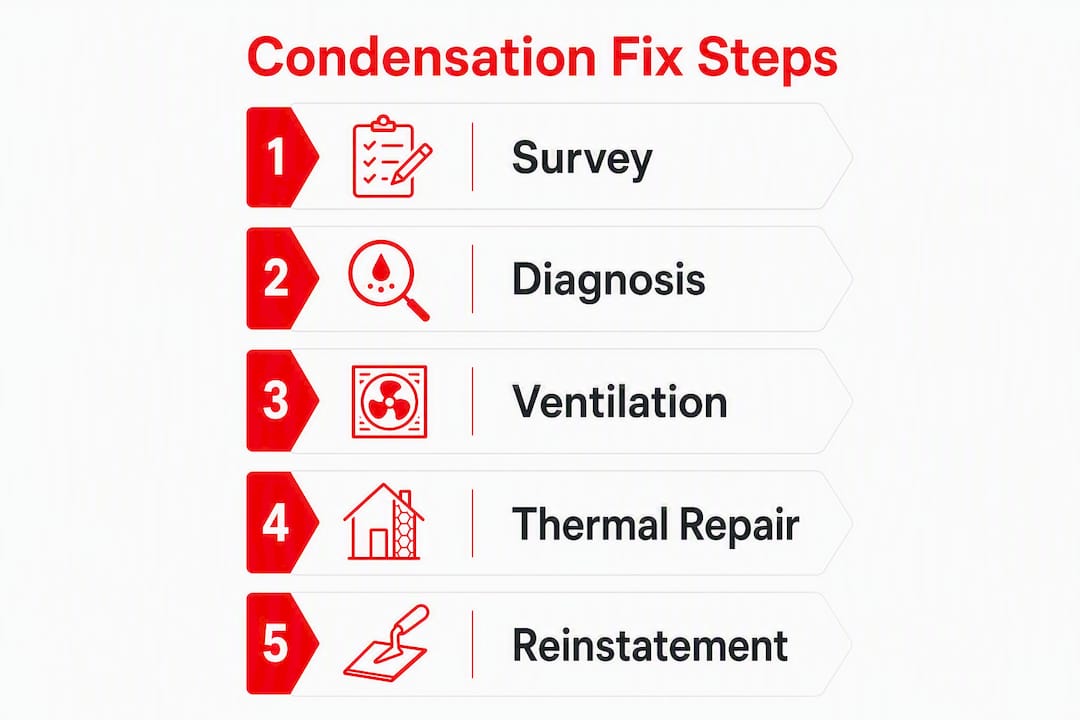
Budgeting for a window condensation fix in Dorset, Hampshire or Wiltshire involves three phases.
- Survey and diagnostic testing: a specialist damp and timber survey typically takes two to four hours on site, with a written report delivered within five to seven working days. Indicative survey fees vary by property size and complexity; request a fixed-fee quotation before instructing.
- Remedial works by package: a ventilation upgrade (extractor replacement or PIV installation) is usually a one-day job. Thermal-bridge remediation combined with plaster reinstatement typically runs two to five days on site, followed by a drying period before final decoration.
- Budget contingency: allow for hidden findings. Borescope inspection may reveal concealed timber decay or a failed cavity tray that was not visible during the initial survey. Specify staged payments tied to completion milestones, and confirm that the written guarantee is issued on practical completion, not on invoice.
Why landlords need a professional damp survey
A professionally documented survey creates a defensible paper trail that supports dispute resolution, satisfies regulatory obligations and limits liability. Commissioning a professional damp survey gives landlords dated evidence, urgency rankings and a recommended remediation plan that demonstrates proportionate investigation to insurers, lenders and tenancy adjudicators.
The records a landlord should expect from a compliant survey:
- Dated, timestamped photographs of every affected area.
- Instrument logs showing moisture readings, humidity levels and thermal images.
- Written scope of works with urgency ranking for each defect.
- Remedial quotations tied to the documented scope.
- Written workmanship guarantee on completion of works.
A landlord damp and mould inspection that produces this audit trail also reduces the risk of rework: repairs carried out without a documented diagnosis frequently fail when weather or occupancy patterns change.
How to choose the right specialist for a window condensation fix
Buyer checklist
- Confirm the surveyor holds a relevant qualification in building pathology, such as CSDB or CSTDB (Certificated Surveyor of Dampness in Buildings / Timber and Dampness in Buildings).
- Ask whether the report will comply with the Joint Position Statement 2022.
- Request a sample report to verify that it includes instrument logs, timestamped photos and a defined remedial scope.
- Confirm whether the same company carries out the remedial works, and ask for the warranty terms in writing before instructing.
Questions to ask at point of instruction
- Which specific tests will be carried out, and will thermal imaging and hygrometry be included?
- Will the report reference BS5250 and the PCA Code of Practice?
- What guarantees are offered on remedial works, and for how long?
Red flags to watch for
- Reliance on a single damp meter with no chemical or gravimetric testing.
- Free surveys tied directly to treatment sales, where the diagnosis is not independent of the commercial outcome.
- Vague or unsigned scopes of work with no urgency ranking or defined warranty terms.
Quaypointplastering: local survey-led damp and timber specialists
Quaypointplastering provides damp and timber surveys across Dorset, Hampshire and Wiltshire, backed by over 35 years of local experience. Every instruction follows the same survey-led model.
- Survey day: a qualified surveyor carries out a full forensic inspection using thermal imaging, calibrated moisture mapping, hygrometric testing and timber assessment, with timestamped photographs throughout.
- Written report: findings are documented with instrument logs, photo evidence, moisture readings and a clear scope of works, structured to be relied on by solicitors, lenders and insurers.
- Remedial works: carried out under a written workmanship guarantee, with photographic sign-off on completion.
- Landlord audit trail: every report is formatted to support compliance records, dispute resolution and insurance requirements.
Coverage: Dorset, Hampshire and Wiltshire, with local knowledge of the building fabrics, construction periods and environmental conditions specific to the region.
Practical next steps before your survey
Preparing properly means the surveyor can investigate more thoroughly and the report will be more complete.
- Gather any previous damp reports, structural surveys or specialist assessments for the property.
- Collect photographs you have taken of affected areas, noting dates where possible.
- Arrange access to loft spaces, underfloor voids, cellars and any areas behind fitted furniture near affected walls.
- If the property is tenanted, notify occupants and confirm access timing in writing.
- Note the heating regime, ventilation habits and any recent changes to insulation or windows.
When you contact Quaypointplastering, include a brief description of where condensation appears, how long it has been present, and any previous treatment. This allows an accurate pre-visit assessment and ensures the right equipment is brought to site. Before works begin, confirm that the report will be JPS 2022-compliant and that written guarantee terms will be provided with the quotation.
Key takeaways
A permanent window condensation fix requires a specialist damp and timber survey with instrument-based diagnosis, a documented scope of works, and remedial treatment delivered under a written workmanship guarantee.
| Point | Details |
|---|---|
| Survey first, always | A specialist damp and timber survey is the only reliable basis for a permanent fix. |
| Multiple tests required | Diagnosis combines thermal imaging, hygrometry and chemical testing, not a single damp meter. |
| Remedies follow findings | Ventilation upgrades, thermal-bridge sealing and mould remediation are sized to the survey evidence. |
| Landlord compliance value | A documented survey with urgency rankings and instrument logs supports regulatory obligations and dispute resolution. |
| Quaypointplastering | Provides survey-led damp and timber investigations with written guarantees across Dorset, Hampshire and Wiltshire. |
Why the survey always comes before the treatment
Most properties with persistent window condensation have already had something done: a mould wash, a new extractor, perhaps a DPC injection recommended after a free survey. The condensation returns because the underlying cause was never properly identified. A thermal bridge at a window reveal will keep producing surface moisture regardless of how many times the mould is treated, until the cold surface temperature is raised or the ventilation rate is corrected.
The survey-led approach is not a premium option. It is the only approach that produces a defensible, evidence-based scope of works. Anything else is guesswork dressed as a solution.
Quaypointplastering: guaranteed survey-led investigations in Dorset, Hampshire and Wiltshire
Persistent condensation on windows signals a problem that needs proper investigation, not a surface treatment. Quaypointplastering delivers exactly what this situation requires: a forensic damp and timber survey with thermal imaging, moisture mapping and documented findings, followed by guaranteed remedial works and photographic sign-off.

After you accept a quotation, the works are scheduled promptly, mobilised with the right materials for your specific defect type, and completed to a written workmanship standard. Every client receives a report formatted for solicitors, lenders and insurers, making Quaypointplastering the practical choice for landlords and property managers who need a compliant audit trail as well as a lasting repair.
To commission a damp and timber survey or to discuss condensation and black mould treatment, contact Quaypointplastering today. Tell us where the condensation appears, how long it has been present, and whether any previous treatment has been carried out. We will confirm the survey scope, the report format and the guarantee terms before any work begins.
Useful sources
The following standards and guidance underpin the diagnostic approach, remedial recommendations and landlord compliance points in this article.
- RICS Damp and Mould Consumer Guidance: supports the recommendation for a JPS 2022-compliant specialist survey rather than a general building survey or mortgage valuation.
- Property Care Association Code of Practice: Control of Dampness in Buildings (January 2023): underpins the whole-house assessment approach, ventilation and heating as condensation controls, and the requirement for chemical or gravimetric testing alongside meter readings. Also references BS5250:2021 on surface condensation control.
- RICS Home Survey Standard: confirms that moisture meter readings of windows and doors are indicative tests only, supporting the case for specialist instrument-based investigation.
- PCA CSDB/CSTDB Syllabus: sets the qualification standard for certificated surveyors of dampness and timber; request this credential when choosing a specialist.
- JAG Property Services: What Does a Damp Survey Involve?: supports the landlord compliance and defensible paper-trail points.
When requesting a report, confirm in writing that it will comply with the Joint Position Statement 2022. This single requirement filters out superficial assessments and ensures the findings are structured for use by solicitors, lenders and insurers.