
35 Years' Local Expertise: Survey First for House Longhorn Beetle, UK
35 Years’ Local Expertise: Survey First for House Longhorn Beetle, UK
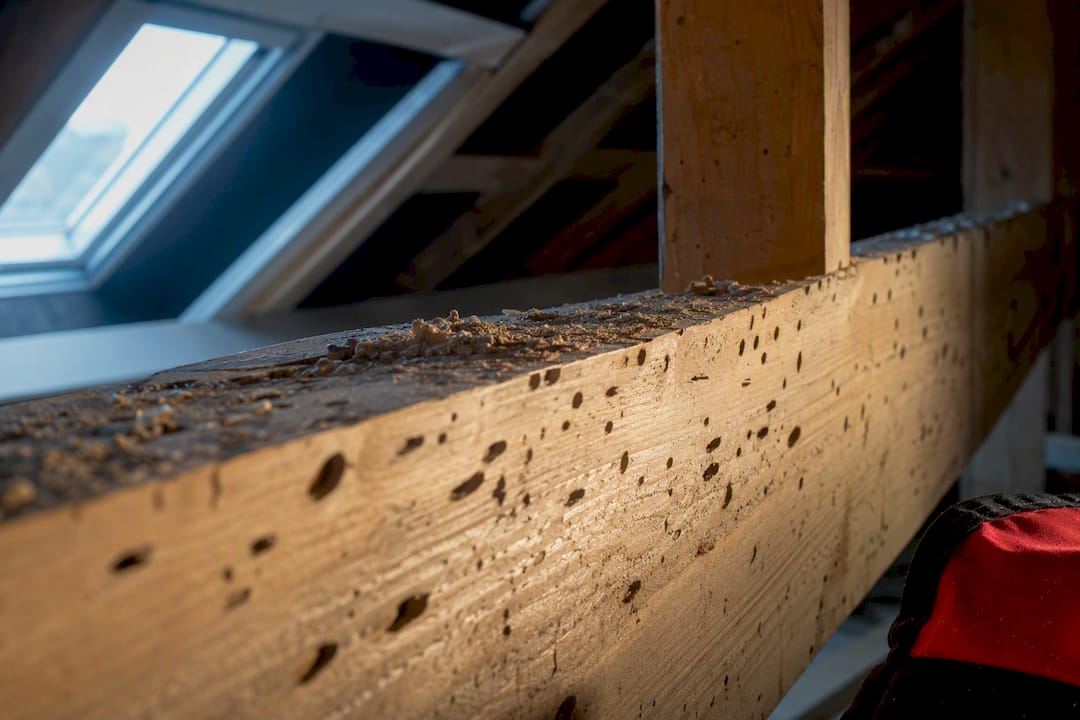
Large oval exit holes, coarse frass, and rafters that sound hollow when tapped point to house longhorn beetle rather than common woodworm. If your loft shows these signs, arrange a professional timber survey before doing anything else. In the meantime, reduce moisture in the roof space and leave affected timbers undisturbed so a surveyor can assess the damage properly.
TL;DR:
- Oval exit holes measuring 6 to 10mm and coarse frass are typical signs of house longhorn beetle damage, especially around new softwood timber.
- The beetle’s larvae feed inside softwood for years before emerging, making visible damage often more extensive than it appears externally.
- The highest risk areas include softwood roof timbers, particularly in properties with recent renovations, poor ventilation, or high moisture levels.
- Professional timber surveys are essential to accurately assess damage, determine active infestation, and recommend appropriate treatment or repair.
- Preventive measures focus on using seasoned or treated timber and maintaining low moisture levels in loft spaces.
Table of Contents
- What are the signs of house longhorn beetle?
- Why does it target fresh softwood timber?
- Where in the UK is house longhorn beetle found?
- What treatment options work for house longhorn beetle?
- How can you prevent house longhorn beetle infestation?
- What does a UK timber survey involve and cost?
- Why survey-led diagnosis beats guesswork
- Book a damp and timber survey with Quay Point Plastering
- Sources
What are the signs of house longhorn beetle?
House longhorn beetle (Hylotrupes bajulus) is a wood-boring beetle whose larvae tunnel through softwood for years before adults emerge, leaving damage that’s often more severe than the visible signs suggest. Adult beetles are dark brown to black with grey markings on the wing cases. The larvae, which do the real structural harm, are creamy white and grow to a significant length.
The exit holes are the giveaway. Common furniture beetle (“woodworm”) leaves round holes around 1 to 2mm across. House longhorn beetle leaves oval holes typically 6 to 10mm wide, often clustered on the same rafter or joist. Around these holes you’ll usually find coarse, gritty frass rather than the fine powder associated with smaller borers, and the Natural History Museum’s guidance on common household pests is a reliable reference if you’re trying to tell species apart.
Check these areas during an inspection:
- Roof timbers and rafters, particularly where sapwood is exposed
- Loft joists and purlins, tapping for a hollow or spongy sound
- Timber surfaces for blistering or a rippled appearance beneath the paint
- Corners and floor areas below timbers for accumulated frass
- Old and new exit holes, since confirming whether holes are still active changes how urgently you need to act
Why does it target fresh softwood timber?
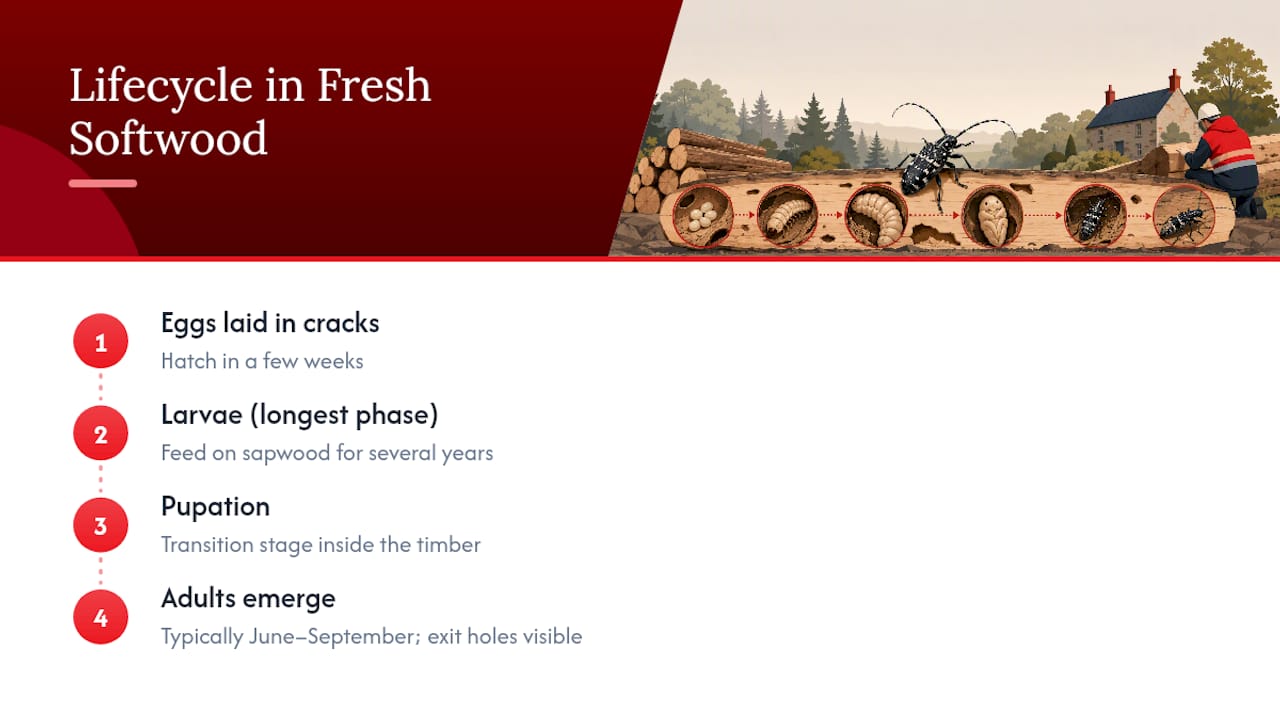
The female beetle lays eggs in cracks and crevices of softwood, favouring pine, spruce, and fir. Eggs hatch in a few weeks, and the larvae then begin the longest and most damaging phase of the lifecycle, feeding on sapwood for several years, depending on temperature and moisture. Pupation follows, and adults typically emerge between June and September, which is when you’re most likely to notice beetles or fresh holes.
Hylotrupes bajulus specifically favours freshly produced sapwood, which means recently felled or newly processed softwood timber carries the highest risk. This matters for anyone who has re-roofed or extended with new softwood in the last decade or so. Damage stays hidden for years while larvae feed inside the timber, so by the time exit holes appear, the structural loss can already be substantial.
Where in the UK is house longhorn beetle found?
Records show concentrations in parts of south-east England, particularly Surrey and neighbouring counties, with scattered occurrences elsewhere linked to imported or newly processed softwood used in construction. Historic outbreaks have been tied to batches of infested timber arriving in new-build developments, a pattern documented in accounts of house longhorn beetle protection measures.
Risk rises where a property has conifer softwood roof construction, poor loft ventilation, elevated timber moisture, or recent renovation work using new softwood. Older thatched or heavily oak-framed roofs carry less risk than a 1970s or 1980s softwood-trussed roof with limited airflow. If your property fits that profile, treat any oval holes or coarse frass as worth investigating rather than dismissing.
What treatment options work for house longhorn beetle?
DIY spray treatments rarely reach larvae feeding deep inside structural timber, and misjudging the extent of damage risks leaving weakened rafters in place. The CABI Compendium datasheet on Hylotrupes bajulus sets out the recognised control methods, which generally fall into three categories:
- Targeted insecticidal treatment applied to affected and surrounding timber to kill larvae and prevent re-infestation.
- Timber replacement or repair where structural strength has already been compromised, often requiring sistered joists or new rafter sections.
- Heat or fumigation treatment, used in more limited or severe cases where conventional application isn’t practical.
Because larval damage is hidden inside the wood, an accredited surveyor needs to assess structural integrity before recommending which of these routes applies. Guidance from local authority pest teams reinforces this, noting that exclusion and moisture management support prevention, but a professional assessment is required once an infestation is suspected.
Before that survey happens, keep loft moisture down, fix any roof leaks promptly, and resist the urge to cover or paint over affected timber. A written survey report will typically grade the severity of damage, identify which timbers need replacement versus treatment, and set out a defined scope of remedial work.
Pro Tip: Photograph exit holes and frass before you clean anything away. A surveyor can date activity more accurately when the original evidence is intact, which often shortens the inspection and keeps costs down.
How can you prevent house longhorn beetle infestation?
Prevention rests on timber selection and moisture control, both of which are within a homeowner’s direct influence. Freshly sawn sapwood is what attracts females looking to lay eggs, so choosing seasoned heartwood or properly pressure-treated timber for structural work removes much of that appeal from the outset.
- Specify seasoned heartwood or treated softwood for rafters, joists, and roof repairs
- Keep loft spaces dry and well ventilated to discourage both beetles and damp-related rot
- Repair roof leaks and flashing faults as soon as they appear
- Seal gaps around timber and store any new softwood off the ground and covered
- Avoid leaving cut ends or exposed sapwood uncoated during fitting work
- Schedule a follow-up inspection 12 to 18 months after any re-roofing or extension using new softwood
Keeping a simple maintenance log, noting when timbers were last checked and what was found, makes it far easier to spot a developing problem early rather than after years of hidden feeding.
What does a UK timber survey involve and cost?
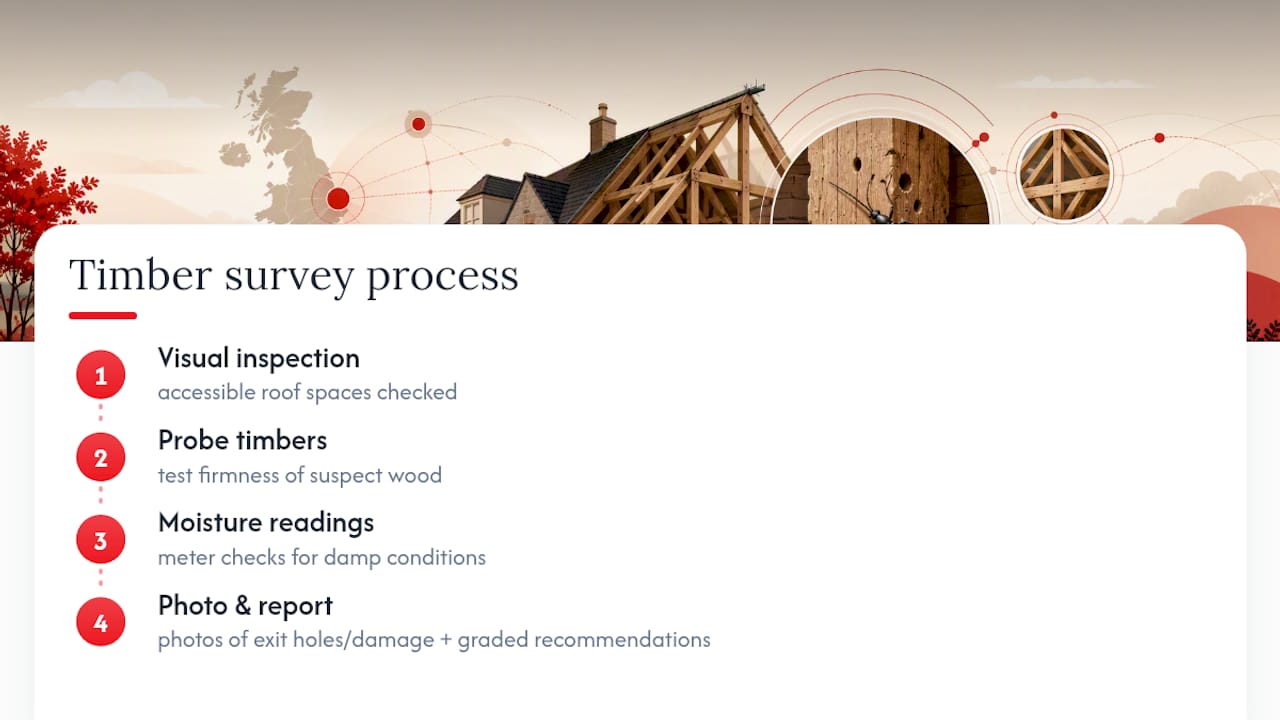
A proper timber survey starts with a visual inspection of accessible roof spaces, followed by probing suspect timbers to test firmness and moisture readings taken with a meter to check for damp conditions that favour beetle activity. Surveyors photograph exit holes, frass, and any structural distortion, then compile written recommendations graded by severity, from monitoring only through to urgent structural repair.
Costs vary with roof access, the extent of timber affected, and whether repairs are needed alongside treatment. Quay Point Plastering’s woodworm treatment cost guide breaks down typical UK price ranges so you can budget realistically and compare quotes on a like-for-like basis. A dedicated timber survey with a documented scope of work matters because it separates genuine structural risk from cosmetic old damage, and a written guarantee on any resulting repair gives you recourse if problems recur.
Why survey-led diagnosis beats guesswork
After more than 35 years assessing timber and damp issues across Dorset, Hampshire, and Wiltshire, one pattern holds: homeowners who skip the survey and jump straight to treatment often pay twice, once for the wrong fix and again for the repair that should have happened first. Documented findings and a defined scope of work remove that guesswork, and a written guarantee means you’re not relying on trust alone. If your loft shows oval exit holes or coarse frass, get it looked at before deciding what to do next.
— Quay
Book a damp and timber survey with Quay Point Plastering
Quay Point Plastering is the alternative to guesswork treatment for homeowners in Dorset, Hampshire, and Wiltshire spotting signs of house longhorn beetle. Rather than quoting for treatment before anyone has confirmed what’s actually happening inside your rafters, every job starts with a proper inspection and a written scope of work, so you know exactly what you’re paying for and why.

The Damp & Timber Survey includes an on-site inspection of roof timbers and structural woodwork, moisture readings, photographic evidence, and a written report grading severity with clear remedial recommendations. If treatment or repair is needed, you’ll get a defined scope of work and a written guarantee before any work begins, covering woodworm treatment where damage has already taken hold.
If oval exit holes, coarse frass, or a hollow-sounding rafter have you concerned, book a survey and get a documented answer rather than a guess.
Sources
- Babergh & Mid Suffolk: Wood-boring insects
- Natural History Museum: Common insect pest species in homes
- CABI Compendium: Hylotrupes bajulus
- Wikipedia: Hylotrupes