
Woodworm treatment cost: UK price guide for 2026
Woodworm treatment cost: UK price guide for 2026
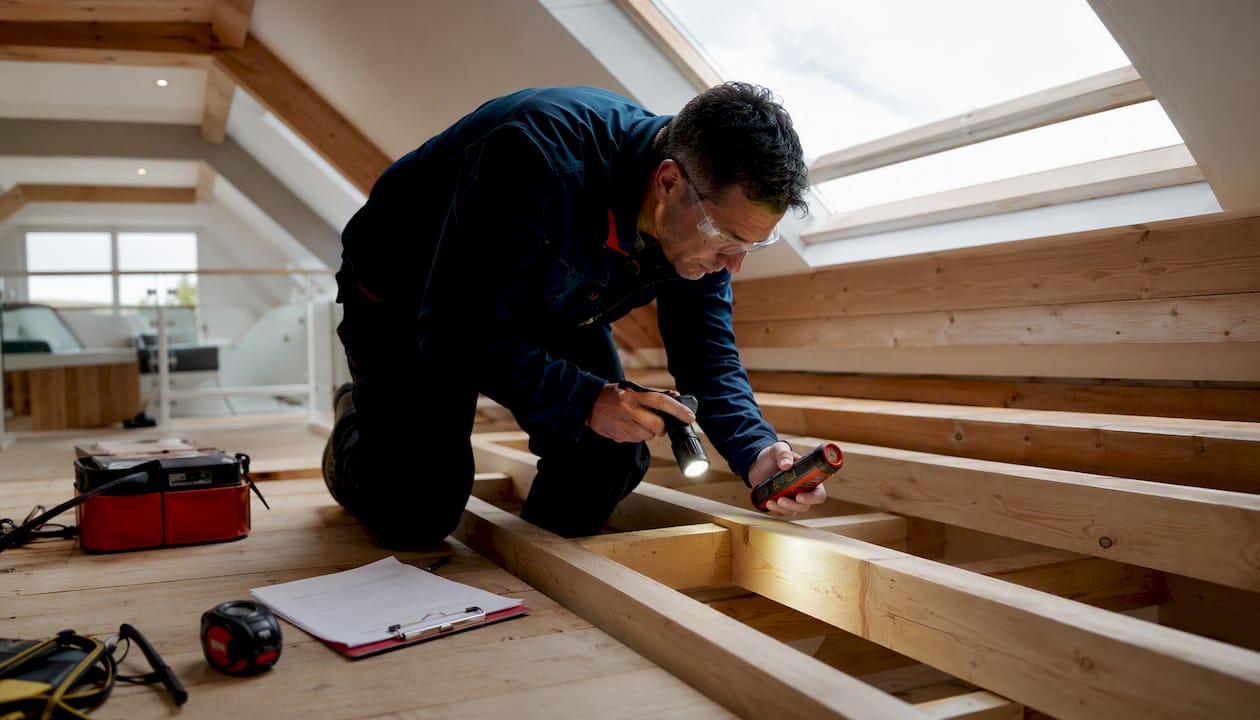
Professional woodworm treatment in the UK for a standard domestic property is generally mid-range in cost, rising significantly where structural repairs, complex access, or heritage constraints are involved. The single most useful first step is not to book treatment immediately — it is to commission a timber survey so you know whether the infestation is even active before spending a penny on chemicals.
Woodworm is the collective term for the larvae of several wood-boring beetle species, most commonly the common furniture beetle (Anobium punctatum). The larvae tunnel through timber for years before emerging as adults, leaving the familiar small exit holes. Many of those holes are historic and entirely inactive, which is why a survey-led diagnosis almost always saves money compared with treating blindly.
Here is a quick summary of the three most common outcome bands:
- Small or localised job (single piece of furniture, one room’s floorboards, or a small loft): £150–£500
- Typical whole-house treatment (suspended floors, loft, and roof timbers in a 3-bed semi): £500–£1,000
- Complex or structural job (active infestation in structural joists, heritage property, or where damp repairs are also required): £1,000–£2,500+
Pro Tip: Woodworm is not an emergency. The beetle lifecycle is slow, which gives you time to get a proper survey before committing to any treatment. Rushing into a full-house fumigation based on a free quote is one of the most common and costly mistakes homeowners make.
Table of Contents
- What are the headline figures for woodworm costs?
- How much does woodworm treatment cost by job size?
- What does a professional woodworm survey cost?
- Which treatment method suits your situation?
- How does the location of affected timber affect the price?
- What factors push the cost of woodworm removal up or down?
- How long does woodworm treatment take from survey to completion?
- Is DIY woodworm treatment worth considering?
- How do you get accurate quotes and compare them fairly?
- Why a survey-led approach usually saves money
- Key takeaways
- A surveyor’s view on getting woodworm costs right
- Book a timber survey with Quaypointplastering
- Useful sources
What are the headline figures for woodworm costs?
| Service | Typical cost band |
|---|---|
| Professional woodworm survey (standard) | £80–£250 |
| Professional woodworm survey (heritage/large) | £285–£525 |
| Small/localised boron treatment (10–12 m²) | £250–£480 |
| Typical whole-house treatment (fogging/fumigation) | £500–£1,000 |
| Complex structural or heritage job | £1,000–£2,500+ |
All prices shown are indicative and exclude VAT unless stated otherwise. Most professional contractors charge VAT at the standard rate, so add 20% to any net quote. Regional variation is real: London and the South East typically add 20–25% to labour-based costs compared with Midlands or northern regions, while rural or remote areas can attract callout premiums of 15–30%.
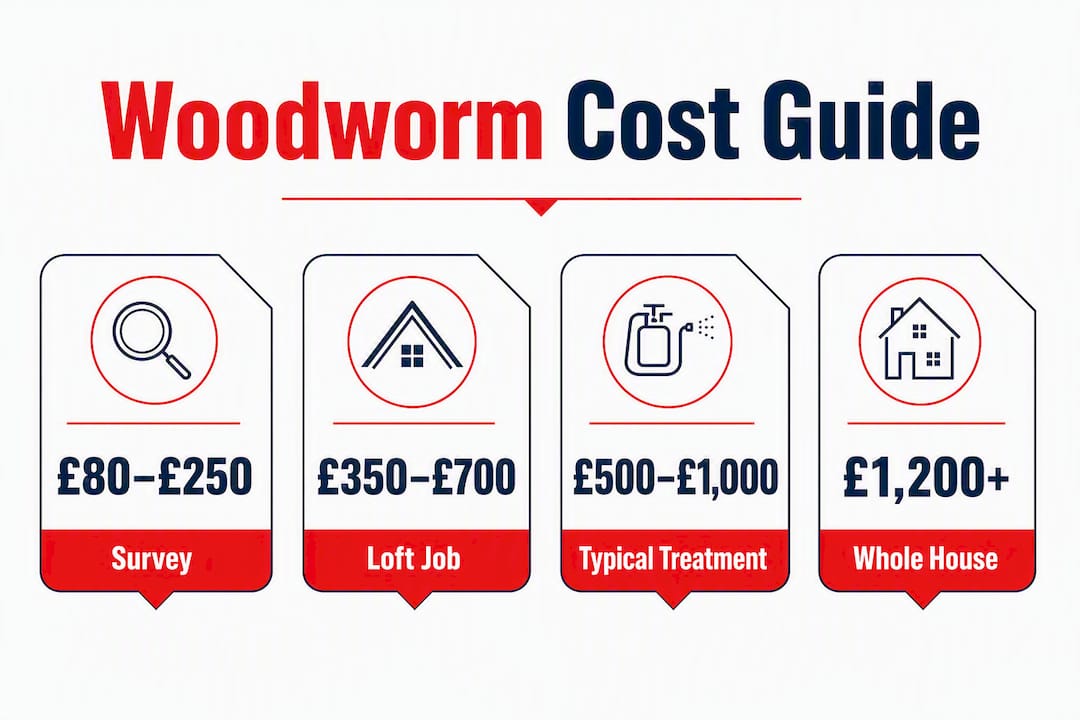
The average professional woodworm treatment for a typical UK home is commonly considered to fall within a mid-range cost band, with higher quotes where structural repairs or complex access are required. That figure aligns with what Checkatrade and other trade guides consistently report as the national mid-range.
How much does woodworm treatment cost by job size?
Understanding the woodworm treatment cost for your specific situation means mapping the affected area to a realistic price band. The following worked examples show what each band typically covers.
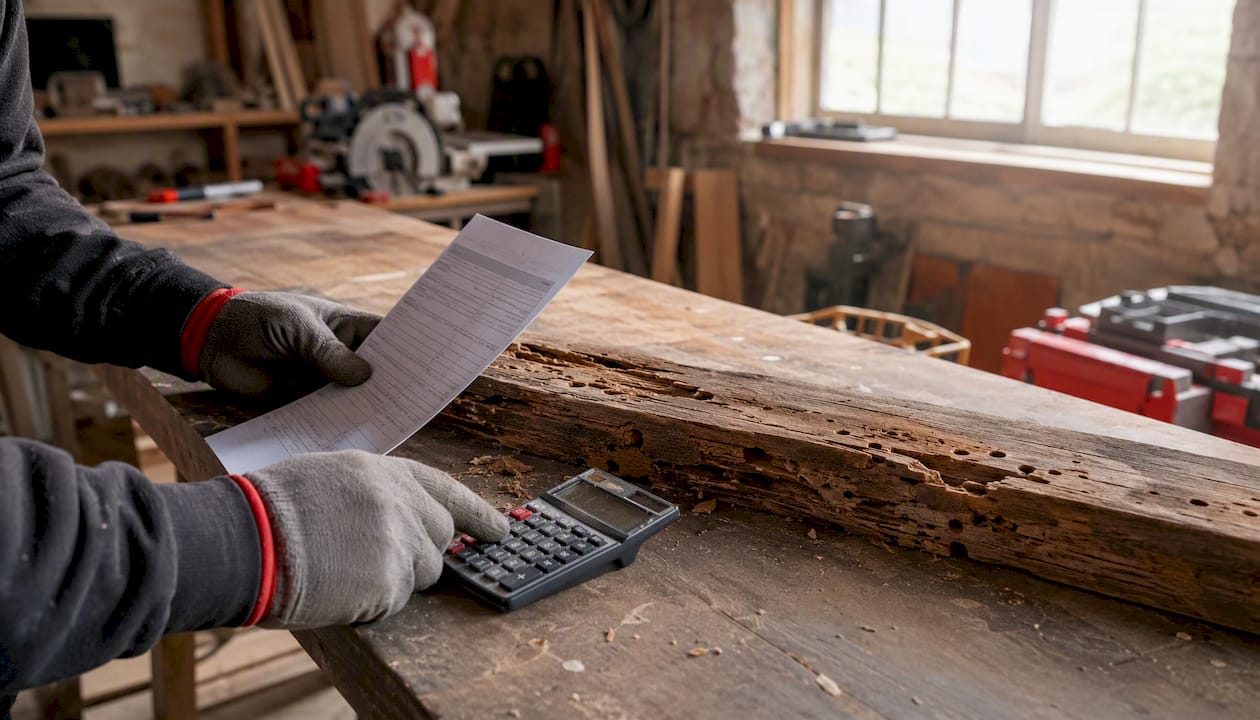
Single room or staircase
A localised treatment covering one room’s floorboards or a staircase, using a boron or permethrin spray, typically falls in the £250–£480 range for a 10–12 m² job. Boron treatments are commonly priced at £20–£50 per m², corresponding to typical provider quotes for this area size. This band usually covers:
- Chemical product and application labour
- Basic site protection (dust sheets, ventilation)
- A written treatment record
It does not usually include making good — that is, reinstating floorboards, plaster, or insulation disturbed during access. Always confirm this in writing before you sign.
Loft-only job
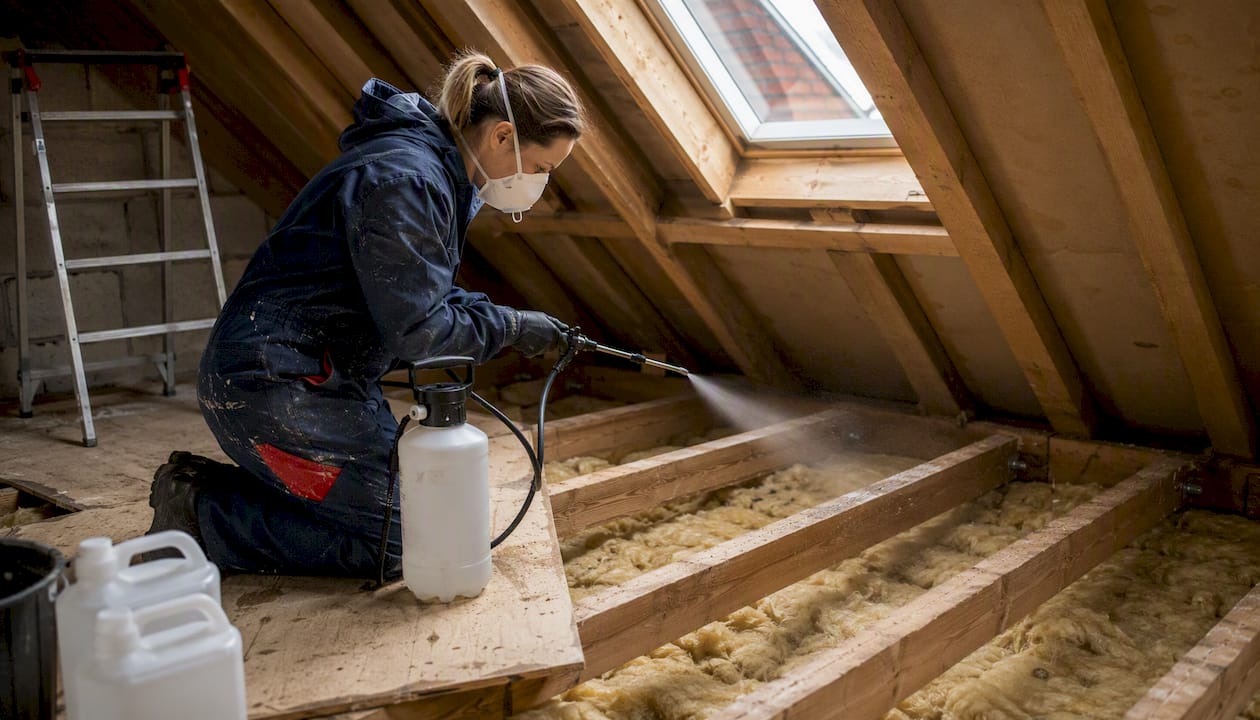
A loft with affected rafters and joists in a standard semi-detached property typically costs £350–£700. Access is straightforward, but the volume of timber and the need to move or temporarily remove loft insulation can push costs toward the upper end.
Suspended timber floor in a terrace
This is one of the more disruptive jobs. Treating the underside of a suspended floor requires either lifting boards or, where access is possible, treating through existing gaps. Expect £500–£900 for a typical two-storey terrace, more if boards need lifting and relaying.
Whole 3-bed semi (loft, floors, and structural timbers)
A comprehensive treatment across a standard three-bedroom semi-detached property, covering loft timbers, suspended floors, and any affected structural joists, typically falls in the £700–£1,200 range. Fogging and fumigation for whole-property treatments are commonly quoted at £500–£1,000, though that figure can rise where access or containment is difficult.
Listed or heritage property
Treatments in listed buildings must often use breathable, less invasive products and may require listed building consent. Specialist contractors and regulatory compliance push costs to £1,500–£3,000 or more, depending on the extent of the infestation and the consents required.
Common exclusions across all price bands:
- Making good (reinstating floorboards, plaster, or insulation)
- Structural timber repairs or replacement
- Damp proofing or ventilation improvements
- Scaffolding or specialist access equipment
- Skip hire or waste removal
What does a professional woodworm survey cost?
A professional, lender-compliant woodworm survey typically costs £80–£250; heritage or complex properties may cost £285–£525. That fee buys you something a free quote cannot: a documented, mapped report that satisfies mortgage lenders and insurers.
Only an accredited, lender-compliant timber report provides the photographed evidence, species identification, and moisture readings that lenders rely on. A free quote from a contractor rarely fulfils those requirements, and if you are buying, selling, or remortgaging, an undocumented treatment can leave you in a difficult position.
A thorough survey report should include:
- Species identification (furniture beetle, deathwatch beetle, house longhorn, or other)
- Moisture readings at affected and adjacent timbers
- Photographs of exit holes, frass, and affected areas
- A mapped plan showing the location and extent of evidence
- Clear distinction between active and historic infestation
- Recommended treatment scope and method
- Any ancillary works required (damp, ventilation, structural)
Use this checklist to compare reports from different surveyors. A report that omits species identification or moisture data is not lender-compliant and may not protect you if the problem recurs.
Pro Tip: Survey fees are often refunded against the cost of treatment if you commission the same firm to carry out the works. Ask about this before you book — it means the survey effectively costs nothing if you proceed, and you still get the documented report regardless.
Many surveyors will also confirm whether old woodworm holes are active or historic during the inspection. This single finding can save you hundreds of pounds by ruling out unnecessary treatment.
Which treatment method suits your situation?
The main professional treatment methods each have different cost profiles, suitability, and disruption levels. Understanding them helps you read quotes intelligently.
- Boron/chemical spray: Water-based boron or permethrin solution applied by brush or spray. Low odour, low disruption, suitable for furniture and accessible structural timbers. Typical cost: £20–£50 per m².
- Fogging: A fine chemical mist dispersed through enclosed spaces such as lofts. Faster coverage than brush application. Typical cost: £300–£700 for a loft or single floor.
- Fumigation: Whole-property or sealed-area treatment using gas or concentrated chemical. Most effective for severe or widespread infestations. Typical cost: £500–£1,000 for a domestic property.
- Heat treatment: Raises timber temperature to a level lethal to larvae. Chemical-free, suitable for listed buildings and sensitive environments. Less widely available; typically costs more than chemical methods.
- Injection: Chemical injected directly into flight holes or timber. Used for localised or inaccessible areas. Often combined with surface spray.
| Method | Typical price band | Best use | Invasiveness | Timescale | Guarantee/follow-up |
|---|---|---|---|---|---|
| Boron/chemical spray | £20–£50 per m² | Furniture, accessible joists | Low | Hours to 1 day | 10–30 year product guarantee typical |
| Fogging | £300–£700 | Lofts, enclosed roof voids | Low–medium | Half to 1 day | Varies; confirm in writing |
| Fumigation | £500–£1,000 | Whole-property, severe cases | Medium–high | 1–2 days + re-entry wait | Varies; confirm in writing |
| Heat treatment | £1,000–£2,500+ | Listed buildings, chemical-sensitive | Low–medium | 1 day | Confirm with contractor |
| Injection | Included in spray cost | Localised, inaccessible areas | Low | Hours | As part of wider treatment |
| Pro Tip: For furniture or small antique pieces, a localised boron treatment applied by a specialist is usually sufficient and far less disruptive than fogging. Ask whether the contractor has experience with antique or veneered timber before they start — the wrong product can cause staining or warping. |
How does the location of affected timber affect the price?
Where the woodworm is matters as much as how much of it there is. Access requirements and the structural role of the timber both influence the final cost significantly.
| Affected area | Typical cost band | Key access/cost notes |
|---|---|---|
| Loft timbers (rafters, joists) | £350–£700 | Usually straightforward; insulation removal adds cost |
| Roof timbers (purlin, ridge, principal rafters) | £500–£1,200 | May require scaffolding or roof access equipment |
| Furniture piece | £80–£300 | Specialist required for antiques; restoration costs separate |
| Suspended timber floor (single storey) | £400–£900 | Board lifting or crawl-space access required |
| Structural joists (ground/first floor) | £1,000–£2,500+ | Structural assessment may be needed; damp often present |
- Scaffolding: Roof timber access often requires scaffolding, adding £500–£1,500 depending on the property.
- Lift equipment: Internal access platforms for high ceilings or complex roof structures add to day rates.
- Moving furniture: Clearing rooms before treatment is usually the homeowner’s responsibility; factor in time or removal costs.
- Temporary accommodation: Fumigation treatments require vacating the property, typically for 24–48 hours.
For properties in Hampshire and Wiltshire, where older stone and brick-built housing stock is common, suspended timber floors and roof structures are frequent sites of activity. A damp and timber survey covering both issues in one visit is often the most cost-effective starting point.
What factors push the cost of woodworm removal up or down?
Several variables can move a quote significantly in either direction. Knowing them helps you assess whether a quote is realistic or whether something has been left out.
Factors that increase cost:
- Active versus historic infestation: Active infestations require immediate treatment; historic ones may need monitoring only. A surveyor distinguishes these by looking for fresh, light-coloured frass and soft hole edges.
- Species: The common furniture beetle is the most straightforward to treat. Deathwatch beetle (Xestobium rufovillosum) affects hardwood structural timbers and is harder to eradicate, often requiring injection alongside surface treatment.
- Damp or ventilation problems: Treating underlying damp or improving ventilation is often part of an effective woodworm solution; failing to address moisture can lead to reinfestation and higher long-term costs. Damp repairs can add several hundred to several thousand pounds depending on severity.
- Structural damage: Severely affected joists or rafters may need sistering or replacement, which is a separate structural cost.
- Listed status: Specialist products, consents, and contractors are required, all of which add to the bill.
- Making good: Reinstating floorboards, plaster, or insulation after treatment is frequently excluded from base quotes.
- Guarantee length and type: Insurance-backed guarantees (IBGs) cost more but protect you if the contractor ceases trading.
Factors that reduce cost:
- Early detection before structural damage occurs
- Good access (open loft, no furniture to move, ground-floor timbers)
- Historic rather than active infestation (monitoring only, no chemical treatment required)
- Combining a woodworm survey with a damp survey in a single visit
A note on insurance-backed guarantees: A 20- or 30-year treatment guarantee is only as good as the company behind it. An insurance-backed guarantee (IBG) from a recognised provider means the warranty is honoured even if the contractor closes. Always ask whether the guarantee is IBG-backed and get the policy details in writing.
How long does woodworm treatment take from survey to completion?
Setting realistic expectations avoids unnecessary stress. Here is a typical sequence:
- Book a survey: Lead times vary from same-week to 2–3 weeks depending on the contractor and time of year.
- On-site survey: Usually 1–3 hours for a standard domestic property; larger or more complex properties take longer.
- Report and scope: A written report and treatment recommendation typically follows within 3–5 working days of the survey.
- Treatment day(s): Pest-control technicians typically charge £30–£70 per hour, and most jobs fall within a 1–3 day window depending on method and property size.
- Re-entry and drying: Boron treatments have minimal re-entry restrictions. Fumigation requires vacating for 24–48 hours and adequate ventilation before re-entry.
- Follow-up monitoring: A follow-up inspection 6–12 months after treatment confirms whether the infestation is inactive.
Additional factors that extend the overall timeline:
- Structural drying after damp repairs (weeks to months depending on severity)
- Listed building consent applications (weeks to months)
- Scaffolding erection and removal for roof access
- Board relaying or plastering reinstatement after treatment
Is DIY woodworm treatment worth considering?
DIY products — permethrin and boron sprays, gels, and liquids — are available from hardware stores and online, typically priced at £7–£35 for a treatment kit. Protective equipment (gloves, masks, brushes) adds roughly £10–£15. For a small, clearly localised, and confirmed-active infestation on accessible furniture or a single floorboard, DIY is a reasonable option.
The risks are significant, however, and worth understanding clearly:
- Misidentifying activity: Treating historic holes wastes money and exposes you to unnecessary chemicals. Without moisture readings and species identification, you cannot be certain the infestation is active.
- Incomplete penetration: Surface sprays do not always reach larvae deep in structural timbers. Inadequate treatment leaves the infestation partially active.
- No guarantee: DIY treatment provides no warranty and will not satisfy a mortgage lender or insurer.
- Lender rejection: If you are buying or selling, an undocumented DIY treatment is unlikely to satisfy a lender’s requirements.
Always choose a professional for structural timbers, listed properties, active widespread infestations, or any situation where a lender-compliant report is required. The cost of getting it wrong — reinfestation, structural deterioration, or a failed mortgage application — far exceeds the saving on a DIY kit.
How do you get accurate quotes and compare them fairly?
Getting like-for-like quotes requires preparation. Contractors who visit an unprepared property often give broad estimates that shift once work begins.
Before you request quotes, do the following:
- Photograph all visible exit holes, frass deposits, and affected timbers.
- Note when you first noticed the problem and whether it has changed.
- Check for damp or condensation near affected areas and photograph any staining.
- Identify the affected rooms, floors, and timber types as precisely as you can.
- Gather any previous survey reports or treatment records.
Questions to ask every contractor:
- Can you identify the species from what you have seen?
- Is your survey report lender-compliant and does it include moisture readings?
- Does your quote include making good after treatment?
- What is the guarantee period and is it insurance-backed?
- Does the quote include VAT?
- Are follow-up visits included or charged separately?
- Is the survey fee refunded if I proceed with treatment?
When comparing quotes, watch for:
- Minimum job charges that inflate small-area quotes
- Access charges listed separately from the treatment cost
- Exclusions for making good buried in the small print
- Free quotes that provide no written report
Pro Tip: A quote that arrives without a written scope of works is not a quote — it is an estimate. Ask for the scope in writing before you agree to anything. This protects you if the final invoice differs from what was discussed.
When comparing pest-control pricing structures, it helps to understand how professional contractors price access, labour, and materials separately. Some contractors bundle these; others itemise them, which makes comparison easier but requires careful reading.
Why a survey-led approach usually saves money
Many homeowners pay for treatment of historic, inactive woodworm unnecessarily. Surveyors look for fresh, light-coloured frass and soft hole edges to confirm current activity; without those signs, treatment is often not required at all.
Consider a typical scenario: a homeowner in Hampshire notices exit holes in loft joists and receives a quote for whole-loft fumigation at £850. A survey-led inspection finds that the moisture content of the timber is below 12% and the frass is dry and compacted, indicating the infestation has been inactive for years. The recommended action is monitoring only, with a ventilation improvement costing £200. Total spend: £280 including the survey fee, versus £850 for unnecessary fumigation.
A survey-led diagnosis does not just confirm what needs treating. It confirms what does not — and that distinction is where most of the savings are found.
Quaypointplastering’s approach to woodworm treatment follows this model precisely: survey first, document the findings, define the scope, then treat only what the evidence supports. Every job comes with a written guarantee, and the survey report is lender-compliant.
Key trust signals to look for in any timber specialist:
- Written, lender-compliant survey report with species ID and moisture readings
- Clearly scoped works with no hidden exclusions
- Written guarantee with IBG option
- Local experience with the property types and timber conditions in your area
- Transparent pricing with VAT stated
Key takeaways
Professional woodworm treatment in the UK costs £500–£1,000 for a typical domestic property, but a survey-led diagnosis is the essential first step to confirm whether treatment is actually needed and to avoid paying for unnecessary works.
| Point | Details |
|---|---|
| Typical cost band | Most domestic treatments fall between £500 and £1,000; structural or heritage jobs can exceed £2,000. |
| Survey first | A lender-compliant survey costs £80–£250 and often prevents unnecessary treatment of historic infestations. |
| Check what is included | Always confirm whether making good, VAT, and follow-up visits are included before signing. |
| Address damp as root cause | Failing to fix underlying moisture issues leads to reinfestation and higher long-term costs. |
| Quaypointplastering | Offers survey-led timber inspections across Dorset, Hampshire, and Wiltshire with written guarantees and lender-compliant reports. |
A surveyor’s view on getting woodworm costs right
The most common mistake I see is homeowners treating the symptom rather than the cause. Someone finds holes in their loft joists, calls a contractor, and agrees to a full fumigation before anyone has checked whether the beetle is still active or whether the timber is damp. The fumigation goes ahead, the damp is never addressed, and within three years the holes are fresh again.
A proper survey takes a few hours and costs a fraction of a treatment. It tells you the species, the moisture levels, whether the infestation is active, and what the timber’s structural condition actually is. From that, you can build a realistic scope of works and a realistic budget. You might find the job is £300. You might find it is £1,500. Either way, you know what you are dealing with before you commit.
Disruption is usually far less than homeowners expect. A boron spray treatment on a loft takes a morning. Even a whole-house job rarely runs beyond two days. The part that takes time is the drying and reinstatement if boards or plaster need to come up — and that is exactly why you want making good included in the quote from the start.
If a surveyor finds deathwatch beetle in structural hardwood timbers, that is when you need a structural engineer involved as well. It is not common, but it is the scenario where costs can escalate significantly. A good survey report will flag this clearly and tell you when to bring in additional expertise.
Book a timber survey with Quaypointplastering
Quaypointplastering offers survey-led timber and damp inspections across Dorset, Hampshire, and Wiltshire, with over 35 years of local experience. If you have noticed exit holes, frass, or suspect timber decay, the right starting point is a documented inspection, not a treatment quote.
Every survey produces a written report with species identification, moisture readings, mapped evidence, and a clearly scoped recommendation. If treatment is required, the scope is defined before any work begins, and all workmanship comes with a written guarantee. Survey fees are discussed transparently at the time of booking, and the report is lender-compliant.
To book a damp and timber survey or a standalone timber survey, contact Quaypointplastering directly. Tell us what you can see, where the property is, and when you first noticed the problem, and we will confirm the right survey type and a realistic timescale.
Useful sources
- Checkatrade: Woodworm Treatment Cost Guide — Trade-verified cost data covering national average ranges, method comparisons, and hourly rates.
- Surveyor Local: How Surveyors Identify Active Woodworm — Technical guidance on distinguishing active from historic infestations and what surveyors look for on site.
- MyBuilder: Woodworm Treatment Cost Guide — Labour rate benchmarks and typical job duration data from verified tradespeople.
- Quaypointplastering: Timber Surveys and Treatment — Details of survey-led timber and woodworm services across Dorset, Hampshire, and Wiltshire, including written guarantees and lender-compliant reports.