
Timber Decay Survey: What It Covers and How to Act on It
Timber Decay Survey: What It Covers and How to Act on It
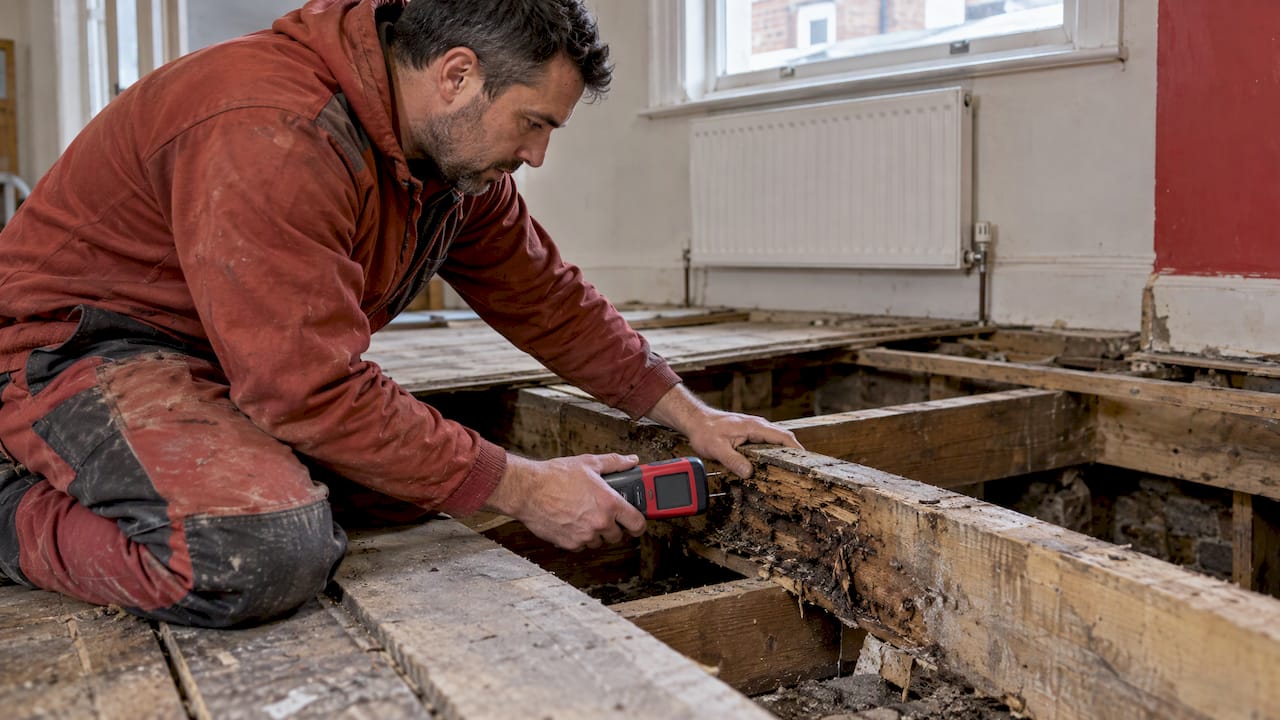
A timber decay survey is an inspection of a property’s timbers for wet rot, dry rot and wood-boring insect attack, together with the moisture that caused it. The useful survey does not stop at naming the rot. It finds where the water is coming from, records what it found in writing and sets out a defined scope of work, so that any treatment follows the diagnosis and not the other way round. That is how we run our damp and timber survey across Dorset, Hampshire and Wiltshire.
TL;DR
- Fungal decay always starts with wet timber, so a survey that does not trace the moisture source is incomplete.
- A proper inspection works through the whole building, from roof level down, not just the visible patch of rot.
- The written report should state what was found, how far it extends, what could not be inspected and what must be repaired.
- Treatment should follow the findings, and removing the water source belongs in the repair specification.
- Book a survey when you see soft or crumbling timber, a musty smell, fine dust under small holes, or damp that keeps returning.
Table of Contents
- What a timber decay survey is, and when to arrange one
- Why the moisture source matters more than the rot
- What the surveyor inspects
- How the inspection is carried out
- What your written report should include
- Turning findings into a defined scope of work
- Older and listed buildings
- Our perspective
- Book a survey with Quay Point
- FAQ
- Sources
What a timber decay survey is, and when to arrange one
A timber decay survey is a specialist inspection of the timber in a building, looking for fungal decay (wet rot and dry rot) and for insect attack such as woodworm. Because decay and dampness are linked, most surveys of this kind look at damp, leaks and ventilation at the same time.
You should consider one when:
- floorboards feel soft or bounce, or skirting boards and window frames crumble when pressed;
- timber has split into cube-shaped pieces, or you can see a white or grey growth on wood or masonry;
- there is a persistent musty smell in a room, cellar or loft;
- you see small round holes with fine dust beneath them;
- damp stains keep returning after you have repainted;
- you are buying, selling, letting or taking on management of an older property and need to know the condition of the timbers.
You do not need to identify the problem yourself. Tell us what you can see, and the survey does the diagnosis. If you want a first look at insect signs, our guide to woodworm signs lists quick checks, and whether old woodworm holes are active is one of the most common questions we hear.
Why the moisture source matters more than the rot
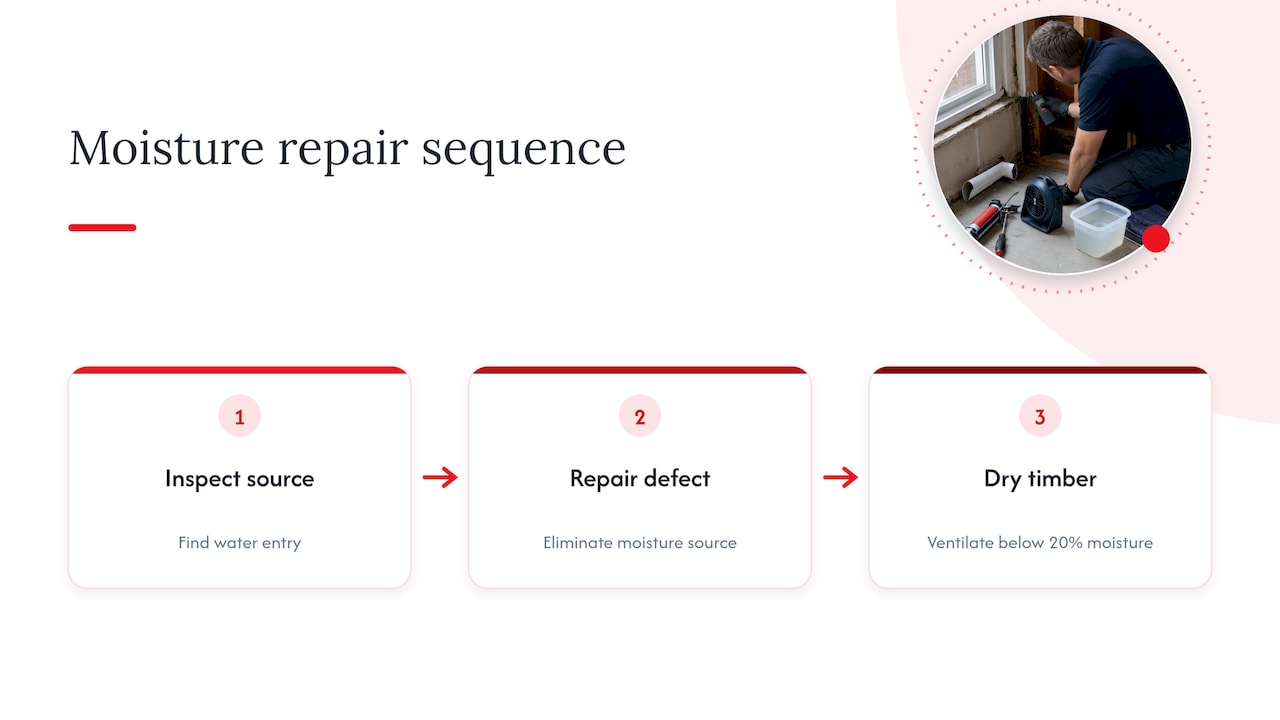
The Property Care Association (PCA), the UK trade body for the sector, states in its guidance that fungal decay always arises because wood has become wet, above 20% moisture content. Its first step after finding decay is to inspect how and where water is entering, repair the defect, and dry the area through better ventilation until the wood falls below 20%.
That has a practical meaning for you. If a surveyor only cuts out and treats the rotten section, and the leak, bridged damp-proof course or blocked airbrick stays as it was, the timber is wet again and the decay can return. The PCA’s guidance on fungal decay says that eliminating the moisture source should be part of the overall repair specification, carried out at the same time or within a set period. It also says preservatives should not be relied on for long-term protection where timbers stay wet.
What the surveyor inspects
Decay in a floor joist or roof timber is rarely caused by the timber itself. The cause is usually elsewhere in the building, so the inspection covers the structure around it. The PCA’s guidance lists what surveyors should look for.
Outside the building
The PCA guidance names these external defects as common routes for water:
- missing or broken roof tiles and slates;
- faulty chimney and window flashings;
- blocked gutters and downpipes;
- deteriorated pointing and cracked render;
- leaking water pipes;
- faulty or missing damp-proof courses, and soil piled up so that it bridges the damp-proof course;
- blocked airbricks.
Roof and gutter faults are a frequent cause of decay in roof timbers and wall plates, which is why leak and roof checks sit inside a timber survey and not apart from it.
Inside the building
Inside, the surveyor follows the trail of moisture. The same guidance points to damaged or poor damp-proof membranes in solid floors, condensation from unlagged pipes or from bathroom and kitchen use, trapped flood water, toilet cistern defects and unventilated floors. Subfloor ventilation matters in particular: the guidance gives airbricks spaced approximately 1.8 metres apart as a suitable arrangement.
The timber itself
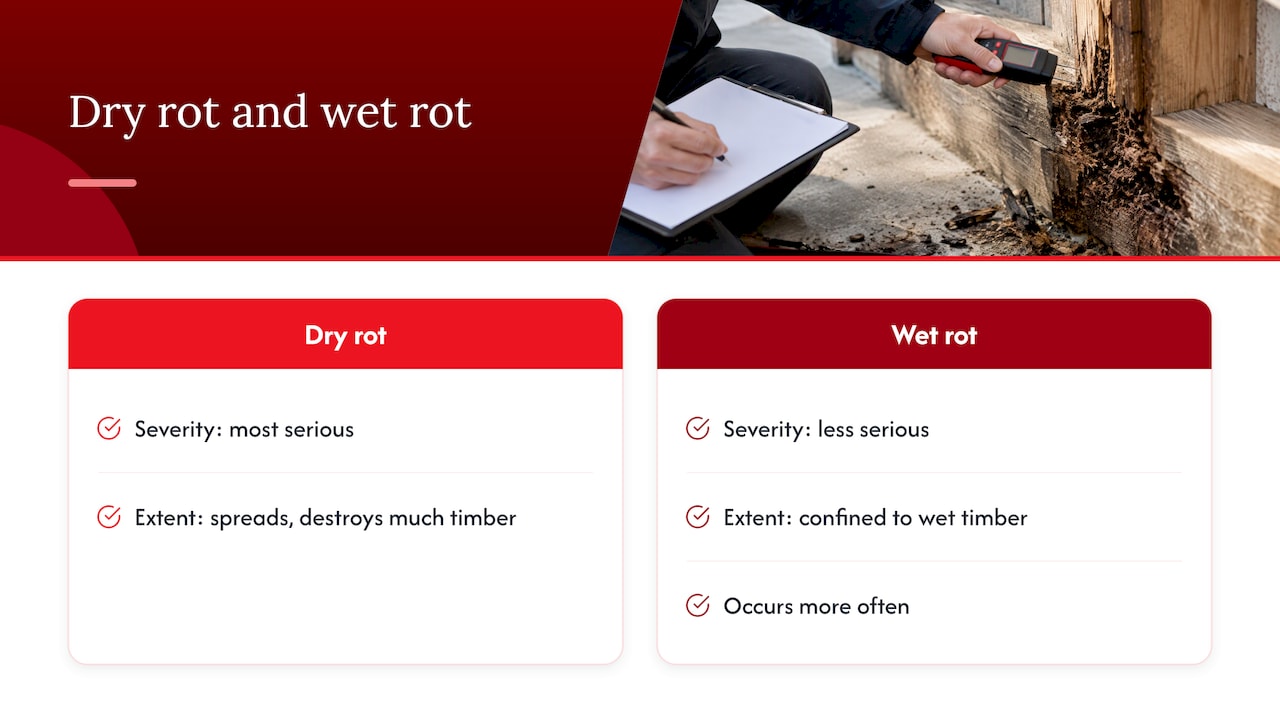
Once the moisture picture is clear, the surveyor looks at the timber. The PCA describes dry rot as the most serious form of fungal decay, able to spread into and destroy much of the timber. Wet rot occurs more often but is less serious and is typically confined to the area where the timber is and remains wet. The distinction decides how much work is needed, which is why identification comes before any quote. Our article on wet rot versus dry rot explains the differences in plain terms.
How the inspection is carried out
The PCA’s 2023 Code of Practice on controlling dampness calls for a whole-house approach. In practice, a sound survey follows these steps.
- Background first. A desktop look at the property before visiting is described as beneficial. The age, construction, previous work and any history of leaks all shape what the surveyor expects to find. You help most here by telling the surveyor what you have noticed and when.
- External inspection, roof first. The surveyor works from roof level downwards, checking the defects listed above. Starting high follows the path water takes.
- Internal visual inspection. Rooms, floors, cellars and roof voids are examined for staining, deformed or cracked timber, fungal growth and insect exit holes.
- Moisture measurement. Readings support what is seen but do not replace judgement. The same Code states that electrical moisture meters give only qualitative, comparative readings in masonry, because salts affect them, and that they cannot tell dampness from different sources apart. All potential causes must be considered before a conclusion is reached.
- Occupant information. The surveyor asks about heating, how many people live in the property and how rooms are ventilated, because plumbing leaks and condensation are among the causes to rule in or out.
- Condition of associated timbers. Where moisture is found, the Code requires the condition of the structural timbers nearby to be established where possible, and any inability to inspect recorded as a risk.
The weak point at each stage is the same: a quick reading on a meter, a single visible patch, or an area that was not opened up. A staged, observed process catches what a snapshot misses. That is why we start from visual symptoms, document them and only then define the scope.
The RICS position statement on investigating moisture in traditional buildings takes the same line. It asks for a holistic diagnosis that deals with causes rather than symptoms, a staged approach that deals with obvious defects first, and recommendations proportionate to the defect and the significance of the building.
What your written report should include
The report is what you keep, what you show a lender, buyer or landlord, and what any guarantee rests on. The PCA’s Code of Practice for wood-destroying insects and fungi sets out what it should contain. Use this as a checklist when you read one:
- Your instructions. The report confirms what you asked the surveyor to look at.
- Conditions found. An accurate description of what was discovered, not generalities.
- Access limits. Areas that were restricted or could not be inspected are stated.
- Identification. Insect species where possible. True dry rot is always identified when found, and wet rots are identified to species where possible.
- Extent. How far the damage and weakening reach.
- Moisture sources. Observed or suspected causes of the dampness.
- Necessary repairs. Repairs or maintenance that, if left out, could compromise the property or invalidate a guarantee.
- Recurrence notice. For true dry rot, written notice that residual moisture after repairs could allow it to return.
The PCA’s dampness Code adds that reports should record significant defects relating to past, present or future water ingress, and explain how dampness starts and sustains fungal decay and influences insect attack.
The RICS statement adds items that help you decide: a summary of observations with an assessment of significance, prioritised repair recommendations, alternative options with their advantages, disadvantages, cost and time implications, and a note of any conflicts of interest.
Records matter afterwards too. The PCA’s Code expects companies to retain the report, quotation and your written instructions for up to seven years where no work is carried out, or for the whole period of any liability where works are done. Ask for your copy and keep it with your property papers.
Turning findings into a defined scope of work
A good report leads to a short, specific scope: what is to be done, where, and in what order. Typically that means three things in sequence.
- Stop the water. Repair the roof, gutter, flashing, pipe or ventilation fault, or deal with the damp route found. Depending on the cause, this may involve leak detection and plumbing repairs, DPC injection and ventilation, or masonry repairs.
- Deal with the decay. Depending on the findings, wet rot, dry rot or woodworm treatment, including replacing timber that has lost its strength.
- Reinstate. Where walls or ceilings were opened or affected by salts, renovation plaster and making good put the finish back.
Where damp is the main driver, you may find our pages on damp after rain and rising damp helpful for recognising the pattern, and condensation and black mould if the symptoms are mainly on walls and ceilings.
Older and listed buildings
Traditional buildings need extra care because their materials behave differently from modern ones, and the RICS statement asks for treatment proportionate to the building’s significance. If your property is listed or you are planning a larger scheme of work, a listed building survey can record the building’s fabric and dimensions before repairs are designed, so the decay survey and the drawings work together.
Our perspective
We start with what you can see: the staining, the soft timber, the smell, the holes. From those symptoms we work backwards to the cause, and we write down what we find before we propose anything.
Rot and woodworm are the visible end of a moisture problem. Our view, in line with the PCA’s guidance, is that the long-term answer is removing the excess water from the building fabric. Treatment of the timber is part of the job, but a repair specification that leaves the leak or the ventilation fault in place is unfinished.
That is why our process is survey-led: documented findings, a defined scope of work and written guarantees on our workmanship. We use original project photography so you can see what was found and what was done. Where a problem sits outside our remit, such as one needing structural input, we say so and refer you to the right specialist rather than stretching beyond what we do.
With more than 35 years in the trade across Dorset, Hampshire and Wiltshire, we have found that clear findings and sensible aftercare are what homeowners and property managers value most.
Quay
Book a survey with Quay Point
If you have soft timber, fungal growth, insect holes or damp that keeps coming back, our timber survey gives you clear, documented findings and a defined scope of work before any treatment is proposed. We cover Dorset, Hampshire and Wiltshire, and homeowners, landlords and property managers can all book. Call 01202 287134 or start from our homepage.

When you contact us, tell us which rooms are affected, how long you have noticed it, and whether there have been leaks, roof work or changes to heating and ventilation. That history shortens the diagnosis.
FAQ
Is a timber decay survey the same as a damp survey?
They overlap, because decay needs moisture. A timber decay survey focuses on the condition of timbers and the cause of any rot or insect attack, while a damp survey looks at moisture in walls and floors. A combined damp and timber survey covers both so that the whole route from water to decay is traced.
What decides how much a survey costs?
The size of the property, how much timber can be reached and where the property is all affect the fee. A larger house with a cellar and roof void takes longer to inspect than a small flat. We do not publish a fixed price, so contact us with details of the property and the symptoms.
Does the survey tell me whether woodworm is still active?
A surveyor looks at the exit holes, the dust and the condition of the timber to judge whether attack is current or old, and the PCA’s Code expects the report to record the type, extent and current nature of the attack. Our advice on old woodworm holes explains what the signs mean.
Can I use the report when buying or selling?
Yes. A written report that states what was found, where access was limited and what repairs are needed gives buyers, sellers and lenders a clear record of the timbers’ condition. Keep your copy, as companies are expected to retain theirs for a set period.
Is dry rot always an emergency?
Dry rot is the more serious form of fungal decay because it can spread through timber and affect much of it, so it should be surveyed promptly. Wet rot is usually confined to the wet area. Either way, the survey identifies which one you have and what the repair needs to include.
Sources
- Guidance Document: Fungal Decay in Buildings (PCA, 2025)
- Guidance Note: Fungal Decay in Buildings (PCA)
- Code of Practice: Control of Dampness in Buildings (PCA, January 2023)
- Code of Practice: Investigation and Control of Wood-Destroying Insects and Fungi in Buildings (PCA)
- Investigation of moisture and its effects on traditional buildings (RICS, September 2022)