
Stop 3mm Mistakes: Structural Timber Treatment Advice for Homeowners
Stop 3mm Mistakes: Structural Timber Treatment Advice for Homeowners
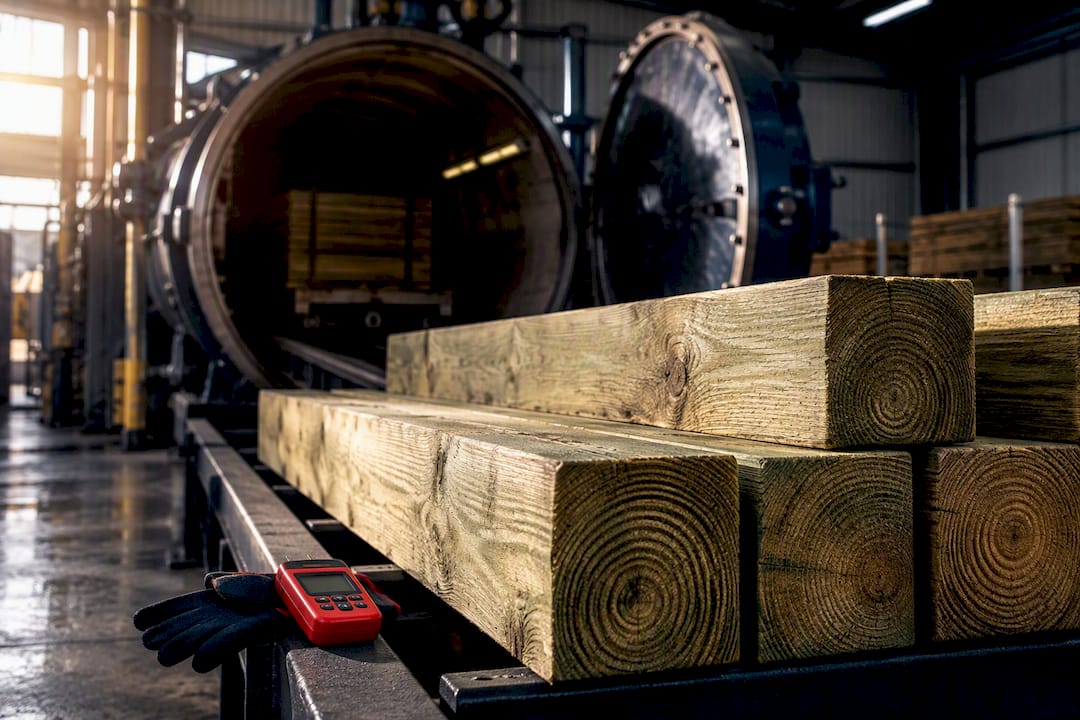
The right treatment always comes down to one question: what will this timber be exposed to, and for how long? Industrial pressure treatment, boron, copper-based systems, oilborne and creosote products, surface dips and fire retardants each suit a different exposure and structural role. For anything load-bearing or already showing decay, a professional survey should decide the treatment, not a guess at the merchant’s counter.
TL;DR:
- Deep, industrial pressure treatment with copper-based preservatives is essential for structural timber exposed to damp or ground contact, as surface treatments offer limited protection.
- Proper treatment requires verifying the specified use category matches real exposure, checking penetration and retention certificates, and considering species and moisture content before installation.
- Remedial treatments are only effective for early-stage decay in accessible, non-structural timber and should not replace factory pressure treatment for critical structures.
- Treating cuts or notches made after factory treatment with end-cut preservatives is crucial to maintain long-term protection and prevent decay.
- Conducting a professional timber survey is vital before choosing treatment, especially for decayed, damp, or structurally critical timber, to ensure appropriate protection and durability.
Table of Contents
- How timber is treated: pressure impregnation vs surface methods
- Which preservative chemistry suits your timber?
- What do use categories (UC2, UC3, UC4) actually mean?
- Getting penetration, retention and moisture right
- Can remedial treatment fix decay, or do you need to replace?
- Safety, disposal and fixing compatibility
- How long should treated timber last, and what does it cost?
- When is it time to call in a survey?
- What actually gets misjudged on site
- Book a survey before you buy a single tin of treatment
- Sources
- FAQ
How timber is treated: pressure impregnation vs surface methods
Structural timber treatment splits into two broad camps: industrial pressure processes and non-pressure surface applications. The gap between them, in practical terms, is depth.
Vacuum and pressure cycles work by loading timber into a sealed cylinder, drawing a vacuum to remove air from the cell structure, then flooding the chamber with preservative under pressure. That pressure forces the chemical past the outer sapwood and into the timber’s cell walls, rather than leaving it sitting on the surface. It’s why industrial vacuum-pressure impregnation is the standard method for structural applications where the timber needs to perform for decades without intervention.
Brushing, dipping and spraying work differently. You’re relying on capillary action and surface contact rather than force, so the preservative rarely gets far.
- Industrial pressure treatment achieves deep, measurable penetration and retention across the cross-section of the timber.
- Brush, dip and spray applications typically penetrate no more than around 3mm into the surface, according to UK government technical guidance.
- That shallow penetration is fine for touch-ups and low-risk internal joinery, but it won’t protect the heartwood of a structural joist or post.
A handful of more specialised processes sit outside these two main camps. Vapour-phase boron treatment, high-pressure jet systems, and supercritical carbon dioxide (SCCO2) carriers can all improve penetration in timber that resists conventional impregnation, refractory species with dense, closed cell structures being the classic case. Technical literature on treating processes notes that these methods remain limited in commercial availability. They tend to appear in specialist or research settings rather than on a standard building site, so don’t expect your local timber merchant to offer SCCO2 treatment as a stock option.
For most structural work, the choice narrows quickly: pressure treatment where the timber is structurally important or exposed to damp, and surface treatment only where the risk is genuinely low and reversible. If you’re unsure which category your timber falls into, that’s precisely the kind of question a timber survey is designed to answer before any product gets specified.
Which preservative chemistry suits your timber?
Preservative choice isn’t really about brand names. It’s about how each chemistry behaves once it’s in the wood, and what it can and can’t tolerate afterwards.
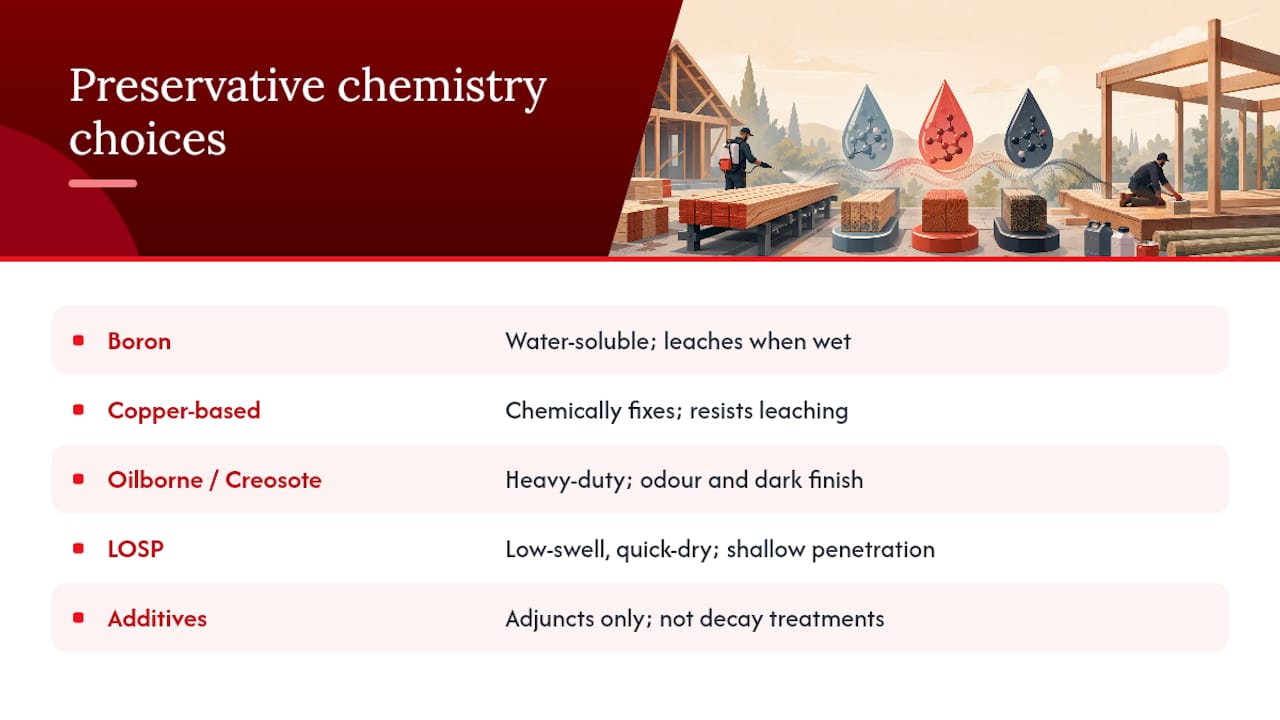
Boron is water-soluble and has low toxicity to people handling it, which makes it a popular choice for internal, above-ground framing such as roof timbers and stud walls. Boron-based preservatives are effective in these dry, protected locations, but the same water solubility that makes them easy to apply also makes them vulnerable. Prolonged wetting leaches the boron out of the timber over time, so it’s the wrong choice anywhere ground contact or repeated dampness is likely.
Copper-based systems, including Copper Azole (CA) and Alkaline Copper Quaternary (ACQ), fix chemically within the wood fibre rather than staying dissolved. That fixing process is what allows copper-based preservatives to handle ground contact and higher-durability structural use, applied via the same vacuum-pressure processes used for boron. They resist leaching far better and are the default choice for fence posts, decking substructures and ground-contact framing.
Oilborne treatments and creosote sit at the heavy-duty end: marine structures, railway sleepers, utility poles, and other applications facing constant severe exposure. These carry stricter handling and disposal restrictions than waterborne systems, and they leave a distinctive odour and dark surface finish that rules them out where appearance or later painting matters.
Light Organic Solvent Preservatives (LOSP) offer a low-swell, quick-drying option often used for pre-primed joinery, though they generally penetrate less deeply than waterborne systems.
Fire retardants and water-repellent additives aren’t decay treatments at all. They’re adjuncts, specified alongside a preservative when a project’s fire rating or weather exposure demands it, not as a substitute for the core preservative choice.
What do use categories (UC2, UC3, UC4) actually mean?
Use Category, sometimes written as hazard class, is the framework that tells a treater and a specifier what level of protection a piece of timber actually needs. It’s built entirely around exposure, not around the timber’s species or appearance.
- UC2 covers timber used internally, above ground, and protected from the weather. Roof trusses and floor joists in a dry loft space typically sit here, and boron-based treatment is commonly specified.
- UC3 covers timber exposed outdoors but not in contact with the ground, split into 3A (coated, better protected) and 3B (uncoated, fully weather-exposed). Fascias, external cladding and exposed beams sit in this band, and copper-based waterborne preservatives are the usual specification.
- UC4 covers timber in direct ground contact or persistent high-moisture conditions, such as fence posts, deck substructures and sleepers. This is where the heaviest-duty copper systems, or oilborne and creosote products for the most severe cases, are specified.
The category alone doesn’t finish the decision, though. Structural criticality matters just as much. A ground-floor joist that’s buried under a finished floor and difficult to inspect or replace deserves a higher retention and deeper penetration than the hazard class alone might suggest, simply because catching a failure early is much harder once it’s built in. Government guidance is consistent on this point: mismatching treatment level to exposure, such as fitting interior-rated boron timber into ground contact, is a well-documented cause of premature failure.
Getting penetration, retention and moisture right
Two figures decide whether a treatment actually works: penetration (how deep the preservative reaches into the cross-section) and retention (how much preservative remains per unit volume once treatment is complete). Get either wrong and the timber looks treated on paper while remaining vulnerable in practice.
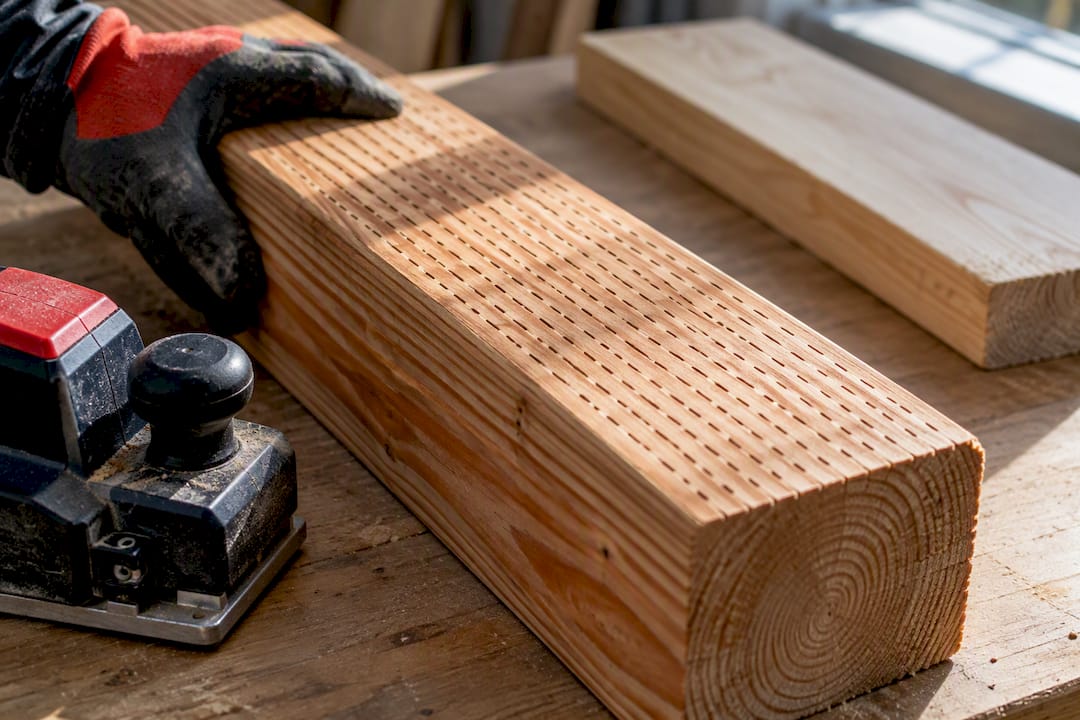
Species plays a bigger role here than most people expect. Some timbers, Douglas fir among them, have a dense, closed heartwood structure that resists preservative uptake even under pressure. Wood handbook guidance on treating processes notes that refractory species like this often need incising, small mechanical cuts across the surface, to open pathways for the preservative to follow. If you’re specifying a species known to be hard to treat, ask your supplier directly whether incising has been used.
Moisture content at the point of treatment matters just as much as species. Pressure treatment depends on the preservative displacing air and moisture within the cell structure, so timber that’s too wet resists penetration in the same way an already-full sponge resists more water. Industry guidance on vacuum pressure boron treatment specifies kiln-dried timber with controlled moisture content both before and after treatment, precisely because inconsistent drying undermines the whole process.
Before you sign off any structural timber delivery, run through this sequence:
- Confirm the specified use category matches the actual exposure the timber will face on site, not just the drawing.
- Ask for the treater’s penetration and retention certificate, not just a receipt saying “treated.”
- Check the species against known refractory types and confirm whether incising was used.
- Verify moisture content readings were taken before and after treatment.
- Plan for field cuts, bolt holes and notches to be treated with an approved end-cut preservative on site, since factory treatment can’t protect a cut made after delivery.
Pro Tip: Any cut, drilled, or notched face made on site after factory treatment exposes untreated timber underneath. Keep a small tin of end-cut preservative on the job and treat every fresh cut before it’s closed up or covered.
Can remedial treatment fix decay, or do you need to replace?
Remedial, on-site treatments have a real but limited role. They work best on early-stage decay in accessible framing, and they are not a substitute for factory pressure treatment where deep, structural protection is needed.
A peer-reviewed study on remedial treatments for framing timber found that boron-glycol applied to three or four faces of affected timber prevented decay progression in early-stage cases, achieving retention of roughly 0.4% boric acid equivalent (BAE). Applying to only one or two faces is generally insufficient to protect the timber’s internal heartwood, because effective redistribution of treatment requires multiple entry points.
The same research found copper naphthenate, at the concentrations tested, often slowed decay without reliably stopping it. That’s a meaningful distinction for anyone weighing up a quick remedial fix against a full replacement.
- Treat three or four accessible faces, not one, if boron-glycol remediation is being attempted.
- Expect remedial treatment to arrest early, surface-level decay rather than reverse structural loss already present.
- Treat remedial work as a stopgap where the timber has already lost significant cross-section, is repeatedly re-wetted by an unresolved leak or damp source, or forms a critical, hard-to-replace structural member.
If a survey finds deep decay, ongoing dampness, or a structural role that leaves no margin for error, replacement or full pressure treatment is the safer route, not a brush and a tin of preservative.
Safety, disposal and fixing compatibility
Treated timber needs sensible handling, both during work and afterwards.
- Wear a dust mask or use extraction when cutting, sanding or routing any preservative-treated timber, and work outdoors or in a ventilated space where possible.
- Never burn offcuts of treated timber on an open fire or in a domestic stove; preservative residues concentrate in ash and smoke.
- Dispose of offcuts and sawdust through your local council’s waste guidance for treated wood, rather than general household waste, since disposal rules vary by preservative class.
- Use corrosion-resistant fasteners, stainless steel or hot-dip galvanised, with copper-based treated timber, since the copper content can accelerate corrosion in standard mild steel fixings.
- Allow treated timber to dry to the manufacturer’s recommended moisture content before painting or coating, and reapply water-repellent coatings periodically to limit long-term leaching.
Pro Tip: If you’re fixing decking or fence posts with copper-treated timber, check your screws and brackets are rated for use with ACQ or CA preservatives specifically, not just “outdoor use.” Standard galvanising isn’t always enough.
How long should treated timber last, and what does it cost?
Correctly specified and installed, pressure-treated structural timber can be expected to perform for decades in its intended use category, provided detailing keeps moisture away from vulnerable joints and end grain. Boron-treated internal framing, kept genuinely dry, tends to last as long as the building itself. Timber in UC4 ground contact carries a shorter realistic service life simply because the exposure is harsher, even with the heaviest treatment.
Cost is driven less by the preservative itself and more by everything around it: access for a treater or contractor, the drying time needed before treatment, and whether remedial repair is even viable compared with straightforward replacement. A remedial brush treatment on an accessible loft timber is a fraction of the cost of stripping back finishes replacing a hidden structural beam.
Inspect structural timber roughly every few years, or sooner after any leak, flood, or visible damp patch, and check specifically for softening, discolouration, and moisture readings at joints and end grain, where decay nearly always starts first.
When is it time to call in a survey?
Choosing between boron, copper, or a factory pressure process isn’t really a materials decision. It’s a diagnosis decision, and that’s where a proper survey earns its keep.
A thorough damp and timber survey should leave you with documented findings: moisture readings taken at the right points, photographs of the affected timber, a clear written scope of what needs treating or replacing, and a specific recommendation rather than a vague warning.
Visible rot, damp that keeps returning despite previous work, or any concern about a structural member all warrant a survey before treatment gets specified. A written guarantee on the resulting work gives you something concrete to hold the contractor to, long after the job is finished.
What actually gets misjudged on site
Most timber treatment failures we come across don’t stem from a bad preservative choice. They stem from someone treating the wrong exposure, boron in a damp cellar, an untreated field cut left exposed, or moisture readings that were never taken before the work began.
Match the treatment to what the timber will actually face, not what looks reasonable on a spec sheet, and get a proper survey before committing to a fix on anything structural. We back our own assessments with written findings and guarantees because that documentation is what actually protects a homeowner years down the line, not the tin the preservative came in.
— Quay
Book a survey before you buy a single tin of treatment
Every treatment recommendation should follow a documented survey first, rather than guessing at a merchant’s shelf. Proper surveys provide moisture readings, photographs and a written scope of work before any product gets specified.
If you’re in Dorset, Hampshire or Wiltshire and dealing with suspected rot, woodworm, or timber that’s been damp for longer than it should be, a timber survey gives you a documented answer rather than a guess. Our timber treatment services cover everything from woodworm and wet rot through to dry rot, all backed by written guarantees and aftercare once the work is done. For dampness that keeps coming back regardless of what’s already been tried, our general surveys are the sensible starting point. Get in touch to book an inspection and get a clear, documented scope of work before you spend a penny on treatment.
Sources
For readers who want to go straight to the primary material, gov.uk’s timber treatment guidance covers regulatory scope, the technical chapter on treating processes details preservative classes in depth, and the peer-reviewed study on remedial framing treatments is the key source behind the boron-glycol efficacy figures cited above. On related building performance standards, Complete EPC’s guidance on TM59 compliance is a useful read.
- Effectiveness of remedial treatments for controlling decay in framing timber (peer-reviewed study)
- Basic treating processes (technical chapter)
- H1.2 framing timber treatment (industry guidance)
FAQ
What are the different types of timber treatment?
The main families are industrial vacuum-pressure impregnation, boron treatment, copper-based systems (CA, ACQ), oilborne and creosote products, LOSP, and non-pressure surface applications like brushing or dipping. Each suits a different exposure level and hazard class, from dry internal framing through to ground contact and marine use.
Is Tanalised timber the same as UC4?
Not automatically. “Tanalised” is a brand name for copper-based pressure treatment, and while many Tanalised products are rated for UC4 ground contact, the specific formulation and retention level determine the actual use category, so it’s worth checking the treater’s certification rather than assuming from the name alone.
What is the best treatment for structural timber?
There isn’t a single best option. Industrial pressure treatment with a copper-based preservative suits most exterior and ground-contact structural work, while boron pressure treatment is generally preferred for internal, above-ground framing. The right choice depends entirely on matching the preservative to the exposure and structural role.
What does “H4” treated timber mean?
H4 is a hazard class rating (used in some national systems, broadly equivalent in intent to UC4) denoting timber treated for ground contact or persistent high-moisture exposure, such as fence posts and deck substructures. It carries a higher preservative retention than internal-use ratings because the exposure risk is significantly greater.
How do I know if my timber needs professional treatment rather than DIY?
Visible rot, timber that’s been repeatedly wet, or any structural member you’re unsure about all warrant a professional survey rather than a DIY brush-on fix. A damp and timber survey gives you documented findings and a defined scope before any treatment is specified, which matters most where replacement, not remediation, may be the safer outcome.